CHICAGO — No-melt cheeses offer consumers and culinary professionals opportunities to make dairy a center-of-plate protein. The cheese retains its shape when cooked and may be used to replace meat in all types of dishes, including breakfast sandwiches.
“Firm, moist cheeses like panela and paneer are proving to be popular options to bring quality protein to the plant-forward plate,” said Ben Yee, director of producer partnerships, California Milk Advisory Board (CMAB), Tracy, Calif. “Panela has a mild flavor similar to a dry pressed ricotta, without melting, so it holds up well as the base for dishes like tacos or even as a meat-like medallion in a tomato sauce. Paneer can be marinated in spices and grilled for kebobs or in sandwiches.”
The CMAB worked with chefs to educate them about the benefits of no-melt cheeses. Dishes that were developed include Nashville hot paneer, where the cheese replaces chicken, and a keto lasagna, where paneer stood in for noodles.
The New York-based Blue Apron meal kit service started offering an “international escape” menu this winter. One of the offerings is paneer and vegetable tacos with peanut and arugula salad. The consumer is instructed to pan fry the diced paneer and then stuff them into flour tortillas alongside sautéed sweet peppers and onion, guacamole and a chipotle sauce.
“These cheeses don’t melt due to their protein structure,” said Suzanne Fanning, chief marketing officer and senior vice president, Dairy Farmers of Wisconsin, Madison, Wis. “Either baked or grilled, these cheeses can form a sweet, caramelized, toasted ‘crust’ that is oh-so-delicious.”
Recognizing this growing trend for center-of-the-plate cheese, Cheeses of Wisconsin, Cottage Grove, Wis., created The Big Moo, which “cooks crispy on the outside, warm and melty on the inside.” What distinguishes The Big Moo from other no-melt cheeses is it is available in flavors like bacon, cheese pizza, jalapeño and roasted garlic. The company promotes the product as keto-friendly with one serving containing 6 grams of protein.
“Gayo Azul Queso Blanco is a white mild and fresh cow’s milk cheese that is growing in popularity,” said Debbie Seife, director of marketing, FrieslandCampina Consumer Dairy North America, Paramus, NJ. “Consumers are enjoying cooking with it and adding it to their meals and dishes. It is also fantastic crumbled over enchiladas, tacos, salads and soups.”
Another Hispanic ingredient cheese gaining traction in the United States is cotija. It is a crumbly, slightly salty cow’s milk cheese.
“Most people have likely had it on tacos, but where it is trending now is in the many varied street corn dishes showing up on menus and in supermarkets,” Ms. Seife said. “The traditional dish is made with corn on the cob, spices and cotija cheese.”
The sharp, tangy cheese does not melt when heated. However, it has an adhesive quality when grated that enables it to cling to corn or other foods. This makes it an appealing ingredient as a garnish on hot dishes.
“Consumers are opening themselves up to experimenting with cheese and to creating plant-forward dishes that still satisfy their cravings,” Mr. Yee said. “Cheese is the ‘glue’ that holds these dishes together, providing the flavor along with the functionality. The biggest challenge is lack of understanding of these lesser-known varieties because they are most often associated with Indian, Mediterranean or Mexican dishes.”
New forms and flavors
Cheese has been an integral part of Italian cooking, sometimes even the center of the plate. One dish that is rather new to the United States and really taking off on menus is cacio e pepe, which translates to “cheese and pepper.” The preparation uses long, thin, cooked noodles, such as angel hair or spaghetti, that are spun with warm pasta water in a partly hollow wheel of pecorino Romano cheese. It is then heavily seasoned with black pepper.
Datassential, Chicago, reports that cacio e pepe was on 48% more menus at the end of 2022 than it was four years earlier. Curious consumers also are experimenting with the cheesy pasta dish that some say is an early ancestor to the US staple of macaroni and cheese.
Norseland Inc., Darien, Conn., offers Lotito Presto Cacio e Pepe Pasta Starters. The refrigerated line comes in four varieties: original, con Pomodori (with sun-dried tomatoes), con Erbe (with wild herbs) and con Picante (with Calabrian chilies). The blends have sheep’s milk pecorino Romano cheese as the No. 1 ingredient. Whole milk powder and whey powder are critical components of the sauce mix. To use the mix, the consumer prepares 1 lb of pasta. During draining, one cup of the hot water is saved and added to the sauce starter, then tossed with pasta. Two shelf-stable varieties — original and black truffle — will enter the market this spring.
Norseland was one of the first to market refrigerated cheese wraps, a high-protein alternative to traditional flour-based tortillas and flatbreads. Folios Cheese Wraps are par-baked sheets of cheese that are free from carbohydrates and gluten. The original line debuted in 2016 in cheddar, Jarlsberg and Parmesan varieties. This year Norseland added mozzarella to the line. The higher moisture content of mozzarella presented baking challenges that the company managed to overcome. The keto-certified wraps may be stuffed, rolled, folded, melted, crisped and baked, said Valerie Liu, brand manager.
Sofia Auricchio Krans, a cheesemaker with BelGioioso Cheese Inc., Green Bay, Wis., said the company has developed a number of cheeses intended for adding kick to all types of recipes. They provide an additional layer of flavor through a familiar format.
“Pepperoncino has spicy red pepper flakes added to the curd for a little heat,” Ms. Auricchio Krans said. “Our Artigiano cheese comes in blueberry, vino rosso (wine) and balsamic with cipollini.
“Our fresh mozzarella is offered marinated with a variety of spice blends, including pesto, hatch chili and white truffle oil,” she said. “We have an espresso-infused mascarpone that goes great in desserts.”
Tegan Passalacqua spent last weekend in what he’s been calling “anxiety purgatory.”
The acclaimed winemaker and owner of Sandlands in Lodi, California, learned on Friday that his financial institution, Silicon Valley Bank, had collapsed. He spent days weighing worst-case scenarios.
Up to $250,000 of his money was insured by the Federal Deposit Insurance Corporation (FDIC); however, Passalacqua had just released all of Sandlands’ winter wine—and had more than twice the insured amount in his account when the bank failed.
“I’m a growing business, so you have these sales periods when you bring in a good chunk of change and it goes away until the next sales period,” he says. “This is about the worst time for it to happen to me.”
Silicon Valley was the second-biggest bank collapse in U.S. history. It was a favorite of venture capital firms and tech startups, many of which pulled out vast sums of money shortly after the bank revealed its huge losses (the result of short-sighted investments paired with rising interest rates) on Wednesday.
While the wine division of the bank formerly known as Silicon Valley Bank represents just two to three percent of the institution’s assets, the roughly 400 wineries that maintained accounts with the institution are now trying to figure out how to best move forward and protect their financial futures.
On Monday morning, after about an hour and 20 minutes of trying to log onto his online banking portal, Passalacqua saw that all of his money—which will soon go toward farming, bottling and other winemaking expenses—was sitting in his account.
In a rare move, all depositors—even above the $250,000 limit—at Silicon Valley Bank were made whole under the systemic risk exception that was approved on Sunday by the FDIC, Department of the Treasury, Federal Reserve and President Biden.
“It’s rare to have a bank of this size fail and not find a suitor to purchase the assets and liabilities,” says Rob Eyler, Ph.D., a professor of Economics at Sonoma State University. “And it’s incredibly rare to have the President of the United States say, ‘We’re good here’ no matter what level of deposit you have.”
As part of the joint announcement on the systemic risk exception, the organizations assured that “No losses associated with the resolution of Silicon Valley Bank will be borne by taxpayers.”
The FDIC’s Deposit Insurance Fund, funded by quarterly fees assessed on FDIC-insured financial institutions and government bond interest, currently holds over $100 billion, which the treasury says is “fully sufficient” to cover SVB depositors.
While that exception to the $250,000 limit saved both large and small producers, like Passalacqua, whose company produces just 3,000 cases per year, many on social media were quick to criticize the move as an elite bailout package.
“BTW, who are typical ‘depositors’ @ #SVB? Wineries, solar, crypto firms. Not exactly mom-and-pop savers,” tweeted Nick DeIuliis, the CEO of natural gas company CNX Resources Corp. “Propped up for years by free money #Fed policy. So why are Main Street taxpayers suddenly bailing out the Cali elite? #bailout.”
That may be true for the bank’s tech clients but doesn’t seem to be the case for many of the wineries that hold SVB accounts. According to Rob McMillan, EVP and founder of Silicon Valley Bank Wine Division, the bank has lent out $1.4 billion in loans spread out amongst its roughly 400 wine clients. Most of those wineries are on the smaller side, says McMillan, producing under 5,000 cases per year.
So, while quite a few, like Passalacqua, may have had large sums in the bank from recent releases, most of the bank’s clients in the notoriously asset-heavy, cash-poor wine industry had far less than the amount insured by the FDIC in their accounts.
“I can’t tell you how many people had more than $250,000, but it wasn’t many,” says McMillan.
Adam Lee of Clarice Wine Company in Santa Lucia Highlands has been a long time customer of Silicon Valley Bank. When the news of its collapse came out Friday, he had $65,000 in his account. While he knew his deposits were covered, he was still stricken with worry about what Silicon Valley Bank’s closure would mean for his business. “It was a bit of panic on Friday as SVB went down,” he says. “I have a line of credit with SVB and I’m not certain what might happen to that if the bank sells.”
Lee’s $100,000 line of credit is just a drop in the bucket, but it’s a lifeline for his company that pays it down until harvest and then borrows it up again to produce his 650 cases per year.
Marcus Goodfellow of Goodfellow Family Cellars is in a somewhat similar but even more stressful boat.
On Monday, he was supposed to close on a property in Oregon’s Willamette Valley with a Silicon Valley Bank loan, after months of back-and-forth paperwork and negotiations. Needless to say, it didn’t happen. And, though the bankers in SVB’s wine division are still inching it forward (potentially closing it tomorrow), Goodfellow is also running through worst-case scenarios and backup plans.
He has already gone past the agreed upon closing date with the buyer, who has extended for a week. If the SVB loan doesn’t go through, Goodfellow could lose his earnest money along with the property if the buyer doesn’t allow him to seek out another bank. “I’d have to be honest and say big banks don’t do this type of stuff as much as Silicon Valley Bank,” he says. “Unquestionably, they have a great understanding of very specific and unique challenges of cash flow that wineries face.”
That’s why, in spite of all the stress from the crisis, many winemakers are more concerned about what will happen to the industry if SVB’s wine department completely shutters. The concern is both a short-term cash crunch and long-term loss of funding for an industry few banks service.
McMillan is fairly confident that won’t happen and they will “roll out of this.” He says he’s already been contacted by four banking businesses and another four to five non-banking companies including private equity firms that have expressed interest in buying up the wine division.
And Eyler believes that any pain in the wine industry that has resulted from SVB’s collapse should be relatively short-lived, aside from some potential cost increases specifically on the lending side. Though he thinks Silicon Valley Bank’s failure will “be a big deal in banking for some time to come” that will require careful consideration of whether this was a regulatory failure, not to mention how the Fed should address its interest rate-raising policy, he believes the wine industry could potentially benefit if more banks begin eyeing the market.
For now, Tim Mayopoulos, the newly appointed CEO of Silicon Valley Bridge Bank, sent out an email to clients urging them to help the institution rebuild its deposit base by leaving money in the bank and transferring back the deposits that have been pulled out over the past week.
Passalacqua is still trying to figure out how to best move his business forward after this weekend—and his unintentional intensive on business banking. In spite of the stress of the crisis, he and other winemakers are still reluctant to move their accounts away from Silicon Valley Bank due to its support of the wine industry and the staff who have helped grow his business. Even the tellers in the bank’s St. Helena office buy his wines via the mailing list, he says.
“They’re literally the people I’m working with on a day-to-day basis,” Passalacqua says. “They are the people who are supporting my brand.”
De acuerdo con los datos de Impact Databank, las generaciones más jóvenes, esto es la Generación Y (o Millennials) nacidos entre 1981-1993 y la Generación Z nacidos entre 1995-2010, están consumiendo cada vez más vino, bebidas espirituosas y cerveza sin alcohol.
En los Estados Unidos, por quinto enero consecutivo, el volumen de ventas de bebidas sin alcohol ha aumentado cada año en comparación con el año anterior. Así, el primer mes de 2023 marcó otro impulso para el llamado "Dry January" (Enero sin Alcohol) con caídas de ventas de bebidas alcohólicas nuevamente, mientras que el consumo del "0% alcohol" creció de manera notable.
Como ejemplo, los datos de Drizly, una de las plataformas más importantes de venta en línea de vino y destilados en los Estados Unidos, que ha publicado que las compras en las categorías de bebidas sin alcohol en enero de 2023 aumentaron un 56% en comparación con enero de 2022.
La tendencia del consumidor es hacia la cerveza, el vino y los licores sin alcohol, más que nunca, aumentando sus ventas en un 129% con respecto al año anterior. En cuanto al vino, el aumento ha sido del 70 %.
Según Impact Databank, los espumosos son el sector de más rápido crecimiento en el mercado del vino. Un ejemplo es la marca Giesen 0%, de Pacific Highway Wines, Nueva Zelanda, que vendió 50.000 cajas de 9 litros el año pasado, frente a solo 12.000 cajas en 2021. Además, Riboli Family Wines apunta a vender 75.000 cajas de su Colección Naturals sin alcohol este año.
Los cerveceros también están atendiendo a esta tendencia. A finales del año pasado, la cerveza canadiense Labatt lanzó Labatt Blue Light Non-Alc Strawberry Acai, un producto dirigido a los Millennials y a los mayores de edad de la Generación Z, con menos del 0,5 % vol. Aunque las marcas de renombre como Heineken 0.0 y Budweiser Zero lideran el sector, Athletic Brewing Co. ha duplicado sus ventas tanto en dólares como en volumen este año.
Molson Coors Beverage Co. también se ha sumado a la tendencia y ha lanzado Roxie, el primer cóctel sin alcohol en lata, que se vende exclusivamente en línea.
"Dry January", efecto dominó
La última investigación de la CGA de Nielsen IQ también analizó si los bebedores que probaron bebidas sin alcohol o con bajo contenido de alcohol continuarían tomándolas después de "dry January". Alrededor de dos tercios de los consumidores que probaron cócteles sin alcohol dijeron que continuarían bebiéndolos después de que terminara el mes. Casi las tres cuartas partes (72 %) de los que bebieron cerveza sin alcohol en enero dijeron que lo volverían a hacer en los meses siguientes.
¿Vino sin alcohol: una tendencia de futuro?
La salud se ha convertido en una prioridad para la sociedad actual, pero ¿qué impacto tendrá esta tendencia en el mercado del vino y cómo se adaptará el sector a los nuevos hábitos de consumo?
En los últimos años, hemos sido testigos de una creciente popularidad en el consumo de bebidas alcohólicas sin contenido de alcohol. El vino sin alcohol, también conocido como vino desalcoholizado o sin alcohol añadido, es una de las bebidas que se ha sumado a esta tendencia.
El vino sin alcohol se elabora mediante un proceso de eliminación del alcohol del vino, lo que da lugar a una bebida con todas las propiedades organolépticas del vino convencional, pero con un contenido de alcohol inferior al 0,5%. Esto lo hace una opción atractiva para aquellos que buscan una alternativa al vino convencional. Sin embargo, sus detractores, afirman que -a diferencia de la cerveza- los vinos sin alcohol todavía están lejos de tener un sabor aceptable, y todo ello a pesar de que el sabor ha mejorado significativamente en los últimos años, especialmente el espumoso. Las bodegas han invertido en investigación y desarrollo para mejorar la calidad y el sabor del vino sin alcohol, lo que ha dado lugar a una amplia variedad de opciones que satisfacen incluso a los paladares más exigentes.
En cualquier caso, el vino sin alcohol es una opción para aquellos que no pueden o no quieren consumir alcohol debido a diversas razones, como problemas de salud, embarazo o al conducir un vehículo.
Por otro lado, el vino sin alcohol también es una opción sostenible. La producción de vino sin alcohol genera menos emisiones de carbono y utiliza menos recursos naturales en comparación con la producción de vino convencional. Esto hace que el vino sin alcohol sea una opción más respetuosa con el medio ambiente.
A medida que la conciencia sobre el consumo responsable de alcohol y la sostenibilidad se ha vuelto cada vez más importante para los consumidores, la demanda de vino sin alcohol ha aumentado en todo el mundo. En respuesta a esta demanda, cada vez son más las bodegas que han comenzado a producir vino sin alcohol y a incorporarlo en sus catálogos de productos.
En España, el consumo de vino sin alcohol ha aumentado significativamente en los últimos años. Según los datos de la Federación Española del Vino, en 2020 se consumieron más de 900.000 litros de vino sin alcohol en el país. Además, se espera que esta tendencia continúe en los próximos años, ya que cada vez son más los consumidores que buscan opciones saludables y sostenibles.
Lo que no podemos negar es que el vino sin alcohol es una tendencia de futuro que ofrece una alternativa saludable y sostenible al vino convencional. A medida que la conciencia sobre el consumo responsable de alcohol y la sostenibilidad continúa creciendo, y las bodegas mejoren el sabor, es probable que la demanda de vino sin alcohol siga aumentando en todo el mundo.
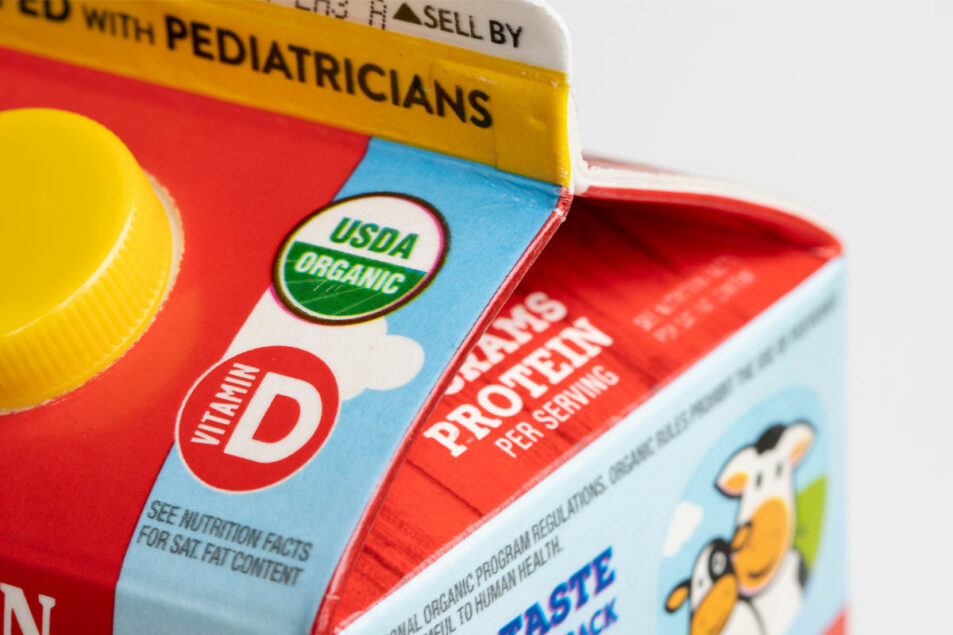
CHICAGO — The US Department of Agriculture National Organic Program (NOP) issued the Strengthening Organic Enforcement (SOE) Act in January after publishing the proposed rule two years earlier. The new rules governing the $57.5 billion organic food industry will close gaps in current organic regulations and build consistent certification practices to prevent fraud and improve the transparency and traceability of organic products.
The rules go into effect March 20. Implementation must be completed within one year.
“This regulation will have significant and far-reaching impacts on the organic sector and will do much to deter and detect organic fraud and protect organic integrity throughout the supply chain,” said Tom Chapman, executive director and chief executive officer, Organic Trade Association, Washington. “Fraud in the organic system — wherever it occurs — harms the entire organic sector and shakes the trust of consumers in organic.”
The rules were necessary because consumers started questioning the truthfulness in organic claims due to a growing number of people making headlines by selling non-organic products as USDA certified. For example, at about the same time the SOE was published, a Minnesota farmer was indicted on charges stemming from a $46 million fraud scheme. The charges allege the farmer cultivated conventional crops using chemical fertilizers and pesticides and falsely provided purchasers with copies of NOP certification.
The SOE aims to prevent such fraud in the future. It also closes loopholes that allowed ingredients that don’t meet NOP standards to infiltrate the supply chain. Key updates include requiring certification of more of the businesses, including brokers and traders, at critical links in organic supply chain.
The SOE also requires organic certificates for all organic imports and creates authority for more robust recordkeeping, traceability practices and fraud prevention procedures.
“The time is now to assess your supply chain and identify uncertified suppliers,” said Liz Figueredo, technical lead, Quality Assurance International, San Diego. “An estimated 1,000 businesses that were exempt under the old regulations now need to be certified, and companies currently certified now need to develop and implement fraud protection plans.”
It’s important to focus on traceability, from raw materials to finished products, said Steven Moore, vice president of food safety, quality, regulatory and innovation, Scoular, Omaha, Neb. He suggested reviewing the NOP handbook and performing an unbiased internal audit of your entire organic management system.
Arnold Coombs, executive director of sales and marketing, Bascom Maple Farms, Alstead, NH, said, “I don’t think that producers who are already USDA certified will have much of a challenge. And I think those of us who are USDA certified are proud of what that means for our product, and we will continue to comply in every way possible to ensure our customers get the products they can trust and deserve.”
Yet, there is work involved for everyone who is part of the organic supply chain. While legitimate businesses are pleased with the efforts to prevent fraud, there is some fear it will burden the supply chain.
“The process across the whole supply chain may become too complex,” said Tania Moreira, senior account manager – west region, AAK USA, Louisville, Ky. “Farmers or processors may not have the infrastructure or resources to be able to comply with all that is required. This could decrease organic supply and increase prices.”
Michael Ivey, national sales director, Butter Buds Inc., Racine, Wis., said, “We’ve already started to put many of these practices in place, but it has taken substantial time and resource commitment.”
Coming into compliance
Farming is not easy. Organic farming is even more difficult.
“If you are doing all the right things, you should get paid for it,” said Beth Robertson-Martin, partnership development, Merge Impact, Morrison, Ill. “This is for farmers and brands alike.”
Annie Bouchard, senior brand manager, Fruit d’Or, Villeroy, Que., said, “It takes an incredible amount of work and dedication to grow organic crops at a scale that satisfies market demands. Organic isn’t something that is quick to initiate or get into compliance with if brands are not already.
“Our best recommendation is to work with the companies that have been doing organic from the beginning. We never ‘went organic.’ We started out that way.”
Not every company starts organic or works with only organic, but many have known the rules were coming since the proposal was issued in 2021. They have been working toward and are ready for implementation. Kerry, Beloit, Wis., has new organic-certified taste modulating solutions that meet the new rule.
“We have our taste solutions ready and fully certified, but there is still a lot of work ahead for product developers in making sure their organic products not only meet the new standards but also continue to taste great,” said Otis Curtis, global portfolio director – Tastesense with Kerry. “These updated requirements for organic labeling involve a large number of new actions that US organic product developers must understand and meet. These include calculating the percentage of organically produced ingredients, and filing and having available certified reports for all of these.”
Alina Slotnik, vice president – bioactives, Brightseed, San Francisco, said, “Launching an organic ingredient is no easy feat. We know this firsthand. This new ruling helps affirm that the work we’ve put in to attain this important label designation is worth the effort.”
Brightseed is introducing an organic hemp ingredient for gut health. It is sourced from upcycled hemp hulls and formulated to optimize bioactive content.
“There is an incredible amount of upfront planning required when launching an organic ingredient or product,” Ms. Slotnik said. “The earlier brands can anticipate their future demand for organic ingredients, the better. This gives suppliers ample time to ensure their raw material growers and processing facilities are in alignment with organic regulations.”
Implementing the new rules is more taxing for imported ingredients. All businesses importing organic agricultural products to the United States must obtain a NOP Import Certificate from a certifying agent accredited by the USDA or from a foreign certifying agent authorized under an organic trade arrangement prior to their shipment.
“One of the biggest challenges may be centered around assuring applicable documentation, including the newly required import certificates from our US brokers and distributors, as well as maintaining all of the required manufacturer’s documentation and export certificates,” said Tim Sonntag, vice president of quality assurance and regulatory for Wixon, St. Francis, Wis. “It’s not just documentation; it’s proper labeling, too. The information can no longer just be on a spreadsheet.
“Organic product developers also need to ensure the non-retail containers used to ship or store certified organic products are labeled with organic identity, production lot number, shipping information and unique information linking the container directly to the audit trail documentation. Audit trail documentation must identify the last certified operation that handled the organic product.”
The new regulations also directly impact product developers by requiring the calculation of the percentage of organically produced ingredients in a product in order to be compliant with using the USDA organic seal. The label is allowed on packaged products made with 100% organically produced ingredients, and it also may be placed on packaged products containing at least 95% organic ingredients.
The calculation of 95% organic ingredients in the old rules was stated as “dividing the total net weight (excluding water and salt) of combined organic ingredients at formulation by the total weight (excluding water and salt) of the finished product.”
“This never made sense so we used the SOE to provide clarification,” said Gwendolyn Wyard, vice president of regulatory and technical affairs at the OTA. “Most companies were doing it the right way, but now it’s official.”
The new rule reads “dividing the total net weight of the combined organic ingredients at formulation by the total weight of all ingredients of the product at formulation. Water and salt added as ingredients at formulation are excluded from the calculation.”
The 5% of allowed non-organically produced agricultural ingredients and processing aids may be found in Title 7 Part 205 of the Code of Federal Regulations, along with all of the requirements of NOP. What’s key about the 5% is it must be on the list and it is not commercially available in organic form. Commercial availability is defined as available in the form, quality and/or quantity needed.
Cost is not an acceptable reason to use non-organic. Further, a packaged product with the organic seal cannot contain organic and non-organic forms of the same ingredient.
Ms. Wyard said the list of ingredients is up for review and there may be some ingredients removed by the end of this year. Those up for discussion include flavors, a number of gums and de-oiled lecithin.
The U.S. Department of Agriculture released a proposed rule outlining new requirements that better align the voluntary “Product of USA” label with consumers’ interpretation of the claim.
The proposed rule allows the voluntary “Product of USA” or “Made in the USA” label claim to be used on meat, poultry and egg products only when they are derived from animals born, raised, slaughtered and processed in the U.S.
USDA says the increased clarity and transparency provided by this change would prevent consumer confusion and help ensure that consumers understand where their food comes from.
“American consumers expect that when they buy a meat product at the grocery store, the claims they see on the label mean what they say,” says Agriculture Secretary Tom Vilsack. “These proposed changes are intended to provide consumers with accurate information to make informed purchasing decisions.”
Background
Under current regulations, imported beef can be brought into the U.S., undergo a "significant transformation," which can be as insignificant as trimming or rewrapping, and then claim the "Product of the U.S.A." label.
Numerous cattle industry groups filed petitions to make the legal case for the USDA to stop allowing imported meat to use a “Product of U.S.A.” label. In July 2021, USDA initiated a comprehensive review to understand what the “Product of USA” claim means to consumers and define the requirements for making the claim.
As part of its review, USDA commissioned a nationwide consumer survey. The survey revealed that the current “Product of USA” labeling claim is misleading to the majority of consumers surveyed, with a significant portion believing the claim means that the product was made from animals born, raised, slaughtered and processed in the U.S.
USDA’s comprehensive review shows there is a clear need to revise the current “Product of USA” label claim so that it more accurately conveys U.S. origin information.
‘Product of USA’ rule changes
Under the proposed rule, the label claim would continue to be voluntary. It would also remain eligible for generic label approval, meaning it would not need to be pre-approved by USDA’s Food Safety and Inspection Service before it could be used on regulated product, but would require supporting documentation to be on file for agency inspection personnel to verify.
The rulemaking also proposes to allow other voluntary U.S. origin claims on meat, poultry and egg products sold in the marketplace. These claims would need to include a description on the package of all preparation and processing steps that occurred in the United States upon which the claim is made.
Cattle groups respond to USDA action
The U.S. Cattlemen’s Association thanks the Biden Administration for finally closing the loophole that allows meat from other countries to be labeled “Product of the USA.” The group plans to submit comments supporting this proposed definition.
“If it says ‘Made in the USA,’ then it should be from cattle that have only known USA soil,” says USCA president Justin Tupper. “Consumers have the right to know where their food comes from, full stop.”
“Truthful labels protect consumers and keep the playing field fair,” says Joe Maxwell, president and co-founder of Farm Action. “After a five-year fight, we’re pleased to see the USDA stepping up to stop the cheaters picking the pockets of America’s farmers and ranchers.”
However, the National Cattlemen’s Beef Association says more needs to be done to protect U.S. cattle producers.
"Simply adding born, raised, and harvested requirements to an already broken label will fail to deliver additional value to cattle producers and it will undercut true voluntary, market-driven labels that benefit cattle producers,” says Kent Bacus, NCBA executive director of government affairs. “We cannot afford to replace one flawed government label with another flawed government label."
“We will continue working to find a voluntary, trade-compliant solution that promotes product differentiation and delivers profitable solutions and for U.S. cattle producers,” Bacus adds.
USDA’s proposed rulemaking is supported by petitions, thousands of comments from stakeholders, and data. USDA encourages stakeholders to comment on the proposed rule, which will be open for public comment for 60 days after publishing in the Federal Register.
Este estudio tiene el objetivo de analizar el desempeño y las oportunidades de negocio de las empresas españolas en el país norteamericano para proporcionar una perspectiva de cuáles son los retos a los que se enfrentan nuestras compañías en un mercado considerado prioritario, en este contexto marcado por la recuperación post-pandemia, la guerra en Ucrania, la volatilidad del mercado energético, la inflación y el proteccionismo. Este informe se ha realizado mediante una encuesta realizada a 143 empresas españolas que operan allí (130) o tienen interés en hacerlo (12), a través de la opinión de una serie de expertos en dicho mercado, y de los testimonios de algunas multinacionales españolas que llevan años de trayectoria en este país como Acesur, ADEX, CAF, Cosentino, GMV, Mapfre, Santander y SENER.
De los resultados de la encuesta se desprende que el 55% de las empresas de la muestra manifiesta que en 2022 han recuperado el nivel de negocio previo a la pandemia, un 33% señala que 2023 será el año en que volverán a los niveles de antes de la crisis sanitaria y solo un 12% considera que la recuperación se producirá de 2024 en adelante, siendo esta recuperación de los niveles de facturación más acusada para las empresas más consolidadas en dicho mercado.
Aproximadamente un 30% de las empresas encuestadas manifiestan que la política comercial proteccionista aplicada por EEUU ha tenido impacto en sus exportaciones a dicho país, un 36% de las empresas del sector industrial reconocen que este tipo de medidas ha tenido un impacto importante o muy importante en su estrategia, y solo un 5% de la muestra de empresas manifiestan haberse visto afectadas por la reforma del NAFTA.
Respecto a este tipo de medidas, más de la mitad (53,5%) señala que puede tener un impacto moderado e incluso el 22% considera que puede tener un impacto importante o muy importante. Por sectores, el industrial considera con casi un tercio (31%) de los encuestados que las medidas proteccionistas tendrán bastante o mucha importancia para abrir nuevas oportunidades en Estados Unidos.
Cuáles son las motivaciones, retos y fortalezas
Para el 78% de las empresas, la facturación que obtienen en este mercado es un factor importante o muy importante en su decisión de operar en este país. Otros aspectos como la imagen y el prestigio (80%) o las posibilidades de contactos con socios son igualmente muy valorados (78%). Para las empresas de los sectores industriales, el factor innovación y tecnología es señalado y percibido también como muy importante.
Las empresas españolas identifican una serie de retos de cara al futuro, siendo e más importante la entrada de nuevos competidores. Así, el 45,9% considera que la entrada de nuevos competidores será el reto mayor al que se enfrentan, seguido de los cambios regulatorios (34,3%). Como fortalezas, las compañías señalan la calidad (63%) de los productos ofrecidos, la imagen y el prestigio de marca (71%) y el precio competitivo (67%). Las alianzas con otros socios son consideradas como un factor de éxito por más del 80% de las compañías. En términos generales una proporción muy elevada de empresas considera que los factores más importantes para el éxito en Estados Unidos son la calidad de productos y servicios y las alianzas con otros socios.
El origen español es mencionado por un 61% como una fortaleza, mientras que para otros 39% esta procedencia representa una debilidad que resta valor. Por sectores, es el de alimentación y bebidas donde se aprecia más la marca España (76%) pero este porcentaje baja al 50% en el sector industrial.
Dados los retos que afronta la empresa española en EEUU, las compañías consideran en un 62% que es muy importante la identificación de oportunidades de negocio. También lo son la identificación de socios y la promoción de la marca España, ya que más del 40% de las empresas necesitarían apoyo en estos dos ámbitos.
Portrait of beautiful young woman holding fresh batter and smiling at camera while filming baking tutorial for video channel, copy space
More than half (59%) of consumers are interested in seeing influencer content about food and beverage products, and 52% say this type of content prompts them to act (e.g., purchase). But, they want authentic content from relatable personalities, rather than celebrities.
These data come from Matter Communications, who surveyed more than 1,000 consumers about their social media consumption, influencer perceptions, and purchase habits in the past year.
Other key takeaways:
81% of consumers have either researched or considered purchasing a product or service after seeing friends, family, or influencers post about it.69% trust recommendations from friends, family, or influencers over information directly from brands.Consumers are most likely to follow relatable (61%) and expert (43%) influencers. Only 11% prefer celebrity influencers.Food and beverage is the top category where consumers want to see influencer content. Their favorite types of content are how-to content (e.g., recipes, 42%), stories with short bits of information with video and/or photos (35%), and photo- or image-based posts with information in captions (33%).YouTube is the platform where consumers say they find the most authentic/beneficial influencer content.
Consumers' willingness-to-pay for meat decreased for all evaluated retail products and food service meals, except the plant-based patty, in February compared to January. Demand was also lower for all products and meals in February of 2023 than in February of 2022, according to the latest Meat Demand Monitor.
The combined beef and pork projected market shares for February were 31% and 21%, respectively at the grocery store and 40% and 14% at the restaurant.
"I think we continue to see the typical U.S. resident 'tighten their belt' financially as cost of living outpaces wage growth. This in turn is pinching both at-home and away-from-home meat demand," says Glynn Tonsor, professor in the Department of Agricultural Economics at Kansas State University.
Consumers also don't expect relief anytime soon as MDM respondents anticipate increases of 2% (or less) in retail ground beef, pork chop and bacon prices.
Launched in February 2020, the MDM project is funded in-part by Beef Checkoff and Pork Checkoff and tracks U.S. consumer preferences, views and demand for meat with separate analysis for retail and food service channels. The monthly survey is conducted online with more than 2,000 respondents reflecting the national population.
Taste, freshness, price and safety remain most important when purchasing protein, however the importance of price increased most since January.
Dining in continues to be a popular choice for respondents with 74% indicating they ate breakfast, 55% lunch and 65% dinner at home in February. In February, 16%, 22% and 31% had beef the prior day for breakfast, lunch and dinner. Pork was included in 19%, 10% and 17% of these meals.
While the majority of respondents correctly noted that USDA inspects all meat sold commercially and cooking temperature is more accurate than color in assessing if meat is "done," more than half of respondents incorrectly responded to questions on pork color and beef quality grade information.
Tonsor says respondents routinely answer those questions incorrectly in the MDM survey.
"While there is always room for improvement in educational efforts, I think the broader meat industry also needs to consider how important some of these details are to consumers," Tonsor says. "For instance, domestic meat demand has had a good run (until say Q4 2022) while also having incorrect knowledge by many on pork color and beef quality grades per the MDM."
In February, 69% of respondents self-declared as regular consumers of products derived from animal products, 12% indicated they are flexitarian/semi-vegetarian, and a combined 11% indicated they are either vegan vegetarian or vegetarian.
One surprising find in the February MDM survey was role of strength-training or other fitness-related goals increasing in importance when respondents make protein purchasing decisions, says Tonsor. More than half of Millennial (1981-1996) and Gen Z (1997 or after) respondents indicated protein consumption is part of their efforts in meeting personal health goals - a point worthy of ongoing monitoring, Tonsor notes.
"I think positioning meat items to align with those seeking to meet personal health goals will continue to be an important opportunity for the industry," Tonsor says. "Having convenient, and desired package sizing is likely aspects of seizing said opportunity."
Today, the U.S. Food and Drug Administration (FDA) issued, for comment, draft guidance to help ensure appropriate labeling of plant-based products that are marketed and sold as alternatives to milk (plant-based milk alternatives, or PBMA). This draft guidance will provide industry with recommendations that will result in clear labeling to empower consumers with information to help them make more informed purchasing decisions. It also clarifies that the common or usual names of some PBMA have been established by common usage, and these names include “soy milk” and “almond milk.”
The FDA recommends that PBMA products that are labeled with the term “milk” in their names, such as “soy milk” or “almond milk,” and that have a nutrient composition that is different than milk, include a voluntary nutrient statement that conveys how the product compares with milk based on USDA’s Food and Nutrition Service (FNS) fluid milk substitutes nutrient criteria. These statements will help consumers make informed dietary choices when it comes to understanding certain nutritional differences between plant-based products that are labeled with “milk” in their names and milk. If a PBMA is not labeled with “milk” as part of its name, but instead is labeled with another term like “beverage” or “drink” and does not make a claim comparing the product to milk, then the voluntary nutrient statement recommendations in the draft guidance do not apply.
In 2018 the FDA issued notice soliciting comments from the public to gain insight into how consumers use PBMA products and how they understand the term “milk” when included in the names of products made, for example, from soy, peas and nuts. The agency received more than 13,000 comments.
After reviewing these comments and conducting focus group studies with consumers, the FDA determined that consumers generally understand that PBMA do not contain milk and choose PBMA because they are not milk. However, many consumers may not be aware of the nutritional differences between milk and PBMA products. For example, almond or oat-based PBMA products may contain some calcium and be consumed as a source of calcium, but their overall nutritional content is not similar to milk and fortified soy beverages and thus they are not included as part of the dairy group in the Dietary Guidelines, 2020-2025. Both the public comments and focus groups helped inform the agency on its recommendations in this draft guidance.
To Submit Comments:
Comments on the draft guidance should be submitted within 60 days after publication in the Federal Register. You may submit electronic comments to Regulations.gov. All written comments should be identified with the docket number FDA-2023-D-0451 and with the title of the guidance document.
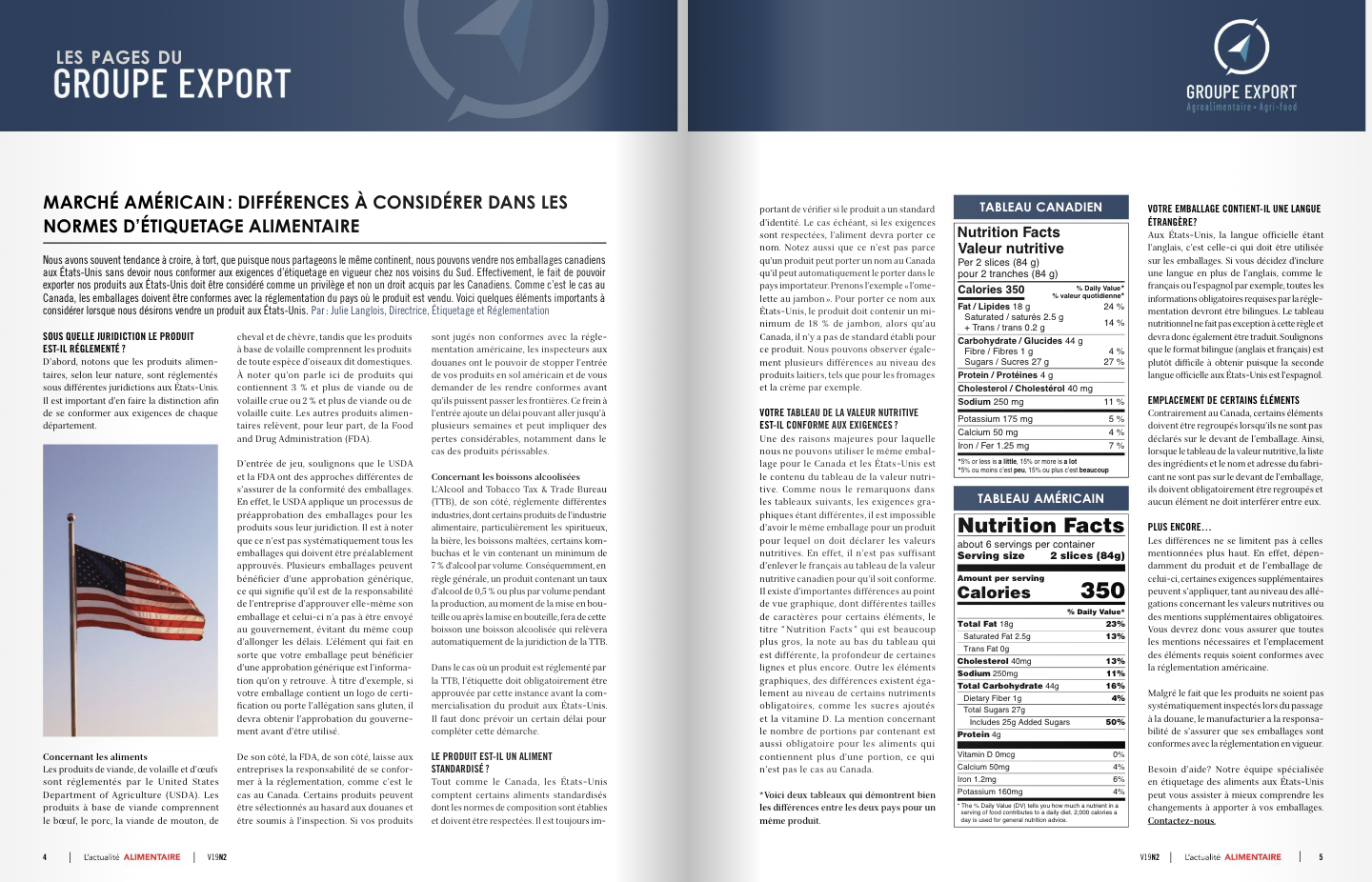
Nous avons souvent tendance à croire, à tort, que puisque nous partageons le même continent, nous pouvons vendre nos emballages canadiens aux États-unis sans devoir nous conformer aux exigences d’étiquetage en vigueur chez nos voisins du Sud. Effectivement, le fait de pouvoir exporter nos produits aux États-unis doit être considéré comme un privilège et non un droit acquis par les Canadiens. Comme c’est le cas au Canada, les emballages doivent être conformes avec la réglementation du pays où le produit est vendu. Voici quelques éléments importants à considérer lorsque nous désirons vendre un produit aux États-unis.
Sous quelle juridiction le produit est-il réglementé ?
D’abord, notons que les produits alimentaires, selon leur nature, sont réglementés sous différentes juridictions aux États-Unis. Il est important d’en faire la distinction afin de se conformer aux exigences de chaque département.
Concernant les aliments
Les produits de viande, de volaille et d’œufs sont réglementés par le United States Department of Agriculture (USDA). Les produits à base de viande comprennent le bœuf, le porc, la viande de mouton, de cheval et de chèvre, tandis que les produits à base de volaille comprennent les produits de toute espèce d’oiseaux dit domestiques. À noter qu’on parle ici de produits qui contiennent 3 % et plus de viande ou de volaille crue ou 2 % et plus de viande ou de volaille cuite. Les autres produits alimentaires relèvent, pour leur part, de la Food and Drug Administration (FDA).
D’entrée de jeu, soulignons que le USDA et la FDA ont des approches différentes de s’assurer de la conformité des emballages. En effet, le USDA applique un processus de préapprobation des emballages pour les produits sous leur juridiction. Il est à noter que ce n’est pas systématiquement tous les emballages qui doivent être préalablement approuvés. Plusieurs emballages peuvent bénéficier d’une approbation générique, ce qui signifie qu’il est de la responsabilité de l’entreprise d’approuver elle-même son emballage et celui-ci n’a pas à être envoyé au gouvernement, évitant du même coup d’allonger les délais. L’élément qui fait en sorte que votre emballage peut bénéficier d’une approbation générique est l’information qu’on y retrouve. À titre d’exemple , si votre emballage contient un logo de certification ou porte l’allégation sans gluten, il devra obtenir l’approbation du gouvernement avant d’être utilisé.