


Indicadores
| Título del ítem | Sumario | Categorías | Creado | |
|---|---|---|---|---|
| Prosecco DOC announces record shipments to UK |
By James Bayley Published: 20 March, 2023 Overall, production volume rose by 1.8% compared to 2021 and sales value increased by 11.5%, reaching 638.5 million bottles sold for an estimated total value of more than 3 billion euros. For the first time, the export quota reached 81.2%, while the 2022 domestic consumption equalled 18.8% of total sales, confirming its position as the leading wine by consumption in Italy. In other foreign markets, record-breaking growth also occurred in the United States at 5.8% over 2021, overtaking the UK in terms of exported volumes by value, for the first time. Germany grew by 2.8% and imported 46 million bottles. France maintained its fourth position in terms of Prosecco DOC exports, registering a 19% increase in volume and a 30% increase in value. While today Italy consumes 120 million bottles of Prosecco DOC, the US is now the top market for the denomination, with more than 134 million bottles imported in 2022. |
Reino Unido | Mercados | Vitivinícola | Competidores | Lunes, 20 Marzo 2023 | |
| Budget misery for UK drinks trade |
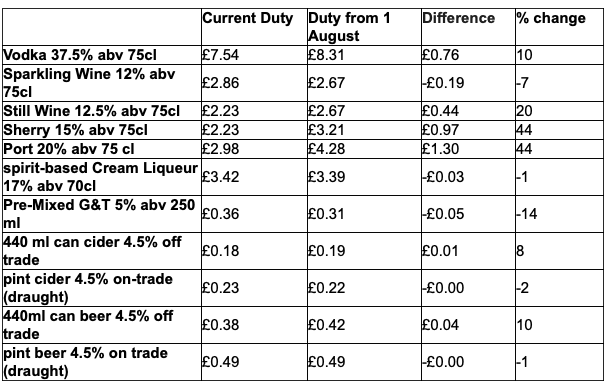
By Andrew Catchpole Published: 15 March, 2023 The Chancellor’s reversal of the freeze, which will now see a hike in duty, paralleling inflation, is now set to coincide with the new alcohol duty regime, also to be enforced from 1 August, which will tax alcohol in multiple bands according to rising abv. The Wine & Spirit Trade Association (WSTA) estimates that some 90% of still wine consumed in the UK will see “at least a 9% duty rise” under the latter regime. This, in turn, will now be compounded by an inflation-linked rise in duty pegged to 10.1% RPI, amounting to a near 20% tax rise of 44p per bottle of still wine, and £1.30 on a bottle of fortified wine. The WSTA described wine drinkers as “facing the biggest single increase in almost 50 years”, the biggest duty hike since 1975, adding that “history has shown that freezing duty does not have a negative impact on Treasury revenues”. With the cost-of-living crisis now heavily impacting consumers, the drinks trade has been warning that this double tax whammy could drive down sales and thus also Treasury revenues, while still stoking the inflation at the heart of the crisis. The trade has also made clear to government the impact of such tax hikes, which will also impact especially harshly upon smaller and specialist importers and retailers, with squeezed margins reducing the appeal for producers of exporting to the UK. While prices inevitably rise, this will also ultimately reduce choice for hard pressed consumers. Furthermore, the increases are not limited to wine, with spirits also being hit, with a 76p hike in the price of a bottle of vodka. This is in contrast to the announcement that from 1 August duty on draught products in pubs will be up to 11p lower than the duty in supermarkets, described by Chancellor Jeremy Hunt as "a differential we will maintain as part of a new Brexit pubs guarantee". Miles Beale, chief executive of the WSTA, said of the duty hikes: “This Budget directly contradicts what this Government claims it is trying to tackle. It will further fuel inflation. It will heap more misery on consumers. And it will damage British business, especially those in the hospitality supply chain, who are still trying to recover from the pandemic. “The double whammy tax hike for wine is a particularly bitter blow for the UKs SME-rich wine businesses. It begs the question - yet again - what does Government have against people who choose to produce and drink wine?” The cost to trade and consumer of the new duty regime and inflationary duty rise in the budget have been provided by the WSTA.
|
Reino Unido | Mercados | Vitivinícola | Legislación y normativa | Miércoles, 15 Marzo 2023 | |
| Ecommerce and premium offer opportunities in ‘challenging’ wine market |
By Andrew Catchpole Published: 16 March, 2023 The report – Key trends for wine in 2023 and beyond – found that “the short- and medium term trend for wine is challenging, with the long-term trend of slowly-declining volumes in many markets expected to continue”. However, it also described opportunities via ecommerce, which remains in good growth post-pandemic, plus “in the premium space”, as drinkers continue to trade up when they do drink wine. • Read more: Rising consumer confidence is the blue sky we’re all looking for Sparkling wine and ‘alternative’ wines were also highlighted as areas where further growth can be expected. In 2021 volumes of the global market for still wine declined by -2%, retail value grew by +5%. This was contrasted by the premium-and-above segment of the total global wine market, which is expected to continue to outpace the standard-and-below segment, with the former forecast to grow at a +3% CAGR, 2022-2026 in volume terms. Another positive sign in the post-pandemic era, is that while consumers have reined in spending due to the global economic climate, the number of consumers that regularly drink wine has recovered in some key markets. This, finds the report, is partly down to younger consumers returning to wine, having re-engaged as on-trade venues once again operate at closer to normal capacity. Drilling down into the detail, though, the outlook for wine remains unfavourable when compared with its nearest rivals. The IWSR found: “Apart from RTDs, all drinks categories experienced a drop in sales in the Covid year of 2020. But whereas spirits are bouncing back strongly, and beer is returning to favour in developing markets, wine’s long-term diminution has continued. “Wine volumes for H1 2021-2022 were down 5%, and of the top 20 wine markets, only Brazil is drinking more wine now than it did in 2017.” In line with concerns across much of the wine sector, the report identified “an increasing reliance on older drinkers”, with a need to engage and recruit younger drinkers. This, it added, would require greater innovation from the trade. Not all markets are equal, however, with the US, UK and Japan among those that have seen a resurgence in the total number of wine drinkers, “mostly driven by younger adult drinkers” boosting sales in pubs, bars and restaurants. These drinkers, in turn, were described as having lower knowledge than their older compatriots, also drinking less wine on a given occasion, but being more open to alternatives and to ‘buying less but better’. They are also less likely to buy into well-known brands. “At just under 1% growth in H1 2022 vs H1 2021, the global volume growth of premium-and-above still wines is fragile, but it is, nonetheless, a clear bucking of the downwards trend of the category as a whole,” said the report, adding that this is a trend that is expected to continue. It did, however, add the caveat that increased spend is often being out-paced by inflation, meaning that many wine drinkers are simply paying more for the same product. |
Reino Unido | Mercados | Vitivinícola | Clientes | Miércoles, 15 Marzo 2023 | |
| Wine industry warns of tax hikes ahead of budget announcement | By Rachel Badham | 14 March, 2023  The Wine and Spirit Trade Association (WSTA) has warned of further tax increases on wine ahead of the spring budget announcement on March 15. With a new alcohol duty system - which will tax alcohol according to strength - due to come into action on August 1 2023, the WSTA predicts that around 90% of still wine will see a 9% duty rise. However, the WSTA has highlighted that if the chancellor Jeremy Hunt announces an end to the freeze on alcohol duty, and chooses to increase duty in line with inflation, wine drinkers will see an even greater tax rise of around 20%. A 20% rise would reportedly see duty on a bottle of still wine go up by 44p, while fortified wines would see an even greater rise. The WSTA described this as the “biggest single increase in almost 50 years” for wine drinkers. Miles Beale, chief executive of the Wine and Spirit Trade Association, said: “If the Chancellor goes ahead with a two-pronged attack on wine drinkers by adding an inflationary duty increase on top of the stealth tax already applied when the Government’s new alcohol duty regime kicks in this summer, duty alone will add 44p to a bottle of still wine. “If alcohol duty rates went up by RPI [with inflation rates], this will be a crippling blow to the UK alcohol industry and consumers who will have to pay the price for tax rises during a cost-of-living crisis.” Related articles: |
Reino Unido | Mercados | Vitivinícola | Legislación y normativa | Lunes, 13 Marzo 2023 | |
| New online platform launched to help food manufacturers with efficiency and productivity |  The Food and Drink Innovation Gateway is a one-stop online tool which connects businesses in the sector, particularly small and medium sized, with a wide range of independent advice and expertise, from commercial authorities through to universities and government-backed programmes. FDF said this partnership would support companies to develop and grow their businesses through the adoption of existing and new technologies, including automation, AI and digital, as well as improving their energy efficiency, reduce waste and help to tackle labour shortages. InvestThe FDF’s chief executive Karen Betts said that the UK’s food and drink businesses are the lifeblood of homes and communities. “The FDF’s Innovation Gateway is designed to provide a much-needed ‘single point of entry’ for companies in our sector which are looking to invest in innovation, automation, new technologies and environmental sustainability. It will help to match businesses with the right support, which already exists in a range of different organisations across the UK but which can be difficult to identify and access,” said Betts. “I’m proud of the very practical support that FDF’s Gateway will offer to our dynamic sector, helping food and drink businesses to grow and thrive, and to remain at the heart of advanced manufacturing and a green economy.” CornerstoneThe new platform was launched at DEFRA’S National Food and Drink Summit this week. “The food and drink industry is a cornerstone of our economy and the largest manufacturing sector in the UK. SMEs are at the heart of this, making up 98% of food and drink manufacturers and employing 146,000 people across the country,” said Food and Farming Minister Mark Spencer MP. “They are global leaders in innovation and I am delighted the FDF’s new Food and Drink Innovation Gateway will be open to them, making it easier for them to adopt new technology.” |
Reino Unido | Logística | Producción | Intersectorial | Miércoles, 08 Marzo 2023 | |
| Womens health among top health and nutrition trends in 2023 |  It also said that affordable nutrition and sugar and salt reduction among some of the top areas for innovation in 2023. Kerry said that trends are underpinned by a desire for sustainable nutrition with consumers becoming more interested in proactively managing their physical and mental health while seeking products that are affordable, healthy and good for the planet. “Sustainability continues to be the leading driver in food and beverage innovation, as consumers become increasingly focused on health and affordability in their nutritional spend. The Kerry Health and Nutrition Institute’s research finds 2023 will see long-standing trends of health and sustainability take more personalised approach to specific consumer groups and need-states. Nutritional innovation is increasingly enabling consumers to proactively manage their physical and mental health including through functional beverages; sex-specific nutrition; and probiotics for more than digestive health," said Nathan Pratt, senior nutrition scientist at Kerry. “We are also seeing consumers placing increased importance on the nutritional density of their foods, as they seek affordable yet healthy alternatives in today’s macroenvironment. The industry must consider all of these trends in the context of feeding a growing global population – a task to which food science and technology will be critically important in the coming year and beyond.” The top 10 trends for 2023Functionality flourishingFunctional beverages are leading an industry-wide boom in products aimed to help consumers proactively manage their health. In 2023, KHNI predicts there will be a focus on short-term need states of beauty; immune support; digestive health; energy; and weight management. Women’s healthWomen’s health issues are being increasingly addressed via nutrition with broadening clinical research, delivering innovative supplement launches to support women’s digestive, heart, cognitive, bone, joint and immune health, KHNI said. These also support female specific need states such as fertility, breastfeeding and menopause. Advanced activityIt is predicted that there will be more products focusing on joint and cardiovascular health with these benefits targeting all active age groups. Cognitive healthThere will continue to be an increased focus on mental wellbeing post-Covid and growing science on the role of ingredients such as adaptogens and nootropics in brain health is seeing cognitive health carve a strong foothold in the food and beverage space. High stakes for sugar and saltChanges in nutrition and labelling legislation are becoming more widespread, and consumers are becoming more health conscience. Front-of-pack signposting is increasing to make healthier choices more simple but is also driving the increasing need for innovative technology to help manufacturers create healthier, more sustainable products, that deliver on taste and experience. Affordable nutritionFood innovation is not only focused on premium novel ingredients, but also on how we can make the food system more economically sustainable by maximising the nutritional density and affordability of foods. Protein production’s futureKNHI said that it would be “nearly impossible” to feed the planet’s population growth using the current systems of food production. Food science and technology will be critically important to innovate alternative means of producing the protein required to feed the planet. Microbiome – beyond digestive healthMicrobes extend far beyond the gut or digestive tract, and microbiologists are identifying more and more bacteria with interesting properties. The microbiome has been linked to a multitude of health benefits beyond digestive health including reproductive and cardiometabolic health, alongside immunity. Hydration optimisedHydration is moving beyond plain water, as consumers look for more exciting options such as sparkling water or electrolyte powers. KNHI said there isalso a move away from sweetness in hydration, with sparkling waters and low-sweetness options are being chosen more commonly by consumers looking to hydrate and manage weight. Plant-based to plant-forwardConsumers are increasingly looking beyond meat mimicry to plant-forward products as they challenge the heavily processed nature of plant proteins, Kerry highlighted. Plant-forward innovations that offer servings of fruits, vegetables, or whole-grains can help bridge gaps in our day-to-day diets while differentiating themselves in the plant-based market. |
Reino Unido | Mercados | Clientes | Intersectorial | Martes, 07 Marzo 2023 | |
| Eating habits are changing with food prices a ‘top concern for consumers |  The findings come from a biannual ‘Food and You 2’ survey conducted by the Food Standards Agency (FSA) and suggest consumer concerns around cost-of-living and food insecurity. A total of 6,770 adults from 4,727 households across England, Wales, and Northern Ireland were surveyed between 26 April and 24 July 2022. The survey revealed most respondents had made changes to their eating habits in the last 12 months. The most common changes related to what and where respondents ate, reducing food costs and increased food management behaviours. Changes included eating out less and consuming fewer takeaways; cooking and eating at home more; buying items on special offer more; and changing what and where they buy to cheaper alternatives. For the most part, respondents said they changed eating habits due to financial reasons (69%). Overall, the top concern for people was revealed to be food prices (66%), followed by food waste (60%) and the amount of sugar in food (59%). Food insecurity was also a major focus on the survey, which indicated that 20% of households across England, Wales and Northern Ireland now have limited or uncertain access to adequate food. “This is the highest reported level of food insecurity since tracking began in 2020,” noted the FSA. Unsurprisingly, food security was associated with household income: respondents with a lower income were more likely to report being food insecure that those with a higher income. The survey also assessed use of food banks and free school meals. Most respondents (95%) reported they had not used a food bank or other emergency food provider in the last year, 3% said they had. Of respondents with children aged 7-15 years in their household, most (74%) said their children do not receive school meals. Approximately one in four (24%) said they do. |
Reino Unido | Clientes | Mercados | Intersectorial | Lunes, 06 Marzo 2023 | |
| Sustainability and efficiency: bulk wine's potential - analysis | By Anne Krebiehl MW | 02 March, 2023  Shipping wine to pack in the UK offers social, green and financial solutions to the issues of the day, argues Anne Krebiehl MW The energy and supply chain crises have put the advantages of bulk shipping wine into sharper focus, both financially and environmentally. Sustainability is almost exclusively discussed in ecological terms when it actually encompasses three aspects equally: ecological, economic and social sustainability. It is the financial incentives that have, until now, driven bulk wine forward but, properly applied, sustainability should hit the bottom line and benefit both the environment and people. Figures from the Wine & Spirit Trade Association show that the UK imported 340 million litres of bulk wine in 2010, representing 26% of all imported wine. By 2019, this had shifted to 516 million litres, or 39%, of imported wine. Even wines that sell at a considerable premium sometimes leave their country of origin in bulk and are bottled in the UK. The consumer is usually none the wiser and happily continues to buy them. The business of bulk wine happens mostly behind the scenes. Many consumers say that environmental concerns matter to them, but price is still a bigger driver of behaviour. Some might argue that to be truly sustainable wine should cost more and be drunk where it is produced, but the world simply is not like that. “Where a wine is packed is not on consumers’ agendas,” says Paul Braydon, head of buying for Kingsland Drinks, the company that first introduced modern bulk table wine to the UK in the 1960s. “Our own research in 2018 found that 95% of consumers are not thinking about where wine is bottled,” says Braydon. “Consumers choose wines to match their occasion, and are looking for quality at a great price.” Braydon says that 90% of bulk wine “is packed into bottles, the remaining 10% split between other formats such as cans and bag-in-box”. Lesley Cook, director of purchasing at premium bulk wine specialist Lanchester Wines, illustrates the benefits in costs and carbon emissions. “The most obvious benefit is that you can double the volume shipped. One 20ft container has a capacity of 9,900 litres of [bottled] wine, while the same container with a flexitank can take 24,000 litres – resulting in a 40% saving in carbon emissions.” The cost saving from shipping the equivalent of 32,000 bottles for the same price as 13,200 bottles respectively makes the retail price much more competitive. WASTEFUL PRACTICES Greg Livengood, president of California-based global bulk wine broker Ciatti, notes that “when bottling wine at source, in many cases the winery needs to import dry goods, such as bottles. Once bottled, you must ship them once again.” Such practices are wasteful and costly. “There is no doubt that economic sustainability has really helped drive the bulk wine category,” Livengood says. “The people running wineries around the world all see the value in bulk wine, and how the cost benefits relate to their bottom line. The ecological argument is coming, but it is lagging the economic reasoning.” Dom de Ville, director of sustainability for the Wine Society, says that shipping wine from New Zealand in flexitank and bottling it in the UK can result in fewer carbon emissions than trucking wine to Calais from a French wine region and on to Wine Society HQ in Stevenage from Dover. But he also cautions that savings achieved by sea-shipping in bulk can be cancelled out by road haulage after wine arrives in the UK. De Ville notes that bulk will take careful modelling of transport and packaging scenarios for the Wine Society, which has a huge range of wines sold in comparatively small volumes. The benefits are more obvious for bigger operators with fewer wines. But he is clear: “We want to explore bulk shipping because there are financial and environmental benefits.” County Durham-based Lanchester Wines and its sister company Greencroft Bottling work with “feeder services to move containers to the Port of Tyne in Newcastle or Teesport near Middlesbrough, rather than bringing them through Felixstowe and Tilbury”, Cook says, cutting carbon emissions by 45% over rail freight and 68% by road. Beyond the obvious cost savings, there is another compelling reason to reduce packaging in the form of Extended Producer Responsibility, a new regulation on recycling otherwise known as ERP. This is being phased in from this year, and due to go live in 2024, and will place an increased cost burden and data recording requirement burden for the costs of recycling packaging on brand owners and importers, assessed on weight. FINANCIAL BENEFITS De Ville at the Wine Society notes that “it will make packaging fees even more expensive” in the future. Anything that reduces packaging weight, whether through glass weight or alternative materials, without impacting the quality of the wine, will bring financial benefits. There is a lot of room for improvement in the way wine is bought, sold and moved around the globe. Greencroft Bottling’s state-of-the-art facility, which is set to become fully operational in early 2023, reveals what can be done. The new site will have both bottling lines and “ancillary lines for bag-in-box, cans, pouches, key kegs or any new types of sustainable packaging”, and a new “counter-pressure line with sparkling capabilities,“ notes Tony Cleary, Lanchester’s group managing director. What is really different, however, is that this facility will be selfpowered, with both solar panels and wind power, and made thermally efficient by insulation. “We are spending more than we might otherwise on a new building,” adds Cleary, “but we’ll soon get that extra investment back through energy savings, so what’s good for the planet is good for the business too.” These plans were laid before the energy crisis, but that they are good sense is even clearer now. The coming decade will see much change. The energy crisis has put a real question mark over glass, with its high energy use and smelting costs. Innovation in filling technology poses other questions. Why are key kegs not yet ubiquitous in the on-trade? Will they find use in retail and give a boost to independent wine shops? Will a new infrastructure emerge based on artisanal, smaller-batch bulk wines? Will people buy wine in pouches? Will there be a breakthrough for letterbox-friendly PET-bottles? Plenty of solutions to improve sustainability in all its forms exist if we let go of old habits. Wine has been with us for millennia and will continue to be with us; it might just get to us in different ways.
Related articles: |
Reino Unido | Mercados | Vitivinícola | Logística | Lunes, 06 Marzo 2023 | |
| Consumers continue to change eating habits but food insecurity rising |  Its survey - Food and You 2 Wave 5 - showed that the most common changes people have made to their eating habits include eating out less and eating fewer takeaways; cooking and eating at home more; buying items on special offer more; and changing what and where they buy to cheaper alternatives. The main causes of reported changes in eating habits were financial reasons (69%), health reasons (47%), and because of COVID-19 and lockdown (41%). Food pricesThe research also revealed that food prices were the top concern for people (66%), with food waste (60%) and the amount of sugar in food (59%) also featuring in the top three prompted concerns. Latest figures from this survey indicated that 20% of households across England, Wales and Northern Ireland are now food insecure, meaning they have limited or uncertain access to adequate food. This is the highest reported level of food insecurity since tracking began in 2020. However, around three quarters of respondents (74%) reported that they had confidence in the food supply chain. Eating habitsEmily Miles, chief executive at the FSA, said: “Food and You 2 provides FSA and the rest of Government with robust data on what people think and do when it comes to food. We are seeing high levels of concern about food prices, as well as people making changes to their eating habits for financial reasons.” She added: “The experiences people are reporting to us are critically relevant to the FSA's work as a regulator, and to our mission to make sure people have food they can trust. The FSA will continue to play our part in protecting health and consumers’ wider interests in relation to food.” Fieldwork for Food and You 2 Wave 5 was conducted between 26 April and 24 July 2022. A total of 6,770 adults from 4,727 households across England, Wales, and Northern Ireland took part. |
Reino Unido | Mercados | Clientes | Intersectorial | Domingo, 05 Marzo 2023 | |
| The potential of bulk wine - analysis | By Anne Krebiehl MW | 02 March, 2023 Shipping wine to pack in the UK offers social, green and financial solutions to the issues of the day, argues Anne Krebiehl MW The energy and supply chain crises have put the advantages of bulk shipping wine into sharper focus, both financially and environmentally. Sustainability is almost exclusively discussed in ecological terms when it actually encompasses three aspects equally: ecological, economic and social sustainability. It is the financial incentives that have, until now, driven bulk wine forward but, properly applied, sustainability should hit the bottom line and benefit both the environment and people. Figures from the Wine & Spirit Trade Association show that the UK imported 340 million litres of bulk wine in 2010, representing 26% of all imported wine. By 2019, this had shifted to 516 million litres, or 39%, of imported wine. Even wines that sell at a considerable premium sometimes leave their country of origin in bulk and are bottled in the UK. The consumer is usually none the wiser and happily continues to buy them. The business of bulk wine happens mostly behind the scenes. Many consumers say that environmental concerns matter to them, but price is still a bigger driver of behaviour. Some might argue that to be truly sustainable wine should cost more and be drunk where it is produced, but the world simply is not like that. “Where a wine is packed is not on consumers’ agendas,” says Paul Braydon, head of buying for Kingsland Drinks, the company that first introduced modern bulk table wine to the UK in the 1960s. “Our own research in 2018 found that 95% of consumers are not thinking about where wine is bottled,” says Braydon. “Consumers choose wines to match their occasion, and are looking for quality at a great price.” Braydon says that 90% of bulk wine “is packed into bottles, the remaining 10% split between other formats such as cans and bag-in-box”. Lesley Cook, director of purchasing at premium bulk wine specialist Lanchester Wines, illustrates the benefits in costs and carbon emissions. “The most obvious benefit is that you can double the volume shipped. One 20ft container has a capacity of 9,900 litres of [bottled] wine, while the same container with a flexitank can take 24,000 litres – resulting in a 40% saving in carbon emissions.” The cost saving from shipping the equivalent of 32,000 bottles for the same price as 13,200 bottles respectively makes the retail price much more competitive. WASTEFUL PRACTICES Greg Livengood, president of California-based global bulk wine broker Ciatti, notes that “when bottling wine at source, in many cases the winery needs to import dry goods, such as bottles. Once bottled, you must ship them once again.” Such practices are wasteful and costly. “There is no doubt that economic sustainability has really helped drive the bulk wine category,” Livengood says. “The people running wineries around the world all see the value in bulk wine, and how the cost benefits relate to their bottom line. The ecological argument is coming, but it is lagging the economic reasoning.” Dom de Ville, director of sustainability for the Wine Society, says that shipping wine from New Zealand in flexitank and bottling it in the UK can result in fewer carbon emissions than trucking wine to Calais from a French wine region and on to Wine Society HQ in Stevenage from Dover. But he also cautions that savings achieved by sea-shipping in bulk can be cancelled out by road haulage after wine arrives in the UK. De Ville notes that bulk will take careful modelling of transport and packaging scenarios for the Wine Society, which has a huge range of wines sold in comparatively small volumes. The benefits are more obvious for bigger operators with fewer wines. But he is clear: “We want to explore bulk shipping because there are financial and environmental benefits.” County Durham-based Lanchester Wines and its sister company Greencroft Bottling work with “feeder services to move containers to the Port of Tyne in Newcastle or Teesport near Middlesbrough, rather than bringing them through Felixstowe and Tilbury”, Cook says, cutting carbon emissions by 45% over rail freight and 68% by road. Beyond the obvious cost savings, there is another compelling reason to reduce packaging in the form of Extended Producer Responsibility, a new regulation on recycling otherwise known as ERP. This is being phased in from this year, and due to go live in 2024, and will place an increased cost burden and data recording requirement burden for the costs of recycling packaging on brand owners and importers, assessed on weight. FINANCIAL BENEFITS De Ville at the Wine Society notes that “it will make packaging fees even more expensive” in the future. Anything that reduces packaging weight, whether through glass weight or alternative materials, without impacting the quality of the wine, will bring financial benefits. There is a lot of room for improvement in the way wine is bought, sold and moved around the globe. Greencroft Bottling’s state-of-the-art facility, which is set to become fully operational in early 2023, reveals what can be done. The new site will have both bottling lines and “ancillary lines for bag-in-box, cans, pouches, key kegs or any new types of sustainable packaging”, and a new “counter-pressure line with sparkling capabilities,“ notes Tony Cleary, Lanchester’s group managing director. What is really different, however, is that this facility will be selfpowered, with both solar panels and wind power, and made thermally efficient by insulation. “We are spending more than we might otherwise on a new building,” adds Cleary, “but we’ll soon get that extra investment back through energy savings, so what’s good for the planet is good for the business too.” These plans were laid before the energy crisis, but that they are good sense is even clearer now. The coming decade will see much change. The energy crisis has put a real question mark over glass, with its high energy use and smelting costs. Innovation in filling technology poses other questions. Why are key kegs not yet ubiquitous in the on-trade? Will they find use in retail and give a boost to independent wine shops? Will a new infrastructure emerge based on artisanal, smaller-batch bulk wines? Will people buy wine in pouches? Will there be a breakthrough for letterbox-friendly PET-bottles? Plenty of solutions to improve sustainability in all its forms exist if we let go of old habits. Wine has been with us for millennia and will continue to be with us; it might just get to us in different ways.
Related articles: |
Reino Unido | Mercados | Vitivinícola | Clientes | Jueves, 02 Marzo 2023 |



Página 1 de 54