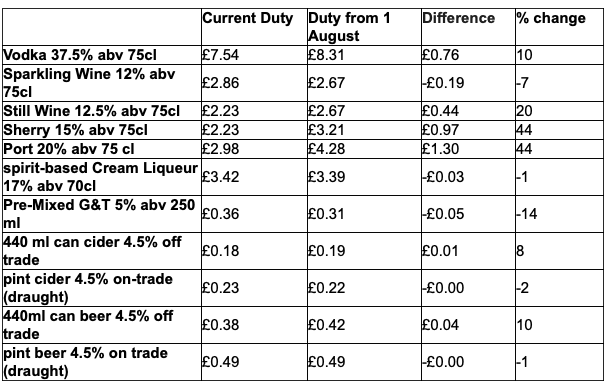
The Chancellor’s reversal of the freeze, which will now see a hike in duty, paralleling inflation, is now set to coincide with the new alcohol duty regime, also to be enforced from 1 August, which will tax alcohol in multiple bands according to rising abv.
The Wine & Spirit Trade Association (WSTA) estimates that some 90% of still wine consumed in the UK will see “at least a 9% duty rise” under the latter regime.
This, in turn, will now be compounded by an inflation-linked rise in duty pegged to 10.1% RPI, amounting to a near 20% tax rise of 44p per bottle of still wine, and £1.30 on a bottle of fortified wine.
The WSTA described wine drinkers as “facing the biggest single increase in almost 50 years”, the biggest duty hike since 1975, adding that “history has shown that freezing duty does not have a negative impact on Treasury revenues”.
With the cost-of-living crisis now heavily impacting consumers, the drinks trade has been warning that this double tax whammy could drive down sales and thus also Treasury revenues, while still stoking the inflation at the heart of the crisis.
The trade has also made clear to government the impact of such tax hikes, which will also impact especially harshly upon smaller and specialist importers and retailers, with squeezed margins reducing the appeal for producers of exporting to the UK. While prices inevitably rise, this will also ultimately reduce choice for hard pressed consumers.
Furthermore, the increases are not limited to wine, with spirits also being hit, with a 76p hike in the price of a bottle of vodka.
This is in contrast to the announcement that from 1 August duty on draught products in pubs will be up to 11p lower than the duty in supermarkets, described by Chancellor Jeremy Hunt as "a differential we will maintain as part of a new Brexit pubs guarantee".
Miles Beale, chief executive of the WSTA, said of the duty hikes: “This Budget directly contradicts what this Government claims it is trying to tackle. It will further fuel inflation. It will heap more misery on consumers. And it will damage British business, especially those in the hospitality supply chain, who are still trying to recover from the pandemic.
“The double whammy tax hike for wine is a particularly bitter blow for the UKs SME-rich wine businesses. It begs the question - yet again - what does Government have against people who choose to produce and drink wine?”
The cost to trade and consumer of the new duty regime and inflationary duty rise in the budget have been provided by the WSTA.
The Wine and Spirit Trade Association (WSTA) has warned of further tax increases on wine ahead of the spring budget announcement on March 15.
With a new alcohol duty system - which will tax alcohol according to strength - due to come into action on August 1 2023, the WSTA predicts that around 90% of still wine will see a 9% duty rise.
However, the WSTA has highlighted that if the chancellor Jeremy Hunt announces an end to the freeze on alcohol duty, and chooses to increase duty in line with inflation, wine drinkers will see an even greater tax rise of around 20%.
A 20% rise would reportedly see duty on a bottle of still wine go up by 44p, while fortified wines would see an even greater rise. The WSTA described this as the “biggest single increase in almost 50 years” for wine drinkers.
Miles Beale, chief executive of the Wine and Spirit Trade Association, said: “If the Chancellor goes ahead with a two-pronged attack on wine drinkers by adding an inflationary duty increase on top of the stealth tax already applied when the Government’s new alcohol duty regime kicks in this summer, duty alone will add 44p to a bottle of still wine.
“If alcohol duty rates went up by RPI [with inflation rates], this will be a crippling blow to the UK alcohol industry and consumers who will have to pay the price for tax rises during a cost-of-living crisis.”
Note: This report includes forecasting data that is based on baseline historical data.
Executive summary
Key health and wellness (HW) trends across the world include keeping bellies and wallets full with satiating, nutritious food and drink; arming consumers with the know-how they need to adapt their meal plans using new alternative ingredients; giving overwhelmed consumers the freedom to indulge, to treat themselves and to help them optimize their mental performance at work, home and play; also, invigorating consumers with new experiences that helps them thrive in extreme environmental conditions by invoking food and drink more as a source of optimism, innovation and connection (Mintel: Global food & drink Trends, 2023).
In Mexico, the new labelling regulation (NOM051) introduced on packaging for food and drink products that have high levels in sugar, salt and fats content, which came into effect towards the end of 2020, has served to bolster consumer concerns and resulted in a continuation of HW trends in 2021. Lower and middle-income Mexicans continued to prioritize fortified foods & beverages in the interest of receiving maximum value from economy brands in the face of continued economic stress brought on by the pandemic (Euromonitor: Health & Wellness in Mexico, 2022).
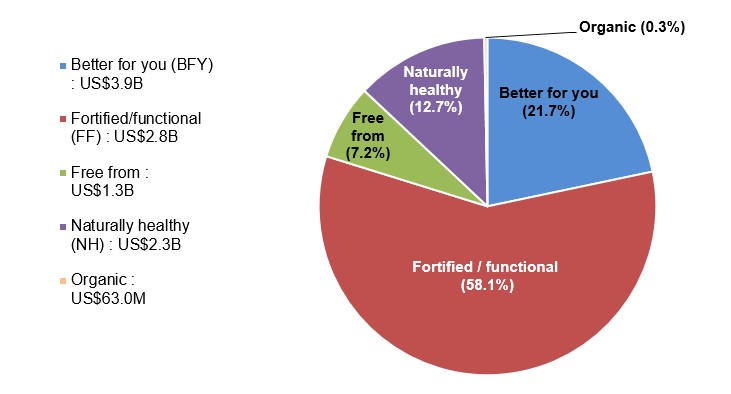
In 2021, retail sales of the Mexican HW sector totaled US$18.1 billion. Of this total, 64% accounted for HW retail food sales at US$11.6 billion with the remainder 36% in HW retail beverage products at US$6.5 billion. The HW category with the highest retail sales value was for fortified/functional (FF) food and drink products at US$10.5 billion, followed by better for you (BFY) at US$3.9 billion and naturally healthy (NH) at US$2.3 billion in 2021. Free from food products and organic food and drink products are becoming more popular amongst Mexicans with registered sales and a compound annual growth rate (CAGR) between 2016 and 2021 of US$1.3 billion (13.1%) and US$63 billion (12.0%), respectively.
According to a Mintel Global survey consisting of 1,000 responses (2022), 59% of Mexicans indicated that they look to consume more nutritious food/drink products packed with vitamins and minerals. Although, competitive pricing is a key consideration when introducing high premium quality products to the market, consumers are looking for 'value-added' products that deliver in forms beyond low cost.
2023 – Global and Mexican food and drink trends
Consumers across the world are looking for reassurance as they continue to be challenged to adapt, with feelings of insecurity and uncertainty surrounded around increasing fluctuations in cost-of-living finances, such as food and drink products. Manufacturers are also, facing these same challenges and are trying to adjust alongside the anxious, value-conscious consumer by continuing to diversify and innovate their brand offerings that offer measurable tangible benefits from what they invest in terms of quality, premium, convenient and budget-friendly products. Consumers are looking for 'value-added' products that go beyond affordable, low prices, where they want satiating, yet nutritious food and drink, while also having the freedom to indulge in new experiences, including the choice between versatile options that help optimize one's health and well-being throughout all life occasions.Footnote 1
To better connect with overwhelmed, fatigued consumers, on-pack product communication should be streamlined to focus on a few specific key health claim benefits in order to remain as a more trustworthy brand. Amongst, the countries with the highest inflation in mid-2022 (including Brazil, Canada, Italy, South Korea), key health claims such as immune support, healthy heart or digestive health benefits and the usage of natural health-boosting ingredients over fortified ones are factors that are often more important than low price offerings. In a Mintel Global Consumer survey, 59% of Mexicans (over 1,000 users) indicated that they look to consume more nutritious food/drink products packed with vitamins and minerals over seeking more affordable options (23%).Footnote 1
'Better-for-us' will become the new 'better-for-you' for ethical consumers that expect that health products considered for 'luxury' should not be restricted to those with high disposable incomes. Food insecurities and exposed inequalities across global and local food systems have only heightened during the pandemic, forcing a shift toward community-led solutions - and moving away from power monopolies that have driven food systems in the past. Manufacturers are forced to address sustainable issues beyond storage and processing factors; to also, protect the factors that impact the nutritional value of food from farm to table by devoting resources to improve soil health, growing conditions (water stewardship, CO2 levels, pollution), crop genetics, post-harvest nutrient degradation and climate change - to name a few.Footnote 1
Consumers are still cooking at home frequently, but more recently, rising food costs due to inflation, export/food supply issues and the looming threat of a global recession have put more pressure on consumers' abilities to obtain, prepare and maximize their groceries. Brands will need to help consumers become more flexible in the kitchen, both to optimize the usage of alternative, cheaper ingredients and to find new ways to cook with them. Brands have the opportunity to help consumers gain confidence and put them in control when practicing flexibility, by arming them with the 'know how' guidance and support, while offering versatile ways to incorporate new ingredients and transforming traditional recipes in new ways. Now more important than it was pre-pandemic, brands can enhance the experience of at-home consumption, by building food and drink into self-care regimens, and transforming the experience from a guilty pleasure to a necessary coping mechanism - whereby lower than global average, 22% of 1,000 Mexican respondents indicated that they like to relieve stress by eating comforting foods and 27% like to pamper themselves (that is, taking relaxing baths/showers, in-home facials).Footnote 1
Health and wellness sector – market overview
Overall, the HW Mexican sector reached a retail sales value of US$18.1 billion in 2021, which has increased at a CAGR of 6.5% (2016-2021) and a forecast CAGR of 6.4% (2021-2026). A total of 64% were HW packaged food products at a sales value of US$11.6 billion, with the FF category representing the highest market share at 66.3%, followed by BFY (11.7%), free from (11.3%), NH (10.5%) and organic (0.3%) in 2021.
The remainder 36% of HW non-alcoholic beverages reached sales of US$6.5 billion, which are thriving the most from within the FF (43.6%), BFY (39.4%), NH (16.7%), and organic ( 0.3%) related drink categories in 2021.
Retail sales in Mexico of HW packaged food and beverage products, historical and forecast using fixed 2022 exchange rate, US$ millions
Category
2016
2021
CAGR* % 2016-2021
2022
2026
CAGR* % 2021-2026
Total - Health and wellness food and drink by type
13,231.6
18,093.4
6.5
19,246.3
24,688.4
6.4
Better for you (BFY)
2,877.3
3,918.7
6.4
4,164.0
5,351.5
6.4
Fortified / functional (FF)
8,004.5
10,509.2
5.6
11,115.2
13,795.1
5.6
Free from
705.9
1,303.9
13.1
1,421.6
2,074.4
9.7
Naturally healthy (NH)
1,608.3
2,298.7
7.4
2,475.0
3,361.0
7.9
Organic
35.7
63.0
12.0
70.6
106.5
11.1
Source: Euromonitor, 2022
*CAGR: Compound Annual Growth Rate
Health and wellness food and drink sales in 2021Description of above image
Value (US$ million)
Market share (%)
Better for you (BFY)
3,918.7
21.7
Fortified / functional (FF)
10,509.2
58.1
Free from
1,303.9
7.2
Naturally healthy (NH)
2,298.7
12.7
Organic
63.0
0.3
Source: Euromonitor, 2022
Health and wellness packaged food products
Retail sales in Mexico of HW packaged food products, historical and forecast using fixed 2022 exchange rate, US$ millions
Category
2016
2021
CAGR* % 2016-2021
2022
2026
CAGR* % 2021-2026
Total - Health and wellness packaged food by type
8,298.5
11,573.9
6.9
12,315.9
15,752.8
6.4
Better for you (BFY)
881.0
1,349.0
8.9
1,439.8
1,894.2
7.0
Fortified / functional (FF)
5,857.7
7,668.7
5.5
8,096.3
9,892.1
5.2
Free from
705.9
1,303.9
13.1
1,421.6
2,074.4
9.7
Naturally healthy (NH)
833.0
1,212.1
7.8
1,312.4
1,820.6
8.5
Organic
20.9
40.2
14.0
45.8
71.5
12.2
Source: Euromonitor, 2022
*CAGR: Compound Annual Growth Rate
Health and wellness beverages products
Non-alcoholic HW beverages fall under both hot drink (coffee, tea, other) and soft drink categories such carbonates, energy/sport drinks, fruit or vegetable juices or powders concentrations, functional drinks, iced/ready-to-drink (RTD) coffee or tea drinks, enhanced/flavored bottled water combinations, and Asian specialty drinks.
Retail sales in Mexico of health and wellness beverage products, historical and forecast using fixed 2022 exchange rate, US$ millions
Category
2016
2021
CAGR* % 2016-2021
2022
2026
CAGR* % 2021-2026
Total - Health and wellness beverages by type
4,933.2
6,519.5
5.7
6,930.3
8,935.7
6.5
Better for you (BFY)
1,996.3
2,569.7
5.2
2,724.2
3,457.3
6.1
Fortified / functional (FF)
2,146.9
2,840.5
5.8
3,018.8
3,903.0
6.6
Naturally healthy (NH)
775.3
1,086.5
7.0
1,162.5
1,540.4
7.2
Organic
14.7
22.8
9.2
24.8
35.0
8.9
Source: Euromonitor, 2022
*CAGR: Compound Annual Growth Rate
Competitive analysis – Health and wellness packaged food and beverages
In 2021, Coca Cola with a Mexican market share of 10.5% and Nestlé SA (9%) were set to see share growth in the HW space as they tapped into a great consumer demand for reduced-calorie and naturally healthy products. Coca-Cola leads in HW beverages with its Coca-Cola Sin Azúcar (Zero Sugar) continuing to make strong gains during the year, which is a brand targeted by the company to provide healthier options and actively tries to redirect consumers from regular Coca-Cola (whose price is also elevated by added taxes). Meanwhile, the Mexican multinational, Grupo Bimbo with a market share of 13.7% in 2021, leads in the HW packaged food segment with its national coverage, well-positioned brands, and efficient distribution network.Footnote 2
"Back to local" is an important trend, which is increasing in visibility and gaining some traction in Mexico. Many coffee brands are looking to promote organic products to support the local coffee industry. During the year, the rationalization strategy implemented in 2020 by many companies has been replaced by products launched with consumers' willingness-to-pay in mind. Motivation for the move towards new product development was further strengthened by the implementation of the new labelling regulation - requiring companies to place black octagonal seals on products that contain excess of sugar, calories, sodium, or fat.Footnote 2
Top 5 companies (associated brands) in health and wellness products in Mexico, 2021 retail value sales (US$ million) and market share (%) - fixed 2021 exchange rate
Better for you – packaged food and beverage category
To qualify for inclusion in the BFY product category, the 'less healthy' element of foodstuff needs to have been actively removed or substituted during the processing stage. Products most likely to be included in this BFY positioning/marketing claim will be those which are low-fat or low-sugar versions of standard products (that is, reduced fat mayonnaise/cheese/milk or reduced sugar confectionery etc). NH drinks contain categories of packaged/flavored/enhanced water, fruit powders, juices and nectars.
Market sizes: Better for you
In Mexico, better for you (BFY) packaged food (US$1.3 billion) and drink (US$2.6 billion) products reached a retail sales value of US$3.9 billion in 2021. The BFY - reduced fat in the food category had the largest sales (mostly dairy) at US$749.8 million, followed by BFY - reduced salt (butter and spreads) at US$403.7 million, and BFY - reduced/no sugar products at US$195.5 million (mostly confectionery) in 2021. BFY sub-categories with the highest CAGRs (2016-2021) were reduced fat sauces, dressings and condiments (12.2%) and ice cream (11.4%), along with reduced sugar yogurt (21%) and spreads, excluding honey (11.5%).
Retail sales of 'better for you' products in Mexico by sub-category, historic fixed 2021 exchange rate, US$ millions
Category
2016
2017
2018
2019
2020
2021
Total - Better for you food and drink by type
2,877.3
3,073.8
3,283.9
3,494.2
3,743.2
3,918.7
Better for you - packaged food
881.0
981.8
1,055.7
1,137.3
1,301.4
1,349.0
Better for you - reduced fat
484.7
528.5
575.6
621.6
708.6
749.8
Dairy
372.3
400.8
431.9
462.8
531.9
550.8
Ice cream
8.9
9.3
10.4
11.2
13.3
15.3
Sauces, dressings and condiments
103.5
118.5
133.3
147.5
163.5
183.7
Better for you - reduced salt (butter and spreads)
256.2
287.6
303.5
328.7
412.3
403.7
Better for you - reduced/no sugar
140.0
165.6
176.7
187.0
180.5
195.5
Confectionery (including sugar-free gum)
106.7
112.9
119.1
126.1
115.3
125.8
Spreads (excluding honey)
5.0
5.7
6.3
6.9
7.6
8.6
Sweet biscuits
11.5
12.6
13.9
14.9
16.2
17.3
Yoghurt
16.9
34.5
37.3
39.1
41.3
43.8
Better for you - beverages
1,996.3
2,092.0
2,228.2
2,357.0
2,441.8
2,569.7
Better for you - reduced caffeine
147.4
157.5
164.3
166.2
170.3
172.9
Better for you - reduced sugar
1,848.9
1,934.4
2,063.8
2,190.7
2,271.5
2,396.8
Source: Euromonitor International, 2022
Retail sales growth (%) of 'better for you' products in Mexico by sub-category, historic
Category
Annual growth % 2021/2020
CAGR* % 2016-2021
Total growth % 2016-2021
Total - Better for you food and drink by type
4.7
6.4
36.2
Better for you - packaged food
3.7
8.9
53.1
Better for you - reduced fat
5.8
9.1
54.7
Dairy
3.6
8.1
47.9
Ice cream
15.0
11.4
71.9
Sauces, dressings and condiments
12.4
12.2
77.5
Better for you - reduced/no salt (butter and spreads)
−2.1
9.5
57.6
Better for you - reduced sugar
8.3
6.9
39.6
Confectionery (including sugar-free gum)
9.1
3.3
17.9
Spreads (excluding honey)
13.2
11.5
72.0
Sweet biscuits
6.8
8.5
50.4
Yoghurt
6.1
21.0
159.2
Better for you - beverages
5.2
5.2
28.7
Better for you - reduced caffeine
1.5
3.2
17.3
Better for you - reduced sugar
5.5
5.3
29.6
Source: Euromonitor International, 2022
*CAGR: Compound Annual Growth Rate
Retail sales of 'better for you' products in Mexico by sub-category, forecast fixed 2021 exchange rate, US$ millions
Category
2021
2022
2023
2024
2025
2026
Total - Better for you food and drink by type
3,918.7
4,164.0
4,426.6
4,710.9
5,017.8
5,351.5
Better for you - packaged food
1,349.0
1,439.8
1,540.7
1,648.7
1,765.8
1,894.2
Better for you - reduced fat
749.8
801.9
859.4
921.0
988.5
1,062.9
Dairy
550.8
581.8
617.3
655.9
698.6
746.8
Ice cream
15.3
16.5
17.9
19.3
21.0
22.8
Sauces, dressings and condiments
183.7
203.6
224.3
245.8
268.9
293.3
Better for you - reduced salt (butter and spreads)
403.7
425.2
451.3
480.2
511.6
546.2
Better for you - reduced/no sugar
195.5
212.7
230.0
247.4
265.7
285.1
Confectionery (including sugar-free gum)
125.8
137.7
149.8
162.0
174.8
188.6
Spreads (excluding honey)
8.6
9.6
10.7
11.8
12.9
14.2
Sweet biscuits
17.3
18.8
20.2
21.7
23.1
24.7
Yoghurt
43.8
46.6
49.3
52.0
54.8
57.6
Better for you - beverages
2,569.7
2,724.2
2,886.0
3,062.3
3,252.0
3,457.3
Better for you - reduced caffeine
172.9
178.9
185.4
191.8
198.5
205.1
Better for you - reduced sugar
2,396.8
2,545.3
2,700.6
2,870.5
3,053.5
3,252.1
Source: Euromonitor International, 2022
Retail sales growth (%) of 'better for you' products in Mexico by sub-category, forecast
Category
Annual growth % 2022/2021
CAGR* % 2021-2026
Total growth % 2021-2026
Total - Better for you food and drink by type
6.3
6.4
36.6
Better for you - packaged food
6.7
7.0
40.4
Better for you - reduced fat
6.9
7.2
41.8
Dairy
5.6
6.3
35.6
Ice cream
7.8
8.3
49.0
Sauces, dressings and condiments
10.8
9.8
59.7
Better for you - reduced salt (butter and spreads)
5.3
6.2
35.3
Better for you - reduced/no sugar
8.8
7.8
45.8
Confectionery (including sugar-free gum)
9.5
8.4
49.9
Spreads (excluding honey)
11.6
10.5
65.1
Sweet biscuits
8.7
7.4
42.8
Yoghurt
6.4
5.6
31.5
Better for you - beverages
6.0
6.1
34.5
Better for you - reduced caffeine
3.5
3.5
18.6
Better for you - reduced sugar
6.2
6.3
35.7
Source: Euromonitor International, 2022
*CAGR: Compound Annual Growth Rate
Competitive landscape – better for you
Leading packaged food companies in Mexico and top brands in the BFY category in 2021, include Nestlé SA (Sveltesse, Carnation) at a market share of 18.4% (US$248.4 million), Cremería Americana SA de CV (Gloria, La Abuelita) at 12.4% (US$166.7 million), and Ganaderos Productores de Leche Pura SA de CV (Alpura) at 10.2% (US$137.9 million).
The Coca-Cola company (top brands: Coke, Ciel, Sprite) dominates within the BFY beverage category at a market share of 45.5% (US$1.2 billion), followed by Le Groupe Danone (Levité) at 24.3% (US$623.8 million), and PepsiCo Inc. (Pepsi Max, Be-Light, H2OH!, 7Up) at 9.7% (US$249.8 million) in 2021.
Top 5 companies (associated brands) of 'better for you' products in Mexico, 2021 retail value sales (US$ million) and market share (%) - fixed 2022 exchange rate
Category
Company
Brand(s)
Retail sales (US$ million)
Market share in 2021
Better for you - packaged food
Nestlé SA
Sveltesse, Carnation
248.4
18.4
Cremería Americana SA de CV
Gloria, La Abuelita
166.7
12.4
Ganaderos Productores de Leche Pura SA de CV
Alpura
137.9
10.2
Sigma Alimentos SA de CV
Noche Buena, Eugenia
124.1
9.2
Unifoods SA de CV
Chipilo, Breyers, Holanda
102.5
7.6
Others
Others
194.6
14.4
Total - market share
1,349.0
100.0
Better for you - beverages
The Coca-Cola Co.
Coke, Ciel, Sprite, Fuze Tea, Fresca, Lift
1,170.2
45.5
Groupe Danone
Levité
623.8
24.3
PepsiCo Inc.
Pepsi (Max), Be-Light, H2OH!, 7-Up
249.8
9.7
Nestlé SA
Nescafé, Taster's Choice, Nestea
125.8
4.9
Mondelez International Inc.
Tang, Clight
114.4
4.5
Private label
Private label
12.1
0.5
Others
Others
205.3
8.0
Total - market share
2,569.7
100.0
Source: Euromonitor, 2022
Product launch analysis – better for you
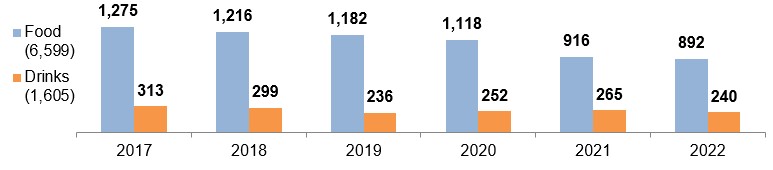
According to Mintel, there were approximately 6,599 new BFY food products launched (including new variety/range extension, packaging, formulation or relaunched) within Mexico between January 2017 and December 2022. These minus food products contained claims such as low/no/reduced (saturated or trans) fat; low/no/reduced calories, cholesterol, sodium, carbs, glycemic; no added sugar or sugar free; diet/light and not pasteurized. During this same period there were 1,605 minus 'BFY' related drink products launched in the Mexican market.
'Better for you' related product launches in Mexico, historical product item count (2017 to 2022)Description of above image
Product
2017
2018
2019
2020
2021
2022
Food (6,599)
1,275
1,216
1,182
1,118
916
892
Drinks (1,605)
313
299
236
252
265
240
Source: Mintel, 2022
Total item count: 8,204
Top sub-categories (brands) within the BFY food category with new product launches in Mexico (2017 to 2022) were sweet biscuits/cookies (Sweetwell), white milk (Lala Deslactosada/Lala 100), corn-based snacks (Doritos Nacho), potato snacks (Sabritas) and flavoured milk (Lala Yomi/Lala 100).
Top brands of 'better for you' food product launches in Mexico, displaying number of products in top sub-categories (2017 to 2021)
Top 10 - Better for you sub-category
Top 50 brands launched (product item count)
Number of products in sub-category
Sweet biscuits / cookies
Sweetwell (20), Don't Worry (18), D'Meals (10), H-E-B Select Ingredients, Okko Super Foods (5), (6), Great Value (3), Granvita (3), I Am(aranth) (2), Sanissimo (1)
411
White milk
Lala - Deslactosada/100 (61), Alpura (26), Sello Rojo (24), Santa Clara (17), Valley Foods (8), Kirkland Signature (6), Great Value (4), Selecto Brand (3), H-E-B Select Ingredients (2), Member's Mark (2), 7-Select (2), Lyncott (2)
312
Corn-based snacks
Doritos Nacho (17), Nopalia (15), I Am(aranth) (5), Sanissimo (4), Nutrisa (4), H-E-B Select Ingredients (2), Hill Country Fare (1), Member's Mark (1), Yema & Co (1)
287
Potato snacks
Sabritas (55), Ruffles (18), 7-Select (14), Selecto Brand (8), H-E-B Select Ingredients (6), Great Value (3), Yema & Co (1), I Am(aranth) (1)
254
Flavoured milk
Lala Yomi/100 (41), Alpura Vaquitas (35), Santa Clara (30), Hershey's (29), Great Value (13), Sello Rojo (8), Alpura (3), Valley Foods (2), 7-Select (2)
252
Bread & bread products
Sanissimo (7), Nopalia (4), Great Value (3), Yema & Co (2), Valley Foods (1)
239
Snack / cereal / energy bars
Kellogg's Special K (15), Sweetwell (6), Don't Worry (6), Kirkland Signature (4), Okko Super Foods (4), Yema & Co. (2), Granvita (1), I Am(aranth) (1)
239
Plant based drinks (dairy alternatives)
Silk (28), AdeS (27), Nature's Heart (17), Kirkland Signature (5), Member's Mark (5), Great Value (4), Valley Foods (4), H-E-B (4), Granvita (3)
217
Cold cereals
Kellogg's Special K (18), Granvita (13), H-E-B Select Ingredients (1), Nature's Heart (1), I Am(aranth) (1), Nutrisa (1)
192
Spoonable yogurt
Chobani (26), H-E-B Select Ingredients (12), Santa Clara (7), Alpura (4), Lyncott (4), Kirkland Signature (2), Lala (1)
181
Total sample size
6,599
Source: Mintel, 2022
Between January 2017 and December 2022, among a sample size of 1,605 new products, top brands launched within the BFY non-alcoholic drink category were Coca-Cola (Sin Azúcar/Light), Tang, Bonafont Kids, V8 Splash and Great Value.
Top brands of 'better for you' drink products launched in Mexico by product item count (2017 to 2022)Description of above image
Coca-Cola (carbonated soft drink): 79
Tang (beverage mix): 56
Bonafont Kids (fruit flavor still drink): 30
V8 Splash (Juice): 21
Great Value (fruit/drink mix/water): 17
Be Light (flavored water): 13
Nestlé Aguitas (flavored water): 12
7UP (carbonated soft drink): 12
Buho (carbonated soft drink): 11
Ciel Exprim (flavored water): 11
Source: Mintel, 2022
Total item count: 1,605
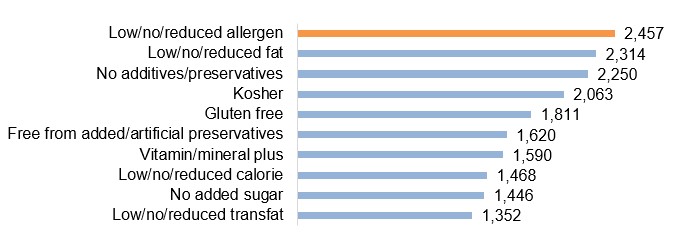
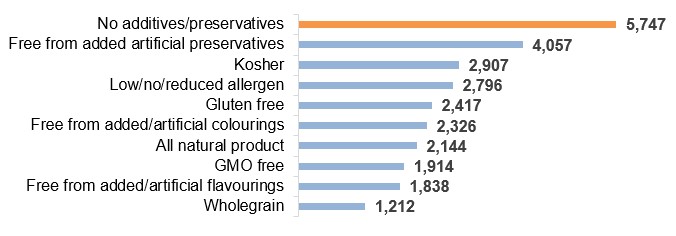
Popular claims associated with BFY food and beverage new product launches over the last six-year period were low/no/reduced allergen or fat, free from or no additives/artificial preservatives, Kosher, gluten free, vitamin/mineral plus, low/no/reduced calorie, no added sugar, and low/no/reduced transfat.
Popular claims for 'better for you' related food and beverage product launches, historical by product item count (2017 to 2022)Description of above image
Low/no/reduced transfat: 1,352
No added sugar: 1,446
Low/no/reduced calorie: 1,468
Vitamin/mineral plus: 1,590
Free from added/artificial preservatives: 1,620
Gluten free: 1,811
Kosher: 2,063
No additives/preservatives: 2,250
Low/no/reduced fat: 2,314
Low/no/reduced allergen: 2,457
Source: Mintel, 2022
Total item count: 8,204
Product examples – better for you
Strawberry Pie Donuts
Source: Mintel, 2022
Company
Yadira Rivera Zapata
Brand
Keto Fitness
Sub-category
Bakery, cake, pastries and sweet goods
Country
Manufactured in Mexico, not imported
Related claims
Low / no / reduced calorie, fat or allergens, diabetic, gluten free, high/added protein
Store type
Mass merchandise / hypermarket, Mexico City 03310
Launch type
New product
Date published
December 2022
Price in US dollars
7.45
This product retails in a 120 gram pack containing two units. Contains excess amounts of saturated fat, and contains sweeteners according to the Mexican Health Secretariat. High in proteins. Baked artisan donut filled with cream cheese and natural strawberry jam. With added protein and monk fruit sweetener. Healthy snack with 11.7 grams of proteins - 4.7 gram of net carbs. Reduced total fat and calories comparing to similar products. Suitable for controlled diabetics and non-coeliac gluten intolerance.
Adobo Hot Flavored Potato Chips
Source: Mintel, 2022
Company
Operadora de Ciudad Juárez
Brand
S-Mart (private label)
Sub-category
Snacks, potato snacks
Country
Manufactured in Canada, market Mexico
Related claims
Gluten free, low / no / reduced transfat and Allergens
Store type
Supermarket
Launch type
New product
Date published
September 2022
Price in US dollars
1.61
This new product retails in a 141.75 gram pack. It is high in calories and sodium, according to the Secretariat of Health for Mexico- Naturally gluten-free - 0% trans fats. Also, available in cheddar and sour cream, sour cream and onion, and classic or wavy original flavoured potato chips.
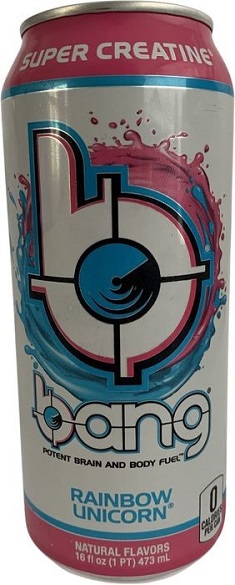
Rainbow Unicorn Flavored Energy Drink
Source: Mintel, 2022
Company
Bang Energy
Brand
Bang
Sub-category
Sports and energy drink, energy drinks
Country
Manufactured in United States, market Mexico
Related claims
No additives / preservatives, low / no / reduced calorie and carb, antioxidant, functional – brain and nervous system / energy, sugar free, free from added / artificial colourings
Store type / location
Specialist retailer Mexico City 03600
Launch type
New product
Date published
December 2022
Price in US dollars
3.36
This new product retails in a 473 millilitres pack. Contains super creatine - Ultra CoQ10- EAA amino acids, natural flavors and stable aqueous amide-protected bioactive creatine species. Powers one up- by the makers of the legendary Redline Energy products. Potent brain and body fuel, with super creatine, caffeine. Zero carbohydrates, sugar, calories and artificial colors.
Fortified / functional – packaged food and beverage categories
When identifying FF products, focus is on products to which health ingredients or/and nutrients have been added, as well as, brands that are positioned to deliver certain functionality. To be included here the enhancement has to be highlighted in the label or hold a health/nutritional claim. FF food and beverages provide health benefits beyond their nutritional value and/or the level of added ingredients wouldn't normally be found in that product and merits inclusion only when the product was actively fortified/enhanced during production. For example healthy products such as 100% fruit/vegetable juices are only added under FF, if additional health ingredients have been added like calcium, omega-3 etc.
Market sizes – fortified / functional
In Mexico, FF packaged food (US$7.7 billion) & drink (US$2.8 billion) products reached a retail sales value of US$10.5 billion in 2021. The largest sales occurred in the FF soft drink category at US$2.6 billion, followed by FF dairy at US$2.3 billion, and FF bread at US$1.6 billion in 2021.
All FF food and drink products registered moderate growth between 2016 and 2021. Categories with the highest CAGRs (between 6-7%) during this period were FF sport drinks, FF bread, FF sweet biscuits, FF snack bars, and FF dairy. FF energy drinks (10%), FF sports drinks (7.9%), and FF milk baby formula (7.9%) are expected to grow the most between the forecast period (2021-2026).
Retail sales of 'fortified / functional' products in Mexico by sub-category, historic fixed 2022 exchange rate, US$ millions
Category
2016
2017
2018
2019
2020
2021
Total - fortified / functional food and drink by type
8,004.5
8,602.8
9,130.5
9,582.7
10,063.4
10,509.2
Fortified / functional - packaged food
5,857.7
6,283.2
6,660.2
6,957.6
7,368.7
7,668.7
Breakfast cereals
629.6
666.7
709.9
741.8
795.3
827.0
Bread
1,215.0
1,306.9
1,390.3
1,447.6
1,627.9
1,633.0
Confectionery
549.5
593.0
634.4
664.7
589.7
636.1
Dairy
1,803.5
1,920.8
2,019.2
2,100.6
2,240.1
2,340.2
Milk baby formula
650.3
694.7
731.2
763.7
795.9
841.9
Prepared baby food
74.1
81.0
86.8
92.1
96.8
103.1
Sweet biscuits
699.5
760.5
809.7
854.0
917.1
966.6
Snack bars
236.0
259.5
278.5
293.2
305.9
320.8
Fortified / functional - beverages
2,146.9
2,319.5
2,470.3
2,625.2
2,694.7
2,840.5
Hot drinks
231.9
242.5
234.7
242.6
250.9
264.6
Fortified / functional - soft drinks
1,915.0
2,077.0
2,235.6
2,382.6
2,443.8
2,575.9
Energy drinks
432.3
444.7
503.0
547.9
524.5
546.8
Sports drinks
437.2
488.3
529.8
566.6
550.4
613.0
Other soft drinks
1,045.5
1,144.0
1,202.9
1,268.2
1,368.9
1,416.1
Source: Euromonitor International, 2022
Retail sales growth (%) of 'fortified / functional' products in Mexico by sub-category, historic
Category
Annual growth % 2021/2020
CAGR* % 2016-2021
Total growth % 2016-2021
Total - fortified / functional food and drink by type
4.4
5.6
31.3
Fortified / functional - packaged food
4.1
5.5
30.9
Breakfast cereals
5.8
5.3
29.5
Bread
6.5
6.8
39.1
Confectionery
4.0
5.6
31.4
Dairy
0.3
6.1
34.4
Milk baby formula
7.9
3.0
15.8
Prepared baby food
4.5
5.3
29.8
Sweet biscuits
5.4
6.7
38.2
Snack bars
4.9
6.3
35.9
Fortified / functional - beverages
5.4
5.8
32.3
Hot drinks
5.5
2.7
14.1
Fortified / functional - soft drinks
5.4
6.1
34.5
Energy drinks
4.3
4.8
26.5
Sports drinks
11.4
7.0
40.2
Other soft drinks
3.4
6.3
35.4
Source: Euromonitor International, 2022
*CAGR: Compound Annual Growth Rate
Retail sales of 'fortified / functional' products in Mexico by sub-category, forecast fixed 2022 exchange rate, US$ millions
Category
2021
2022
2023
2024
2025
2026
Total - fortified / functional food and drink by type
10,509.2
11,115.2
11,722.9
12,360.6
13,052.7
13,795.1
Fortified / functional - packaged food
7,668.7
8,096.3
8,505.9
8,928.5
9,393.5
9,892.1
Breakfast cereals
841.9
890.4
938.4
988.2
1,041.7
1,099.1
Bread
103.1
109.8
116.6
123.9
131.6
140.0
Confectionery
827.0
846.5
867.5
895.7
933.8
979.8
Dairy
1,633.0
1,721.8
1,811.0
1,904.6
2,004.7
2,115.2
Milk baby formula
636.1
694.6
752.0
810.5
869.0
931.2
Prepared baby food
2,340.2
2,461.1
2,563.3
2,662.7
2,779.7
2,898.7
Sweet biscuits
966.6
1,032.2
1,097.1
1,161.9
1,228.9
1,298.4
Snack bars
320.8
339.9
360.0
381.1
404.1
429.6
Fortified / functional - beverages
2,840.5
3,018.8
3,217.0
3,432.0
3,659.2
3,903.0
Hot drinks
264.6
262.7
267.5
272.7
277.7
283.0
Fortified / functional - soft drinks
2,575.9
2,756.2
2,949.5
3,159.4
3,381.5
3,620.0
Energy drinks
546.8
595.1
655.2
728.2
802.2
880.2
Sports drinks
613.0
670.0
724.3
777.3
834.3
895.5
Other soft drinks
1,416.1
1,491.0
1,570.1
1,653.8
1,745.0
1,844.3
Source: Euromonitor International, 2022
Retail sales growth (%) of 'fortified / functional' products in Mexico by sub-category, forecast
Category
Annual growth % 2022/2021
CAGR* % 2021-2026
Total growth % 2021-2026
Total - fortified / functional food and drink by type
5.8
5.6
31.3
Fortified / functional - packaged food
5.6
5.2
29.0
Breakfast cereals
5.8
5.5
30.5
Bread
6.5
6.3
35.8
Confectionery
2.4
3.4
18.5
Dairy
5.4
5.3
29.5
Milk baby formula
9.2
7.9
46.4
Prepared baby food
5.2
4.4
23.9
Sweet biscuits
6.8
6.1
34.3
Snack bars
6.0
6.0
33.9
Fortified / functional - beverages
6.3
6.6
37.4
Hot drinks
−0.7
1.4
7.0
Fortified / functional - soft drinks
7.0
7.0
40.5
Energy drinks
8.8
10.0
61.0
Sports drinks
9.3
7.9
46.1
Other soft drinks
5.3
5.4
30.2
Source: Euromonitor International, 2022
*CAGR: Compound Annual Growth Rate
Competitive landscape – fortified / functional
Leading packaged food companies in Mexico and top brands in the FF category in 2021, include Grupo Bimbo SAB de CV (Bimbo, Marinela, Tía Rosa) at a market share of 30.3% (US$2.3 billion), Nestlé SA (Nido, Nan, Gerber) at 10.7% (US$820.8 million), and The Kellogg Company (Zucaritas, Choco Krispies, Corn Flakes) at 8.8% (US$676.9 million). Private labels accounted for a sales share of 0.9% (US$71.5 million) in 2021.
In 2021, leading FF beverage companies (top brands) in Mexico included The Coca-Cola company (Powerade, Burn, Ciel) at a 15.5% market share (US$441.1 million), followed by Grupo Nutresa SA (Zuko) at 10.8% (US$307.5 million), and Modelez International Inc. (Tang, Clight) at 10.7% (US$303.9 million).
Top 5 companies (associated brands) of 'fortified / functional' products in Mexico, 2021 retail value sales (US$ million) and market share (%) - fixed 2022 exchange rate
Category
Company
Top brand(s)
Retail sales (US$ million)
Market share in 2021
Fortified / functional - packaged food
Grupo Bimbo SAB de CV
Bimbo, Marinela, Tía Rosa, Milpa Real
2,325.0
30.3
Nestlé SA
Nido, Nan, Gerber, Chamyto, Chiquitin
820.8
10.7
Kellogg Company
Zucaritas, Choco Krispies, Corn Flakes
676.9
8.8
Mondelez International Inc.
Trident/Dirol, Clorets, Halls
597.3
7.8
Grupo Lala SAB de CV
Lala, Nutri Leche, Mi Leche
392.8
5.1
Private label
Private label
71.5
0.9
Others
Others
642.8
8.4
Total - market share
7,668.7
100.0
Fortified / functional - beverages
The Coca-Cola Company
Powerade, Burn, Ciel, Gladiator
441.1
15.5
Grupo Nutresa SA
Zuko
307.5
10.8
Mondelez International Inc.
Tang, Clight
303.9
10.7
PepsiCo Inc.
Gatorade, Propel
233.0
8.2
Sociedad Cooperativa Trabajadores de Pascual SCL
Boing
216.9
7.6
Others
Others
235.3
8.3
Total - market share
2,840.5
100.0
Source: Euromonitor, 2022
Product launch analysis – fortified / functional
According to Mintel, there were approximately 5,502 new fortified / functional food products launched (including new variety/range extension, packaging, formulation or relaunched) within Mexico between January 2017 and December 2022. These products contained either fortified (food plus) claims (added calcium, high/added fiber or protein, stanols/sterols, vitamin/mineral fortified) or functional claims (antioxidant, functional: bone health, brain & nervous system, cardiovascular, digestive, energy, eye health, immune system, other; slimming, stress and sleep, weight and muscle gain, high satiety, prebiotic, probiotic).
During this same period there were 1,748 fortified / functional related drink products launched in the Mexican market.
'Fortified / functional' related product launches in Mexico, historical by product item count (2017 to 2022)Description of above image
Product
2017
2018
2019
2020
2021
2022
Food (5,502)
1,046
1,006
986
883
862
719
Drinks (1,748)
294
360
285
218
287
304
Source: Mintel, 2022
Total item count: 7,250
According to new product launches in Mexico (2017 to 2022), top sub-categories (brands) within the FF food category were cold cereals (Kellogg's - Zucaritas/Choco Krispis), white milk (Lala), snack/cereal/ energy bars (Berry Nuts), sweet cookies & biscuits (Garmesa Marias) and pasta (La Moderna).
Top brands of 'fortified / functional' food product launches in Mexico, displaying number of products for top sub-categories (2017 to 2022)
Top 10 - fortified / functional sub-category
Top 50 brands launched (product item count)
Number of products in sub-category
Cold cereals
Kellogg's - Zucaritas (30)/Choco Krispis (30)/Special K (20)/Fruit Loops (15)/All- Bran (9), Great Value (16), Nestlé - Cheerios (18)/Nesquik (14), Quaker (6), Valley Foods (4), H-E-B Select Ingredients (2), Aurrera (1), Okko Super Foods (1)
586
White milk
Lala (47) - Deslactosada (27)/100 (20), Alpura (27), Sello Rojo (27), Santa Clara (25), Nutri (19), Alpura Clásica (17), Great Value (13), Kirkland Signature (7), Aurrera (6), Valley Foods (10), Hill Country Fare (2), Nestlé Carnation Clavel (2), H-E-B Select Ingredients (2), Chedraui (2)
507
Snack/cereal/energy bars
Berry Nuts (18), Kellogg's - Special K (12)/All-Bran (5)/Fruit Loops (4)/Choco Krispis (1), Okko Super Foods (4), Quaker (3), Kirkland Signature (3), Great Value (2), Valley Foods (1)
400
Sweet cookies and biscuits
Gamesa Marias (19), Quaker (5), Mister Gourmet (2), Okko Super Foods (2), Kellogg's - Zucaritas (2)/Choco Krispis (1)/Fruit Loops (1), La Moderna (1), Great Value (1)
310
Pasta
La Moderna (76), Kellogg's - Choco Krispis (33), Yemina (32), S-Mart (17), Aurrera (15), H-E-B Select Ingredients (10), Chedraui (9), Valley Foods (2)
308
Flavored milk
Santa Clara (30), Great Value (13), Nestlé Nesquik (9), Sello Rojo (8), Kellogg's - All-Bran (5), Lala 100 (3), Alpura (3), Aurrera (2), Danonino (2), Valley Foods (2), Chedraui (1), Kirkland Signature (1)
283
Plant based drinks
AdeS (41), Silk (24), Nature's Heart (16), Valley Foods (4), Kirkland Signature (4), Great Value (3)
227
Liquid yogurt/cultured milk
Danone Danonino (20), Santa Clara (16), Hill Country Fare (10), Sello Rojo (2), Lala 100 (2), Chobani (1)
193
Fruit snacks
Mister Gourmet (6), Okko Super Foods (5), Great Value (3),
159
Bread and bread products
Bimbo (20), Nopalia (4), Hill Country Fare (3), H-E-B Select Ingredients (2), Great Value (1)
157
Total sample size
5,502
Source: Mintel, 2022
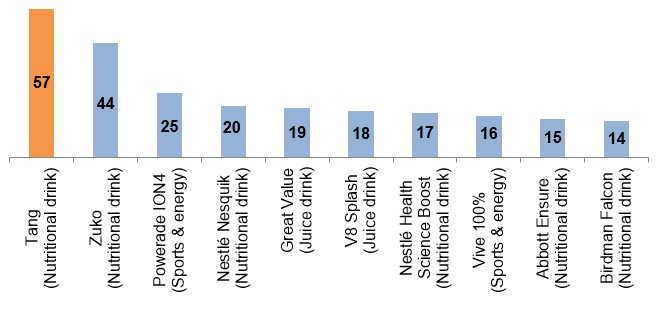
Between January 2017 and December 2022, among a sample size of 1,748 new products, top brands launched within the FF non-alcoholic drink category were Tang (Sin Azúcar/Light), Zuko, Powerade ION4, Nestlé Nesquick, and Great Value.
Top brands of 'fortified / functional' drink products launched in Mexico by product item count (January 2017 to December 2022)Description of above image
Tang (Nutritional drink): 57
Zuko (Nutritional drink): 44
Powerade ION4 (Sports and energy: 25
Nestlé Nesquik (Nutritional drink): 20
Great Value (Juice drink): 19
V8 Splash (Juice drink): 18
Nestlé Health Science Boost (Nutritional drink): 17
Vive 100% (Sports and energy): 16
Abbott Ensure (Nutritional drink): 15
Birdman Falcon (Nutritional drink): 14
Source: Mintel, 2022
Total item count: 1,748
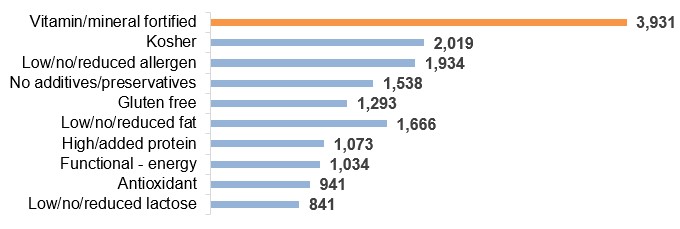
Popular claims associated with FF food and beverage new product launches over the last six-year period were vitamin/mineral fortified, Kosher, low/no/reduced allergen/fat/lactose, no additives/preservatives, gluten free, high/added protein, functional - energy, and antioxidant.
Popular claims for 'fortified / functional' related food and beverage product launches, historical product item count (2017 to 2022)Description of above image
Vitamin/mineral fortified: 3,931
Kosher: 2,019
Low/no/reduced allergen: 1,934
No additives/preservatives: 1,538
Gluten free: 1,293
Low/no/reduced fat: 1,666
High/added protein: 1,073
Functional - energy: 1,034
Antioxidant: 941
Low/no/reduced lactose: 841
Source: Mintel, 2022
Total item count: 7,250
Product examples – fortified / functional
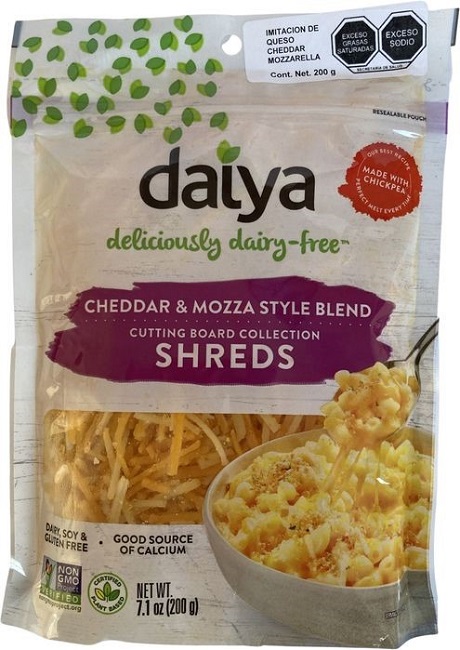
Cheddar & Mozza Style Blend
Source: Mintel, 2022
Company / brand
Daiya Foods
Importer
Tiendas Soriana
Sub-category
Dairy, processed cheese
Country
Manufactured in Canada, market Mexico
Related claims
Added calcium, Kosher, vitamin/mineral fortified, Halal, gluten free, low/no/reduced allergen, vegan/no animal ingredients, GMO and dairy free, plant based
Store name / type
Mega Soriana, mass merchandise/hypermarket, Mexico City 01090
Launch type
New variety / range extension
Date published
November 2022
Price in US dollars
7.12
This product is now available, and retails in a 200 gram pack. Deliciously dairy-free. Cutting board collection shreds, made with chickpea. Free from soy, gluten, GMO and peanuts. Good source of calcium. Plant based. Contains excess amounts of saturated fats and sodium, according to the Secretariat of Health of Mexico. Resealable pouch and is a freezable, Vegan product. Logos and certifications: Certified plant based, certified gluten free, non-GMO; Project verified: Halal, Kosher.
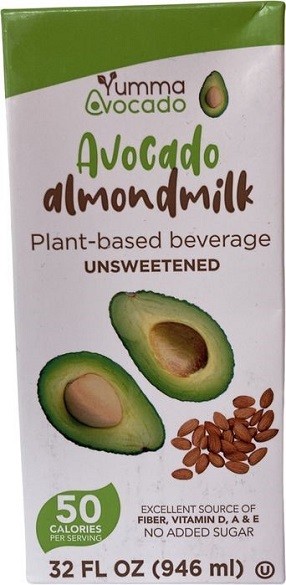
Avocado Almond Milk
Source: Mintel, 2022
Company / brand
Yumma Foods/Yumma Avocado
Importer
Distribuidora Yaxche
Sub-category
Dairy, plant based drinks (dairy alternatives)
Country
Manufactured in Canada, market Mexico
Related claims
High/added fibre, vegetarian, premium, vitamin/ Mineral fortified, gluten free, low/no/reduced allergen, dairy free, no added sugar, plant based
Store name / type
La Comer, supermarket, Mexico City 03900
Launch type
New product
Date published
June 2022
Price in US dollars
4.96
This unsweetened plant-based beverage is made with premium Hass avocados, is an excellent source of fibre, and vitamins D, A and E, and contains 50 calories per serving. It is kosher-certified, vegetarian and free from added sugar, dairy, gluten and soy. This product retails in a recyclable 946 millilitre pack, bearing the FSC Mix logo.
Free from – packaged food and beverage categories
The free from category includes product claims such as free from gluten, lactose, allergens, dairy and free from meat. This excludes foods which are certified 'free' of a specific product, when this is based on use of sterilised equipment.
Market sizes – Free from
The free from market has became more popular in Mexico, which grew at a CAGR of 13.1% (2016-2021) with a packaged food retail sales value of US$1.3 billion in 2021. The largest category in the free from food sector was within the free from lactose category with sales at US$845.5 million, consisting of sub-categories such as 'free from lactose - dairy' (US$735.8 million) and the 'free from lactose - baby food' (US$109.6 million).
There were no free from drink products reported in Euromonitor within the Mexican market. The free from allergens - HA milk formula category had the highest historical growth at a CAGR of 16.2% (2016-2021) and is expected to continue to grow the most at a CAGR of 11.5% (2021-2026).
Retail sales of 'free from' products in Mexico by sub-category, historic fixed 2022 exchange rate, US$ millions
Category
2016
2017
2018
2019
2020
2021
Total - 'free from' packaged food by type
705.9
821.1
939.4
1,060.6
1,227.6
1,303.9
Free from allergens - HA milk formula
84.7
102.0
119.8
138.7
158.1
179.8
Free from dairy - milk
148.6
169.5
189.7
211.6
244.8
278.6
Free from lactose
472.5
549.5
629.8
710.3
824.6
845.5
Baby food
72.2
80.5
87.7
94.9
101.7
109.6
Dairy
400.4
469.0
542.1
615.4
723.0
735.8
Source: Euromonitor International, 2022
Retail sales growth (%) of 'free from' products in Mexico by sub-category, historic
Category
Annual growth % 2021/2020
CAGR* % 2016-2021
Total growth % 2016-2021
Total - 'free from' packaged food by type
6.2
13.1
84.7
Free from allergens - HA milk formula
13.7
16.2
112.3
Free from dairy - milk
13.8
13.4
87.5
Free from lactose
2.5
12.3
78.9
Baby food
7.8
8.7
51.8
Dairy
1.8
12.9
83.8
Source: Euromonitor International, 2022
*CAGR: Compound Annual Growth Rate
Retail sales of 'free from' products in Mexico by sub-category, forecast fixed 2022 exchange rate, US$ millions
Category
2021
2022
2023
2024
2025
2026
Total - 'free from' packaged food by type
1,303.9
1,421.6
1,559.0
1,711.1
1,883.0
2,074.4
Free from allergens - HA milk formula
179.8
203.4
228.0
253.8
281.4
310.5
Free from dairy - milk
278.6
313.1
348.9
387.4
429.7
476.7
Free from lactose
845.5
905.1
982.1
1,069.9
1,172.0
1,287.1
Baby food
109.6
118.6
128.0
138.3
149.5
162.1
Dairy
735.8
786.5
854.1
931.6
1,022.5
1,125.0
Source: Euromonitor International, 2022
Retail sales growth (%) of 'free from' products in Mexico by sub-category, forecast
Category
Annual growth % 2022/2021
CAGR* % 2021-2026
Total growth % 2021-2026
Total - 'free from' packaged food by type
9.0
9.7
59.1
Free from allergens - HA milk formula
13.1
11.5
72.7
Free from dairy - milk
12.4
11.3
71.1
Free from lactose
7.0
8.8
52.2
Baby food
8.2
8.1
47.9
Dairy
6.9
8.9
52.9
Source: Euromonitor International, 2022
*CAGR: Compound Annual Growth Rate
Competitive landscape – free from
Leading packaged food companies (top brands) in Mexico in the 'free from' category in 2021, include Grupo Lala SAB de CV (Lala, Vita Lala, Borden) at a market share of 19.7% (US$257.0 million), Ganaderos Productores de Leche Pura SA de CV (Alpura) at 17.2% (US$224.3 million), and Nestlé SA (Nido, Nan, Nestlé) at 12.4% (US$162.0 million).
Top 5 companies (associated brands) of 'free from' packaged food products in Mexico, 2021 retail value sales (US$ million) and market share (%) - fixed 2022 exchange rate
Company
Brand(s)
Retail sales (US$ million)
Market share in 2021
Grupo Lala SAB de CV
Lala, Vita Lala, Borden, Boulder
257.0
19.7
Ganaderos Productores de Leche Pura SA de CV
Alpura
224.3
17.2
Nestlé SA
Nido, Nan, Nestlé, Nursoy, SMA
162.0
12.4
The Coca-Cola Company
Ades, Santa Clara, Del Valle
107.6
8.3
Groupe Danone
Silk, Aptamil
94.0
7.2
Others
Others
290.2
22.3
Total - market share
1,303.9
100.0
Source: Euromonitor, 2022
Product launch analysis – free from
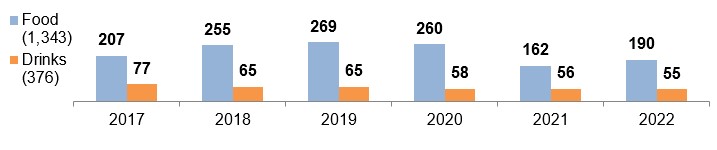
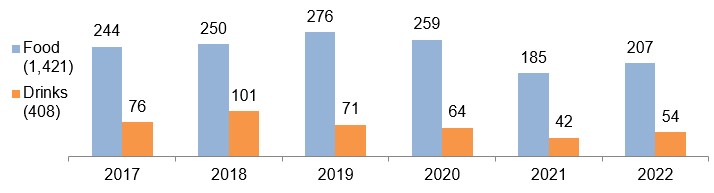
According to Mintel, there were approximately 1,343 new free from food products launched (including new variety/range extension, packaging, formulation or relaunched), within Mexico between January 2017 and December 2022. These products contained free from ingredient claims such as caffeine, dairy, hormone or palm oil free. During this same period, there were 376 free from drink products launched.
'Free from'related product launches in Mexico, historical by product item count (2017 to 2022)Description of above image
Product
2017
2018
2019
2020
2021
2022
Food (1,343)
207
255
269
260
162
190
Drinks (376)
77
65
65
58
56
55
Source: Mintel, 2022
Total item count: 1,719
According to new product launches in Mexico (2017 to 2022), top sub-categories (brands) within the free from food category were poultry products (Pilgrim's), white milk (Lala - Deslactosada/Light/100/Orgánica), sweet biscuits/cookies (Sweetwell), snack/cereal/energy bars (Nature's Bakery) and plant based drinks or dairy alternatives (Nature's Heart).
Top brands of 'free from' food product launches in Mexico, displaying number of products top sub-categories (2017 to 2022)
Top 10 - free from sub-category
Top 50 brands launched (product item count)
Number of products in sub-category
Poultry products
Pilgrim's (52), Tyson (52), Bachoco (22) - Prácticos (7), Del Día Empanizados (7), Aires de Campo (6), Lala Plenia (5), Verdes Motivos (4), H-E-B Select Ingredients (2)
237
White milk
Lala (33) - Deslactosada (27) / Light (12) / 100 (10) / Orgánica (5), Kirkland Signature (4), Aires de Campo (4), Valley Foods (4), H-E-B Select Ingredients (2)
120
Sweet biscuits/ cookies
Sweetwell (18), Lenny & Larry's The Complete Cookie (10), Gaveti (5), AngelFood2 (5), I Am(aranth) (2), H-E-B Select Ingredients (2)
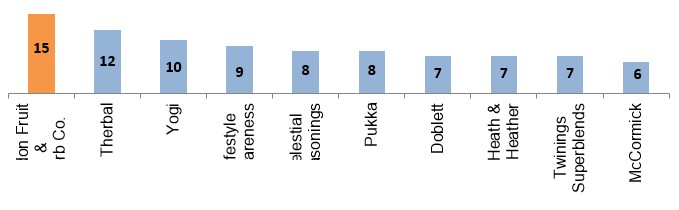
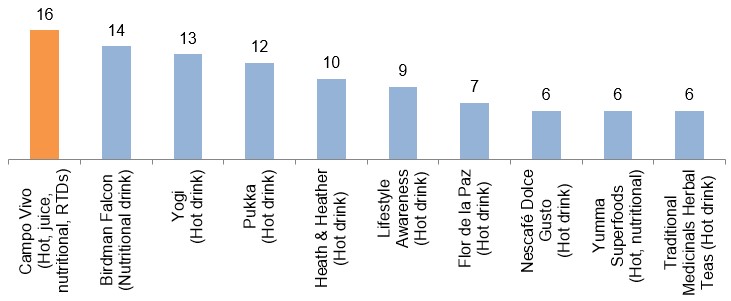
Between January 2017 and December 2022, among a sample size of 376 new free from hot beverage products, top brands launched within the free from non-alcoholic drink category were The London Fruit & Herb Company, Therbal, Yogi, Lifestyle Awareness, and Celestial Seasonings.
Top brands of 'free from' hot beverage products launched in Mexico by product item count (2017 to 2022)Description of above image
London Fruit and Herb Co.: 15
Therbal: 12
Yogi: 10
Lifestyle Awareness: 9
Celestial Seasonings: 8
Pukka: 8
Doblett: 7
Heath and Heather: 7
Twinings Superblends: 7
McCormick: 6
Source: Mintel, 2022
Total item count: 376
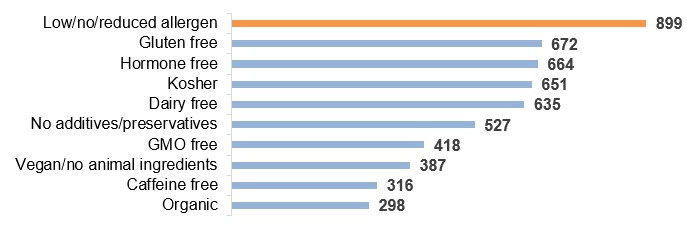
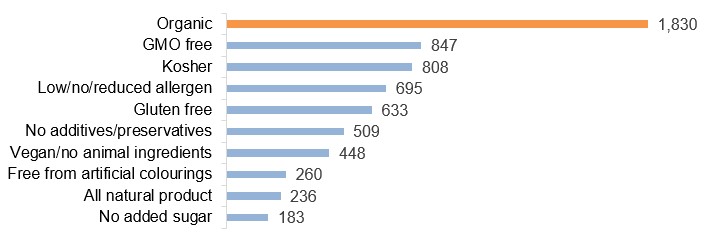
Popular claims associated with 'food minus' food & beverage new product launches over the last six-year period were low/no/reduced allergen, gluten free, hormone free, Kosher, dairy free, no additives/ preservatives, GMO free, vegan/no animal ingredients, caffeine free, and organic.
Popular claims for 'free from' related - food and beverage product launches, historical by product item count (2017 to 2022)Description of above image
Low/no/reduced allergen: 899
Gluten free: 672
Hormone free: 664
Kosher: 651
Dairy free: 635
No additives/preservatives: 527
GMO free: 418
Vegan/no animal ingredients: 387
Caffeine free: 316
Organic: 298
Source: Mintel, 2022
Total item count: 1,719
Product examples – free from
Gluten Free Meatless Pepperoni Style Pizza
Source: Mintel, 2022
Company
Daiya Foods
Brand
Daiya
Sub-category
Meals and meal centers, pizzas
Country
Manufactured in Canada, market Mexico
Related claims
High / added fibre, Premium, gluten free, low / no / reduced allergen, vegan / no animal ingredients, GMO free, dairy free, plant based
Store name / type
Soriana, mass merchandise/hypermarket, Puebla 72020
Launch type
New formulation
Date published
April 2022
Price in US dollars
11.99
This product has been reformulated with and a new and improved recipe featuring premium cutting board cheeze shreds. This plant based product is made with gourmet ingredients, and is free from GMOs, dairy, gluten and soy. This vegan pizza is a good source of fiber, and contains saturated fat and sodium excess according to the Mexican Health Secretary. It retails in a recyclable 16.7 ounce pack featuring baking instructions.
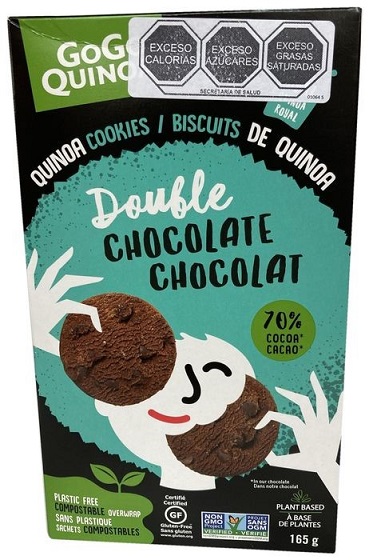
Double Chocolate Quinoa Cookies
Source: Mintel, 2022
Company / importer
Cie 2 Ameriks/Tiendas Soriana
Brand
GoGo Quinoa
Sub-category
Bakery, sweet biscuits/cookies
Country
Manufactured in Canada, market Mexico
Related claims
High / added fibre, Kosher, gluten free low / no / reduced allergen, high / added protein, GMO free, dairy free, plant based
Store name / type
Soriana Mega, supermarket, Mexico City 03730
Launch type
New packaging
Date published
August 2021
Price in US dollars
8.91
This product has been repackaged with an updated design. These plant-based cookies, according to the Secretariat of Health for Mexico, are high in calories, sugars and saturated fats. They have been made using 70% cocoa, and comprise of natural ingredients, including: royal quinoa flour, which has been harvested in the Bolivian highlands; chia seeds, which are rich in protein and fiber; and kiwicha, a small crunchy seed with a full-bodied nuttiness. These cookies are free from eggs, milk, corn, soy, nuts and peanuts, have been kosher certified and made using RSPO certified palm oil. They retail in a recyclable 165 gram pack, itself made from 100% recycled fibres and features the Certified Gluten-Free and Non GMO Project Verified logos. The pack also features a plastic-free and compostable overwrap in accordance with the manufacturer's aim to reduce plastic consumption by 2021. Also, available in chocolate chip variety.
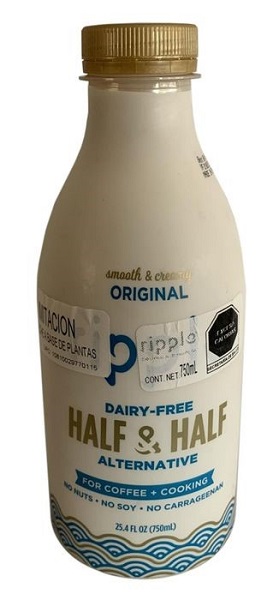
Dairy-Free Half & Half Alternative
Source: Mintel, 2022
Company / importer
Ripple Foods/RD Amerimex
Brand
Ripple
Sub-category
Dairy, creamers
Country
Manufactured in Canada, market Mexico
Related claims
Low / no / reduced: cholesterol, allergen, lactose, and saturated fat, Kosher, gluten free, vegan / no animal ingredients, GMO free, dairy free, plant based
Store name / type
Soriana Mega, supermarket, Mexico City 03730
Launch type
New variety / range extension
Date published
March 2022
Price in US dollars
6.16
The original, plant-based product is said to be smooth and creamy, and contains no nuts, GMO, gluten, lactose, soy or carrageenan, saturated fat or cholesterol. It can be used for coffee or cooking, is claimed to be nutritious and delicious, and is made with 100% vegan pea protein. This kosher-certified product retails in a recyclable 750 millilitre pack, bearing the Certified B Corporation logo, and an excess of calories warning by the Mexican Health Secretariat.
Naturally healthy – packaged food and beverage categories
The NH category includes food and beverages on the basis of naturally containing a substance that improves health and wellbeing beyond the product's pure calorific value and are usually a healthier alternative within a certain sector/subsector. Examples include high fibre food (wholegrain/wholemeal/ brown) soy products, sour milk drinks, nuts, seeds and trail mixes, honey, fruit & nut bars, and olive oil; along with NH beverages such as 100% fruit/vegetable juice, superfruit juice, natural mineral/spring water, RTD green tea etc. Noting that NH food and beverages that are additionally fortified fall into the FF category.
Market sizes: naturally healthy
In Mexico, NH packaged food (US$1.2 billion) and NH drink (US$1.1 billion) products reached a retail sales value of US$2.3 billion in 2021. The largest sales occurred in the NH soft drink category such as bottled water and fruit/vegetable juices at US$975.5 million, followed by staples like NH nuts, seeds & trail mixes at US$558.1 million, NH - high fibre breakfast cereals at US$190.7 million, NH olive oil at US$137.7 million, and NH honey at US$127.1 million in 2021.
The NH segment benefited from the ongoing shift towards a more holistic and preventative approach to health & wellness, which is highly related with rising consumer concerns about the long-term consumption of artificial additives and an interest in natural ingredients.Footnote 2 All NH food and drink products registered moderate growth between 2016 and 2021 at a total CAGR of 7.4%. Categories with the highest growth during this period were NH rice (11.4%), NH - high fibre pasta (9.5%), NH hot tea drinks (9.3%), NH fruit snacks (9%), and NH honey (9%). NH cereal bars (12.9%), NH olive oil (9.4%), and NH rice (9.2%) products are expected to grow the most over the forecast period (2021-2026).
Retail sales of 'naturally healthy' products in Mexico by sub-category, historic fixed 2021 exchange rate, US$ millions
Category
2016
2017
2018
2019
2020
2021
Total - Naturally healthy food and drink by type
1,608.3
1,777.4
1,915.0
2,053.1
2,186.8
2,298.7
Naturally healthy - packaged food
833.0
926.2
1,003.8
1,077.8
1,148.8
1,212.1
Cereal bars
61.9
68.9
74.6
81.5
80.9
82.8
Fruit snacks
24.4
27.5
30.6
33.3
35.3
37.6
Honey
82.6
96.8
102.4
110.2
121.4
127.1
Nuts, seeds and trail mixes
378.2
423.3
463.9
500.9
529.5
558.1
Olive oil
92.1
102.0
109.2
115.1
126.8
137.7
Rice
4.2
4.7
5.4
5.9
6.5
7.2
Naturally healthy - high fibre packaged food
189.6
202.9
217.8
230.9
248.3
261.6
Breakfast cereals
135.9
147.1
158.0
168.0
181.5
190.7
Pasta
9.7
10.8
11.9
12.7
14.0
15.3
Sweet biscuits
44.0
45.0
48.0
50.2
52.8
55.5
Naturally healthy - beverages
775.3
851.2
911.2
975.3
1,038.0
1,086.5
Naturally healthy - hot drinks
77.8
84.0
91.4
95.6
104.0
111.1
Tea
46.5
50.6
55.8
59.2
66.7
72.4
Other hot drinks
31.4
33.4
35.6
36.4
37.3
38.7
Naturally healthy - soft drinks
697.4
767.3
819.8
879.6
934.0
975.5
Bottled water
312.7
339.8
364.5
388.2
416.8
425.5
Fruit/vegetable juice
384.7
427.5
455.3
491.4
517.2
549.9
Source: Euromonitor International, 2022
Retail sales growth (%) of 'naturally healthy' products in Mexico by sub-category, historic
Category
Annual growth % 2021/2020
CAGR* % 2016-2021
Total growth % 2016-2021
Total - Naturally healthy food and drink by type
5.1
7.4
42.9
Naturally healthy - packaged food
5.5
7.8
45.5
Cereal bars
2.3
6.0
33.8
Fruit snacks
6.5
9.0
54.1
Honey
4.7
9.0
53.9
Nuts, seeds and trail mixes
5.4
8.1
47.6
Olive oil
8.6
8.4
49.5
Rice
10.8
11.4
71.4
Naturally healthy - high fibre packaged food
5.4
6.6
38.0
Breakfast cereals
5.1
7.0
40.3
Pasta
9.3
9.5
57.7
Sweet biscuits
5.1
4.8
26.1
Naturally healthy - beverages
4.7
7.0
40.1
Naturally healthy - hot drinks
6.8
7.4
42.8
Tea
8.5
9.3
55.7
Other hot drinks
3.8
4.3
23.2
Naturally healthy - soft drinks
4.4
6.9
39.9
Bottled water
2.1
6.4
36.1
Fruit/vegetable juice
6.3
7.4
42.9
Source: Euromonitor International, 2022
*CAGR: Compound Annual Growth Rate
Retail sales of 'naturally healthy' products in Mexico by sub-category, forecast fixed 2021 exchange rate, US$ millions
Category
2021
2022
2023
2024
2025
2026
Total - Naturally healthy food and drink by type
2,298.7
2,475.0
2,667.8
2,877.7
3,108.8
3,361.0
Naturally healthy - packaged food
1,212.1
1,312.4
1,422.6
1,542.5
1,675.3
1,820.6
Cereal bars
82.8
93.8
106.4
120.3
135.5
151.8
Fruit snacks
37.6
41.3
45.0
48.6
52.7
57.3
Honey
127.1
134.2
143.3
154.1
166.6
180.5
Nuts, seeds and trail mixes
558.1
607.8
661.1
718.1
780.7
848.9
Olive oil
137.7
150.3
164.3
179.7
196.9
216.0
Rice
7.2
8.0
8.7
9.5
10.3
11.2
Naturally healthy - high fibre packaged food
261.6
277.1
293.8
312.2
332.5
354.9
Breakfast cereals
190.7
200.9
212.2
224.6
238.4
253.5
Pasta
15.3
16.7
18.2
19.8
21.6
23.7
Sweet biscuits
55.5
59.4
63.4
67.8
72.5
77.8
Naturally healthy - beverages
1,086.5
1,162.5
1,245.2
1,335.2
1,433.5
1,540.4
Naturally healthy - hot drinks
111.1
118.9
127.8
137.2
147.4
158.6
Tea
72.4
77.5
83.8
90.6
98.1
106.7
Other hot drinks
38.7
41.4
44.0
46.6
49.3
51.9
Naturally healthy - soft drinks
975.5
1,043.6
1,117.4
1,198.0
1,286.1
1,381.8
Bottled water
425.5
453.6
483.1
514.2
546.5
580.2
Fruit/vegetable juice
549.9
590.0
634.4
683.8
739.7
801.6
Source: Euromonitor International, 2022
Retail sales growth (%) of 'naturally healthy' products in Mexico by sub-category, forecast
Category
Annual growth % 2022/2021
CAGR* % 2021-2026
Total growth % 2021-2026
Total - NH food and drink by type
7.7
7.9
46.2
Naturally healthy - packaged food
8.3
8.5
50.2
Cereal bars
13.3
12.9
83.3
Fruit snacks
9.8
8.8
52.4
Honey
5.6
7.3
42.0
Nuts, seeds and trail mixes
8.9
8.7
52.1
Olive oil
9.2
9.4
56.9
Rice
11.1
9.2
55.6
Naturally healthy - high fibre packaged food
5.9
6.3
35.7
Breakfast cereals
5.3
5.9
32.9
Pasta
9.2
9.1
54.9
Sweet biscuits
7.0
7.0
40.2
Naturally healthy - beverages
7.0
7.2
41.8
Naturally healthy - hot drinks
7.0
7.4
42.8
Tea
7.0
8.1
47.4
Other hot drinks
7.0
6.0
34.1
Naturally healthy - soft drinks
7.0
7.2
41.7
Bottled water
6.6
6.4
36.4
Fruit/vegetable juice
7.3
7.8
45.8
Source: Euromonitor International, 2022
*CAGR: Compound Annual Growth Rate
Competitive landscape – naturally healthy
Leading packaged food companies (top brands) in Mexico in the NH category in 2021, include PepsiCo Inc. (Lay's, Barras - Quaker, Mafer) at a market share of 33.1% (US$401.0 million), Grupo Bimbo SAB de CV (Barcel, Hot Nuts) at 12.6% (US$153.0 million), and Deoleo SA (Carbonell, Carapelli, Arroz SOS) at 4% (US$48.1 million). Private labels accounted for a sales share of 15.9% (US$192.7 million) in sales value in 2021.
In 2021, leading NH beverage companies (top brands) in Mexico included Nestlé SA (Santa María, S Pellegrino) at a 16.8% market share (US$182.1 million), followed by Grupo Jumex SA de CV (Jumex, Bida) at 15.1% (US$164.0 million), and Keurig Dr Pepper Inc. (Peñafiel, Aguafiel) at 12.7% (US$138.5 million). Private label NH beverages represented 0.3% (US$3.3 million) in sales in Mexico over the year.
Top 5 companies (associated brands) of 'naturally healthy' products in Mexico, 2021 retail value sales (US$ million) and market share (%) - fixed 2021 exchange rate
Category
Company
Top brand(s)
Retail sales (US$ million)
Market share in 2021
Natually healthy - packaged food
PepsiCo Inc.
Lay's, Barras - Quaker, Mafer, Sunchips
401.0
33.1
Grupo Bimbo SAB de CV
Barcel, Hot Nuts
153.0
12.6
Deoleo SA
Carbonell, Carapelli, Arroz SOS
48.1
4.0
General Mills Inc.
Nature Valley, Fiber One
34.5
2.8
Grupo Industrial Vida SA de CV
Granvita, Cashitas, Granola Muesli
31.4
2.6
Others
Others
56.3
4.6
Private label
Private label
192.7
15.9
Total - market share
1,212.1
100.0
Natually healthy -beverages
Nestlé SA
Santa María, S Pellegrino
182.1
16.8
Grupo Jumex SA de CV
Jumex, Bida
164.0
15.1
Keurig Dr Pepper Inc.
Peñafiel, Aguafiel
138.5
12.7
The Coca-Cola Company
Del Valle
92.5
8.5
Groupe Danone
Evian
82.8
7.6
Private label
Private label
3.3
0.3
Others
Others
218.9
20.1
Total - market share
1,086.5
100.0
Source: Euromonitor, 2022
Product launch analysis – naturally healthy
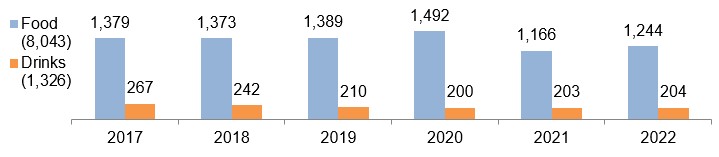
According to Mintel, there were approximately 8,043 new natural food products launched (including new variety/range extension, packaging, formulation or relaunched), within Mexico between January 2017 and December 2022. These claims were either an 'all natural', GMO free, no artificial additives (colourings, flavourings) and preservatives, organic or wholegrain products.
During this same period there were 1,326 naturally healthy related drink products launched.
'Naturally healthy' related product launches in Mexico, historical product item count (2017 to 2022)Description of above image
Product
2017
2018
2019
2020
2021
2022
Food (8,043)
1,379
1,373
1,389
1,492
1,166
1,244
Drinks (1,326)
267
242
210
200
203
204
Source: Mintel, 2022
Total item count: 9,369
According to new product launches in Mexico (2017 to 2022), top sub-categories (brands) within the NH food category were cold cereals (Nestlé Cheerios), both sweet biscuits/cookies and snack/cereal/energy bars (Quaker), vegetables (La Costeña), and seasonings (Esquina González).
Top brands of 'naturally healthy' food products launched in Mexico by product item count (2017 to 2022)
Top 10 - Naturally healthy sub-category
Top 50 brands launched (product item count)
Number of products in sub-category
Cold cereals
Nestlé Cheerios (18), Granvita (14), Bob's Red Mill (9), Eat Natural Lima Limón (9), Tía Ofilia (8), Quaker (6), H-E-B Select Ingredients (2), Aires de Campo (2), Valley Foods (2), Yema & Co. (1), I Am(aranth) (1)
473
Sweet biscuit/cookies
Quaker (15), Don't Worry (11), H-E-B (5) - Select Ingredients (3)/Organics (1), Okko Super Foods (4), I Am(aranth) (3), Kirkland Signature (2), Great Value (2), Granvita (2), Yema & Co. (1)
405
Snack/cereal/energy bars
Quaker (8), Kirkland Signature (7), Eat Natural Lima Limón (7), Okko SuperFoods (6), Don't Worry (6), Bob's Red Mill (5), Granvita (4), Valley foods (3), Great Value (2), Yema & Co. (2), Aires de Campo (1), I Am(aranth) (1)
365
Vegetables
La Costeña (19), La Huerta (18), Herdez (16), Del Monte (13), Great Value (11), Global Premier (8), Isadora (5), Kirkland Signature (4), Member's Mark (4), La Sierra (4), Valley Foods (3), Eat Natural Lima Limón (3), Chata (1), Yema & Co. (1)
295
Seasonings
Esquina González (28), Intalmesa (11), H-E-B - Select Ingredients (4)/Organics (1), Valley Foods (4), Yema & Co. (3), Knorr (1), Member's Mark (1), Aires de Camp (1)
289
Baking Ingredients
Morama (12), Bob's red Mill (11), Tía Ofilia (6), Granvita (5), H-E-B - Organics (5)/Select Ingredients (1), Aires de Campo (2), Yema & Co. (2), Esquina González (2), Okko Super Foods (2), Intalmesa (2), Great Value (1), Quaker (1)
276
Bread and bread products
Nopalia (4), H-E-B Select Ingredients (2), Great Value (2), Yema & Co. (2), Valley Foods (2), Member's Mark (1)
249
Fruit snacks
Nochiola (9), H-E-B Organics (5), Okko Super Foods (4), Intalmesa (2), Kirkland Signature (1), Member's Mark (1), Yema & Co. (1), Valley Foods (1)
247
Meat products
Chata (27), Kirkland Signature (5), H-E-B (6) - Select Ingredients (1), Aires de Campo (1), Herdez (1)
228
Fish products
Marina Azul (25), Atún Dolores (21), Member's Mark (11), Herdez (5), Kirkland Signature (4), Great Value (2), Chata (1) Valley Foods (1)
212
Total sample size
8,043
Source: Mintel, 2022
Between January 2017 and December 2022, among a sample size of 1,326 new products, top brands launched within the NH drink category were Jumex, Bonafont Kids, Del Valle, Therbal, and Campo Vivo.
Top brands of 'naturally healthy' beverage product launches in Mexico, displaying number of products in top sub-categories (2017 to 2022)Description of above image
Jumex (Juice drink): 72
Bonafont Kids (Juice drink): 31
Del Valle (Juice drink): 21
Therbal (Hot beverage): 16
Campo Vivo (Nutritional /hot / juice / ready-to-drink): 16
Birdman Falcon (Nutritional): 14
Yogi (Hot beverage): 14
Ocean Spray (Juice drink): 13
Pukka (Hot beverage): 12
Búho (Carbonated, RTDs): 12
Source: Mintel, 2022
Total item count: 1,326
Popular claims associated with NH food & beverage new product launches over the last six-year period were no additives/preservatives, free from added artificial preservatives/colourings/flavourings, Kosher, low/no/reduced allergen, gluten free, all natural product, GMO free, and wholegrain.
Popular claims for 'naturally healthy' related food and beverage product launches, historical by product item count (2017 to 2022)Description of above image
No additives/preservatives: 5,747
Free from added artificial preservatives: 4,057
Kosher: 2,907
Low/no/reduced allergen: 2,796
Gluten free: 2,417
Free from added/artificial colourings: 2,326
All natural product: 2,144
GMO free: 1,914
Free from added/artificial flavourings: 1,838
Wholegrain: 1,212
Source: Mintel, 2022
Total item count: 9,369
Product examples – naturally healthy
Tzatziki and Dill Dip
Source: Mintel, 2022
Company / importer
Skotidakis Goat Farm/Primex
Brand
Skotidakis
Sub-category
Savoury spreads, dips
Country
Manufactured in Canada, market Mexico
Related claims
All natural product, Kosher
Store name / type
Costco, club store, Mexico City 01180
Launch type
New packaging
Date published
January 2022
Price in US dollars
7.51
This product has been repackaged with an updated design. This kosher certified product is described both a dip and dressing and, according to the Secretariat of Health for Mexico, is high in saturated fats. It has been made using all natural ingredients and retails in a 681 gram pack.
Total Oat
Source: Mintel, 2022
Company
Tiendas Tres B
Brand
Quick (private label)
Sub-category
Breakfast cereals, hot cereals
Country
Manufactured in Canada, market Mexico
Related claims
All natural product, wholegrain
Store name / type
Tiendas 3B, mass merchandise / hypermarket, Mexico City 03020
Launch type
New packaging
Date published
February 2022
Price in US dollars
0.58
This product has been repackaged and now retails in a newly designed 400 gram pack featuring preparation instructions. The product is a source of fiber, is described as 100% natural wholegrain oat flakes, and contains no seals or legends, according to the Secretariat of Health of Mexico.
Blueberry Herbal Tea
Source: Mintel, 2022
Company / importer
Trans-Herb/Fertre
Brand
La Cour Tisane
Sub-category
Hot beverages, tea
Country
Manufactured in Canada, market Mexico
Related claims
All natural product, Kosher, toxins free
Store name / type
City Market, supermarket, Cuernavaca 62290
Launch type
New variety / range extension
Date published
October 2022
Price in US dollars
4.43
This product retails in a 34 gram pack containing 20 1.7 gram units within freshness sealed tea bags. 100% natural herbal tea. Non-chlorine bleached white filter paper. Can be enjoyed hot or iced. Pack bearing usage directions. Logos and certifications: Kosher.
Organic – packaged food and beverage categories
Organic products are often associated with 'free-from' or 'all natural' attribute claims, including fat-free/extra lean or salt/sodium-free or 'no added' ingredients that are known to be considered as being unhealthy. Beverages within the organic category only include juice types that usually consist of all natural ingredients. Opportunity exists in Mexico to develop claims such as organic, and interest in natural products is high across all sectors, making it an important consideration for new product development.
Market sizes – Organic
As consumers have become increasingly concerned about the production processes, as well as more aware about the presence of artificial chemicals in products, the organic market has become more trusted in Mexico growing at a CAGR of 12% (2016-2021), registering organic packaged food (US$40.2 million) and drink (US$22.8 million) combined retail sales value of US$63.0 million in 2021. With the demand for organic products also supported by rising environmental consciousness, organic products looked set to see notable growth in coffee, juices, and baby food in 2021.Footnote 2
The largest category in the organic sector was within the hot drink - organic coffee category with sales at US$19.6 million, followed by organic spreads (US$16.1 million) and organic ready meals (US$6.9 million).
Between 2016 and 2021, the highest growing organic categories were dairy (24.1%), baby food (19.3%), sauces, dressings and condiments (14.9%), and ready meals (13.3%). Categories forecast (2021-2026) to grow the most are organic dairy (17.6%), organic baby food (12.5%), and organic rice, pasta & noodles (12.5%) products.
Retail sales of organic products in Mexico by sub-category, historic fixed 2022 exchange rate, US$ millions
Category
2016
2017
2018
2019
2020
2021
Total - organic food and drink by type
35.7
40.6
45.7
50.2
55.9
63.0
Organic packaged food
20.9
24.1
27.3
30.5
34.8
40.2
Baby food
1.9
2.6
3.1
3.6
4.1
4.6
Dairy
1.9
2.1
2.5
3.3
4.3
5.6
Edible oil
0.8
0.9
1.0
1.1
1.2
1.3
Ready meals
3.7
4.3
4.8
5.4
6.1
6.9
Rice, pasta and noodles
0.3
0.3
0.4
0.4
0.5
0.5
Sauces, dressings and condiments
2.6
3.1
3.6
4.0
4.5
5.2
Spreads
9.7
10.7
11.8
12.7
14.1
16.1
Organic beverages
14.7
16.6
18.4
19.6
21.1
22.8
Hot drinks - coffee
12.9
14.4
16.1
17.0
18.2
19.6
Soft drinks - fruit/vegetable juice
1.9
2.2
2.4
2.7
2.9
3.2
Source: Euromonitor International, 2022
Retail sales growth (%) of organic products in Mexico by sub-category, historic
Category
Annual growth % 2021/2020
CAGR* % 2016-2021
Total growth % 2016-2021
Total - organic food and drink by type
12.7
12.0
76.5
Organic packaged food
15.5
14.0
92.3
Baby food
12.2
19.3
142.1
Dairy
30.2
24.1
194.7
Edible oil
8.3
10.2
62.5
Ready meals
13.1
13.3
86.5
Rice, pasta and noodles
0.0
10.8
66.7
Sauces, dressings and condiments
15.6
14.9
100.0
Spreads
14.2
10.7
66.0
Organic beverages
8.1
9.2
55.1
Hot drinks - coffee
7.7
8.7
51.9
Soft drinks - fruit/vegetable juice
10.3
11.0
68.4
Source: Euromonitor International, 2022
*CAGR: Compound Annual Growth Rate
Retail sales of organic products in Mexico by sub-category, forecast fixed 2022 exchange rate, US$ millions
Category
2021
2022
2023
2024
2025
2026
Total - organic food and drink by type
63.0
70.6
78.9
87.6
96.7
106.5
Organic packaged food
40.2
45.8
51.9
58.1
64.6
71.5
Baby food
4.6
5.1
5.8
6.5
7.4
8.3
Dairy
5.6
7.0
8.4
9.8
11.1
12.6
Edible oil
1.3
1.4
1.6
1.7
1.8
2.0
Ready meals
6.9
7.7
8.6
9.5
10.5
11.5
Rice, pasta and noodles
0.5
0.6
0.7
0.7
0.8
0.9
Sauces, dressings and condiments
5.2
5.8
6.4
7.1
7.8
8.6
Spreads
16.1
18.1
20.5
22.8
25.2
27.6
Organic beverages
22.8
24.8
27.0
29.4
32.1
35.0
Hot drinks - coffee
19.6
21.2
23.0
25.0
27.1
29.4
Soft drinks - fruit/vegetable juice
3.2
3.6
4.0
4.4
5.0
5.6
Source: Euromonitor International, 2022
Retail sales growth (%) of organic products in Mexico by sub-category, forecast
Category
Annual growth % 2022/2021
CAGR* % 2021-2026
Total growth % 2021-2026
Total - organic food and drink by type
12.1
11.1
69.0
Organic packaged food
13.9
12.2
77.9
Baby food
10.9
12.5
80.4
Dairy
25.0
17.6
125.0
Edible oil
7.7
9.0
53.8
Ready meals
11.6
10.8
66.7
Rice, pasta and noodles
20.0
12.5
80.0
Sauces, dressings and condiments
11.5
10.6
65.4
Spreads
12.4
11.4
71.4
Organic beverages
8.8
8.9
53.5
Hot drinks - coffee
8.2
8.4
50.0
Soft drinks - fruit/vegetable juice
12.5
11.8
75.0
Source: Euromonitor International, 2022
*CAGR: Compound Annual Growth Rate
Competitive landscape – organic
Leading organic packaged food companies (brand) in Mexico 2021, include Grupo Herdez SAB de CV (Aires de Campo) at a market share of 28.8% (US$11.6 million), Grupo Industrial Cuadritos Biotek, SA de CV (Bové) at 9.4% (US$3.8 million), and Nestlé SA (Gerber) at 8.7% (US$3.5 million). Private labels accounted for a sales share of 5.6% (US$2.3 million) in sales value in 2021.
Leading organic beverage companies (top brands) in Mexico included Grupo Herdez SAB de CV (Aires de Campo, Blasón) at a market share of 24.5% (US$5.6 million), followed by Santa Cruz Natural Inc. (Santa Cruz) at 4.5% (US$1.0 million), and Nestlé SA (Taster's Choice) at 0.7% (US$0.2 million) in 2021. Private label organic beverages held a market share of 9.3% (US$2.1 million) in sales in Mexico over the year.
Top 5 companies (associated brands) of organic products in Mexico, 2021 retail value sales (US$ million) and market share (%) - fixed 2022 exchange rate
Category
Company
Brand(s)
Retail sales (US$ million)
Market share in 2021
Organic - packaged food
Grupo Herdez SAB de CV
Aires de Campo
11.6
28.8
Grupo Industrial Cuadritos Biotek, SA de CV
Bové
3.8
9.4
Nestlé SA
Gerber
3.5
8.7
Lancaster Colony Corporation
Marzetti
1.9
4.6
Grupo Lala SAB de CV
Lala
1.6
4.1
Private label
Private label
2.3
5.6
Others
Others
13.0
32.3
Total - market share
40.2
100.0
Organic - beverages
Grupo Herdez SAB de CV
Aires de Campo, Blasón
5.6
24.5
Santa Cruz Natural Inc.
Santa Cruz
1.0
4.5
Nestlé SA
Taster's Choice
0.2
0.7
Private label
Private label
2.1
9.3
Others
Others
13.9
60.9
Total - market share
22.8
100.0
Source: Euromonitor, 2022
Product launch analysis – organic
According to Mintel, there were approximately 1,421 new organic food products launched (including new variety/range extension, packaging, formulation or relaunched), within Mexico between January 2017 and December 2022. During this same period there were 408 organic drink products launched in Mexico.
Organic product launches in Mexico, historical product item count (2017 to 2022)Description of above image
Product
2017
2018
2019
2020
2021
2022
Food (1,421)
244
250
276
259
185
207
Drinks (408)
76
101
71
64
42
54
Source: Mintel, 2022
Total item count: 1,829
According to new product launches in Mexico (2017 to 2022), top sub-categories (brands) within the organic food category were seasonings (Esquina González), snack/cereal/energy bars and cold cereals (Eat Natural Lima Limón), baking ingredients (Tía Ofilia) and pasta (Castagno Orgánico).
Top brands of organic food products launched in Mexico by product item count (2017 to 2022)
Top 10 - Organic sub-category
Top 50 brands launched (product item count)
Number of products in sub-category
Seasonings
Esquina González (28), Utopia Organics (10), Great Value (8), Orgánicos Monterrey (4), H-E-B Organics (1)
81
Snack/cereal/energy bars
Eat Natural Lima Limón (7), Campo Vivo (3), Aires de Campo (1), I Am(aranth) (1), Great Value (1), Yema 7 Co. (1)
78
Cold cereals
Eat Natural Lima Limón (5), Tu Tipo (5), Tía Ofilia (4), Nature's Path Organic (3), Aires de Campo (2), Campo Vivo (2), Léa Nature Jardin BiO (2), Full Circle Market Organic (1), GoGo Quinoa (1)
71
Baking ingredients
Tía Ofilia (6), H-E-B Organics (5), Bob's Red Mill (5), Ost (3), Aires de Campo (2), Esquina González (2), Campo Vivo (2), Orgánicos Monterrey (2), La Cocina Verde (1), Yema & Co. (1), Enature (1), GoGo Quinoa (1)
71
Pasta
Castagno Orgánico (10), H-E-B Central Market (7), Castagno (6), Ost (5), GoGo Quinoa (2), Campo Vivo (1)
Nopalia (14), Late July Snacks (11), Better Snack Org (8), I Am(aranth) (5), Kirkland Signature (3), Campo Vivo (1), Sun Harvet (1)
53
Vegetables
Earthbound Farm Organic (8), Buen Origen Orgánicos (2), Kirkland Signature (1), Campo Vivo (1), Yema & Co. (1), Léa Nature Jardin BiO (1)
45
Plant based drinks (dairy alternatives)
Güd (7), Kirkland Signature (5), H-E-B Organics (4), Extra Special (2), Great Value (1), Member's Mark (1)
44
Confiture and fruit spreads
Aires de Campo (5), Helios Bio (5), Enature (3), Kirkland Signature (2), La Cocina Verde (2), Léa Nature Jardin BiO (2), Yema & Co. (1), LaSelva (1)
44
Total sample size
1,421
Source: Mintel, 2022
Between January 2017 and December 2022, among a sample size of 408 new products, top brands launched within the organic drink category were Campo Vivo, Birdman Falcon, Yogi, Pukka, and Heath & Heather.
Top brands of organic beverage product launches in Mexico, displaying number of products in top sub-categories (2017 to 2022)Description of above image
Campo Vivo (Hot, juice, nutritional, ready-to-drink): 16
Birdman Falcon (Nutritional drink): 14
Yogi (Hot drink): 13
Pukka (Hot drink): 12
Heath and Heather (Hot drink): 10
Lifestyle Awareness (Hot drink): 9
Flor de la Paz (Hot drink): 7
Nescafé Dolce Gusto (Hot drink): 6
Yumma Superfoods (Hot, nutritional): 6
Traditional Medicinals Herbal Teas (Hot drink): 6
Source: Mintel, 2022
Total item count: 408
Popular claims associated with organic food & beverage new product launches over the last 6-year period were organic, GMO free, Kosher, low/no/reduced allergen, gluten free, no additives/preservatives, vegan/no animal ingredients, free from added artificial colourings, all natural product and no added sugar.
Popular claims of organic food and beverage product launches, historical by product item count (2017 to 2022)Description of above image
Organic: 1,830
GMO free: 847
Kosher: 808
Low/no/reduced allergen: 695
Gluten free: 633
No additives/preservatives: 509
Vegan/no animal ingredients: 448
Free from artificial colourings: 260
All natural product: 236
No added sugar: 183
Source: Mintel, 2022
Total item count: 1,830
Product examples – organic
Organic Creamy Peanut Butter Spread
Source: Mintel, 2022
Company / importer
Tiendas Chedraui
Brand
Sun Harvest
Sub-category
Sweet spreads, nut spreads
Country
Manufactured in Canada, market Mexico
Related claims
Organic, ease of use
Store name / type
Chedraui Selecto, supermarket, Pueblo 72820
Launch type
New variety / range extension
Date published
July 2022
Price in US dollars
9.28
This product is new to the range. This USDA certified organic spread, according to the Secretariat of Health for Mexico, is high in calories, saturated fats and sodium. It is described as velvety smooth, can be spread on sandwiches or simply enjoyed as is with a spoon and does not require stirring. It retails in a 794 gram pack. According to the manufacturer, Sun Harvest embodies a green lifestyle with a wide collection of products that are natural, organic and earth friendly.
Organic Pure Maple Syrup
Source: Mintel, 2022
Company / importer
Hanseatik
Brand
Shady Maple Farms
Sub-category
Sweet spreads, syrups
Country
Manufactured in Canada, market Mexico
Related claims
Kosher, low / no / reduced fat, organic
Store name / type
City Market, supermarket, Cuernavaca 62290
Launch type
New product
Date published
February 2022
Price in US dollars
12.86
This grade A product is said to be rich in taste and amber in color. It is kosher-certified, fat-free and retails in a 250 millilitre pack.
Organic Early Grey Chocolate Raspberry Black Tea
Source: Mintel, 2022
Company / importer
Trans-Herb/Fertre
Brand
Four O'Clock
Sub-category
Hot beverages, tea
Country
Manufactured in Canada, market Mexico
Related claims
Kosher, organic, gluten free, low / no / reduced allergen
Store name / type
City Market, supermarket, Cuernavaca 62290
Launch type
New packaging
Date published
November 2021
Price in US dollars
11.84
This product has been repackaged with an updated design. This organic and kosher certified black tea has been naturally flavoured and is gluten-free. It has been naturally flavored and retails in a recyclable 37.5 gram pack containing 15 2.5 gram teabags, which are compostable, and printed with vegetable ink. The pack also features featuring brewing instructions and the Enterprise Familiale Canadienne, Fairtrade logos.
Health and wellness distribution channels
In Mexico, non-grocery specialist stores with sales of US$532.8 million (2021/2020: +4.0%) that are the source of important NH and organic brands, along with shopping centres that began to open up in the second half of 2021, helped bolster HW sales of healthy beverages at retail and on-trade locations in urban areas frequented by many office workers. These distribution channels, which were disproportionally affected by a decline during shutdowns in the previous year, in some cases were made up in the increases of online sales (+5.3%) at US$198.4 million in 2021 - but only high-income consumers moved to these higher priced items.Footnote 2
A wide range of products that target the health and wellness concerns of consumers are offered through different distribution channels. Modern grocery retailers with the majority 72.4% market share at US$13.1 billion and traditional grocery retailers (23.4%) at US$4.2 billion in 2021, remain the most popular outlets, particularly for fortified foods and beverage sales, along with products low in calories or fat. Over the review period (2021/2020), traditional food/drink/tobacco specialist retailers increased the most in sales by 13.9% (US$201.0 million), while modern grocery retailers (+4.7%) have contributed to growth in sales of HW products with its outlets offering a wider variety of HW brands and products.Footnote 2
Although COVID-19 has served to bolster consumers' health-consciousness, as sales through convenience stores at US$909.0 million (+5.2%) and forecourt retailers at US$88.0 million (+7.7%) returned in 2021, impulse purchases for on-the-go consumption of processed foods and drinks, driven by typical indulgence-seeking behaviours were favored more often in these outlets. Meanwhile in 2021, organic and naturally healthy products were mostly available through specialist retailers, supermarkets at sales of US$5.4 billion (+4.9%) and hypermarkets at US$4.3 billion (+4.3%) over the same review period.Footnote 2
Distribution channels for bakery products in Mexico, by outlet type retail value sales (US$ millions) and market share
Outlet Type
2016
2021
Value
Market share (%)
Value
Market share (%)
Total - retail channels
13,231.6
100.0
18,093.4
100.0
Store-based retailing
13,108.7
99.1
17,865.1
98.7
Total - grocery retailers
12,745.7
96.3
17,332.3
95.8
Modern grocery retailers
9,482.8
71.7
13,091.5
72.4
Convenience stores
671.1
5.1
909.0
5.0
Discounters
1,825.8
13.8
2,487.8
13.7
Forecourt retailers
67.8
0.5
88.0
0.5
Hypermarkets
3,096.4
23.4
4,250.3
23.5
Supermarkets
3,821.8
28.9
5,356.4
29.6
Traditional grocery retailers
3,262.9
24.7
4,240.8
23.4
Food/drink/tobacco specialists
166.9
1.3
201.0
1.1
Independent small grocers
2,980.5
22.5
3,864.8
21.4
Other grocery retailers
115.5
0.9
175.0
1.0
Total - non-grocery specialists
363.0
2.7
532.8
2.9
Non-store retailing
122.9
0.9
228.4
1.3
E-Commerce
100.3
0.8
198.4
1.1
Vending
22.5
0.2
30.0
0.2
Source: Euromonitor International, 2022
Health and wellness opportunities for Canada
Both the COVID-19 crisis and the introduction of the new labelling regulation (NOM051) that came into force in October 2020, has served to reinforce health concerns that were already gaining in urgency before the pandemic. There is a rising awareness of the seriousness of the problem of obesity in Mexico and Mexicans are increasingly adopting a more holistic and preventative approach to focus on the role that nutritional health plays in maintaining both physical and mental wellbeing.Footnote 2
With a strong platform, further development of more sophisticated products by companies and the increased availability of new HW packaged food and beverage brands, particularly low sugar and naturally non-sweet products will continue to gain in relevance in Mexico over the forecast period (2021 to 2026). Nevertheless, as consumers' confidence and purchasing power adjusts towards added stress imposed by the pandemic, under this significant financial constraint many Mexicans may shift to regular, more affordable products or brands. Those premium products that were only beginning to gain in demand as consumer base incomes rose, such as cold brews and functional waters, may struggle over the coming few years. And, although political decisions to ban all products with black seals (high in sugar, fat or salt) from sale at public schools for example have raised awareness, the new regulation has not significantly shifted consumption of already widely perceived unhealthy products (that is, carbonates). Another impeding constraint on growth for International HW brands and products into Mexico includes the trend towards local production, where consumers are increasingly looking for products of Mexican origin.Footnote 2
For more information
The Canadian Trade Commissioner Service:
International Trade Commissioners can provide Canadian industry with on-the-ground expertise regarding market potential, current conditions and local business contacts, and are an excellent point of contact for export advice.
More agri-food market intelligence:
International agri-food market intelligence
Discover global agriculture and food opportunities, the complete library of Global Analysis reports, market trends and forecasts, and information on Canada's free trade agreements.
Agri-food market intelligence service
Canadian agri-food and seafood businesses can take advantage of a customized service of reports and analysis, and join our email subscription service to have the latest reports delivered directly to their inbox.
More on Canada's agriculture and agri-food sectors:
Canada's agriculture sectors
Information on the agriculture industry by sector. Data on international markets. Initiatives to support awareness of the industry in Canada. How the department engages with the industry.
For additional information on the upcoming flagship tradeshows in Mexico, please contact:
Ben Berry, Deputy Director
Trade Show Strategy and Delivery
Agriculture and agri-food Canada Esta dirección de correo electrónico está siendo protegida contra los robots de spam. Necesita tener JavaScript habilitado para poder verlo.
Resources
Euromonitor International, historical/forecasts (2016-2026) data source
Euromonitor | January 2022. Country Report: Health and Wellness in Mexico
Mintel Global New Products Database, 2022
Zegler, Jenny. Mintel | October 2022. 2023: Global Food & Drink Trends
Sector Trend Analysis – Health and wellness – Packaged food and beverage trends in Mexico
Global Analysis Report
Photo credits
All photographs reproduced in this publication are used by permission of the rights holders.
All images, unless otherwise noted, are copyright His Majesty the King in Right of Canada.
To join our distribution list or to suggest additional report topics or markets, please contact:
Agriculture and Agri-Food Canada, Global Analysis
1341 Baseline Rd, Tower 5, 3rd floor
Ottawa ON K1A 0C5
Canada
Email: Esta dirección de correo electrónico está siendo protegida contra los robots de spam. Necesita tener JavaScript habilitado para poder verlo.
The Government of Canada has prepared this report based on primary and secondary sources of information. Although every effort has been made to ensure that the information is accurate, Agriculture and Agri-Food Canada (AAFC) assumes no liability for any actions taken based on the information contained herein.
Reproduction or redistribution of this document, in whole or in part, must include acknowledgement of agriculture and agri-food Canada as the owner of the copyright in the document, through a reference citing AAFC, the title of the document and the year. Where the reproduction or redistribution includes data from this document, it must also include an acknowledgement of the specific data source(s), as noted in this document.
Agriculture and Agri-Food Canada provides this document and other report services to agriculture and food industry clients free of charge.
CHICAGO — The US Department of Agriculture National Organic Program (NOP) issued the Strengthening Organic Enforcement (SOE) Act in January after publishing the proposed rule two years earlier. The new rules governing the $57.5 billion organic food industry will close gaps in current organic regulations and build consistent certification practices to prevent fraud and improve the transparency and traceability of organic products.
The rules go into effect March 20. Implementation must be completed within one year.
“This regulation will have significant and far-reaching impacts on the organic sector and will do much to deter and detect organic fraud and protect organic integrity throughout the supply chain,” said Tom Chapman, executive director and chief executive officer, Organic Trade Association, Washington. “Fraud in the organic system — wherever it occurs — harms the entire organic sector and shakes the trust of consumers in organic.”
The rules were necessary because consumers started questioning the truthfulness in organic claims due to a growing number of people making headlines by selling non-organic products as USDA certified. For example, at about the same time the SOE was published, a Minnesota farmer was indicted on charges stemming from a $46 million fraud scheme. The charges allege the farmer cultivated conventional crops using chemical fertilizers and pesticides and falsely provided purchasers with copies of NOP certification.
The SOE aims to prevent such fraud in the future. It also closes loopholes that allowed ingredients that don’t meet NOP standards to infiltrate the supply chain. Key updates include requiring certification of more of the businesses, including brokers and traders, at critical links in organic supply chain.
The SOE also requires organic certificates for all organic imports and creates authority for more robust recordkeeping, traceability practices and fraud prevention procedures.
“The time is now to assess your supply chain and identify uncertified suppliers,” said Liz Figueredo, technical lead, Quality Assurance International, San Diego. “An estimated 1,000 businesses that were exempt under the old regulations now need to be certified, and companies currently certified now need to develop and implement fraud protection plans.”
It’s important to focus on traceability, from raw materials to finished products, said Steven Moore, vice president of food safety, quality, regulatory and innovation, Scoular, Omaha, Neb. He suggested reviewing the NOP handbook and performing an unbiased internal audit of your entire organic management system.
Arnold Coombs, executive director of sales and marketing, Bascom Maple Farms, Alstead, NH, said, “I don’t think that producers who are already USDA certified will have much of a challenge. And I think those of us who are USDA certified are proud of what that means for our product, and we will continue to comply in every way possible to ensure our customers get the products they can trust and deserve.”
Yet, there is work involved for everyone who is part of the organic supply chain. While legitimate businesses are pleased with the efforts to prevent fraud, there is some fear it will burden the supply chain.
“The process across the whole supply chain may become too complex,” said Tania Moreira, senior account manager – west region, AAK USA, Louisville, Ky. “Farmers or processors may not have the infrastructure or resources to be able to comply with all that is required. This could decrease organic supply and increase prices.”
Michael Ivey, national sales director, Butter Buds Inc., Racine, Wis., said, “We’ve already started to put many of these practices in place, but it has taken substantial time and resource commitment.”
Coming into compliance
Farming is not easy. Organic farming is even more difficult.
“If you are doing all the right things, you should get paid for it,” said Beth Robertson-Martin, partnership development, Merge Impact, Morrison, Ill. “This is for farmers and brands alike.”
Annie Bouchard, senior brand manager, Fruit d’Or, Villeroy, Que., said, “It takes an incredible amount of work and dedication to grow organic crops at a scale that satisfies market demands. Organic isn’t something that is quick to initiate or get into compliance with if brands are not already.
“Our best recommendation is to work with the companies that have been doing organic from the beginning. We never ‘went organic.’ We started out that way.”
Not every company starts organic or works with only organic, but many have known the rules were coming since the proposal was issued in 2021. They have been working toward and are ready for implementation. Kerry, Beloit, Wis., has new organic-certified taste modulating solutions that meet the new rule.
“We have our taste solutions ready and fully certified, but there is still a lot of work ahead for product developers in making sure their organic products not only meet the new standards but also continue to taste great,” said Otis Curtis, global portfolio director – Tastesense with Kerry. “These updated requirements for organic labeling involve a large number of new actions that US organic product developers must understand and meet. These include calculating the percentage of organically produced ingredients, and filing and having available certified reports for all of these.”
Alina Slotnik, vice president – bioactives, Brightseed, San Francisco, said, “Launching an organic ingredient is no easy feat. We know this firsthand. This new ruling helps affirm that the work we’ve put in to attain this important label designation is worth the effort.”
Brightseed is introducing an organic hemp ingredient for gut health. It is sourced from upcycled hemp hulls and formulated to optimize bioactive content.
“There is an incredible amount of upfront planning required when launching an organic ingredient or product,” Ms. Slotnik said. “The earlier brands can anticipate their future demand for organic ingredients, the better. This gives suppliers ample time to ensure their raw material growers and processing facilities are in alignment with organic regulations.”
Implementing the new rules is more taxing for imported ingredients. All businesses importing organic agricultural products to the United States must obtain a NOP Import Certificate from a certifying agent accredited by the USDA or from a foreign certifying agent authorized under an organic trade arrangement prior to their shipment.
“One of the biggest challenges may be centered around assuring applicable documentation, including the newly required import certificates from our US brokers and distributors, as well as maintaining all of the required manufacturer’s documentation and export certificates,” said Tim Sonntag, vice president of quality assurance and regulatory for Wixon, St. Francis, Wis. “It’s not just documentation; it’s proper labeling, too. The information can no longer just be on a spreadsheet.
“Organic product developers also need to ensure the non-retail containers used to ship or store certified organic products are labeled with organic identity, production lot number, shipping information and unique information linking the container directly to the audit trail documentation. Audit trail documentation must identify the last certified operation that handled the organic product.”
The new regulations also directly impact product developers by requiring the calculation of the percentage of organically produced ingredients in a product in order to be compliant with using the USDA organic seal. The label is allowed on packaged products made with 100% organically produced ingredients, and it also may be placed on packaged products containing at least 95% organic ingredients.
The calculation of 95% organic ingredients in the old rules was stated as “dividing the total net weight (excluding water and salt) of combined organic ingredients at formulation by the total weight (excluding water and salt) of the finished product.”
“This never made sense so we used the SOE to provide clarification,” said Gwendolyn Wyard, vice president of regulatory and technical affairs at the OTA. “Most companies were doing it the right way, but now it’s official.”
The new rule reads “dividing the total net weight of the combined organic ingredients at formulation by the total weight of all ingredients of the product at formulation. Water and salt added as ingredients at formulation are excluded from the calculation.”
The 5% of allowed non-organically produced agricultural ingredients and processing aids may be found in Title 7 Part 205 of the Code of Federal Regulations, along with all of the requirements of NOP. What’s key about the 5% is it must be on the list and it is not commercially available in organic form. Commercial availability is defined as available in the form, quality and/or quantity needed.
Cost is not an acceptable reason to use non-organic. Further, a packaged product with the organic seal cannot contain organic and non-organic forms of the same ingredient.
Ms. Wyard said the list of ingredients is up for review and there may be some ingredients removed by the end of this year. Those up for discussion include flavors, a number of gums and de-oiled lecithin.
The U.S. Department of Agriculture released a proposed rule outlining new requirements that better align the voluntary “Product of USA” label with consumers’ interpretation of the claim.
The proposed rule allows the voluntary “Product of USA” or “Made in the USA” label claim to be used on meat, poultry and egg products only when they are derived from animals born, raised, slaughtered and processed in the U.S.
USDA says the increased clarity and transparency provided by this change would prevent consumer confusion and help ensure that consumers understand where their food comes from.
“American consumers expect that when they buy a meat product at the grocery store, the claims they see on the label mean what they say,” says Agriculture Secretary Tom Vilsack. “These proposed changes are intended to provide consumers with accurate information to make informed purchasing decisions.”
Background
Under current regulations, imported beef can be brought into the U.S., undergo a "significant transformation," which can be as insignificant as trimming or rewrapping, and then claim the "Product of the U.S.A." label.
Numerous cattle industry groups filed petitions to make the legal case for the USDA to stop allowing imported meat to use a “Product of U.S.A.” label. In July 2021, USDA initiated a comprehensive review to understand what the “Product of USA” claim means to consumers and define the requirements for making the claim.
As part of its review, USDA commissioned a nationwide consumer survey. The survey revealed that the current “Product of USA” labeling claim is misleading to the majority of consumers surveyed, with a significant portion believing the claim means that the product was made from animals born, raised, slaughtered and processed in the U.S.
USDA’s comprehensive review shows there is a clear need to revise the current “Product of USA” label claim so that it more accurately conveys U.S. origin information.
‘Product of USA’ rule changes
Under the proposed rule, the label claim would continue to be voluntary. It would also remain eligible for generic label approval, meaning it would not need to be pre-approved by USDA’s Food Safety and Inspection Service before it could be used on regulated product, but would require supporting documentation to be on file for agency inspection personnel to verify.
The rulemaking also proposes to allow other voluntary U.S. origin claims on meat, poultry and egg products sold in the marketplace. These claims would need to include a description on the package of all preparation and processing steps that occurred in the United States upon which the claim is made.
Cattle groups respond to USDA action
The U.S. Cattlemen’s Association thanks the Biden Administration for finally closing the loophole that allows meat from other countries to be labeled “Product of the USA.” The group plans to submit comments supporting this proposed definition.
“If it says ‘Made in the USA,’ then it should be from cattle that have only known USA soil,” says USCA president Justin Tupper. “Consumers have the right to know where their food comes from, full stop.”
“Truthful labels protect consumers and keep the playing field fair,” says Joe Maxwell, president and co-founder of Farm Action. “After a five-year fight, we’re pleased to see the USDA stepping up to stop the cheaters picking the pockets of America’s farmers and ranchers.”
However, the National Cattlemen’s Beef Association says more needs to be done to protect U.S. cattle producers.
"Simply adding born, raised, and harvested requirements to an already broken label will fail to deliver additional value to cattle producers and it will undercut true voluntary, market-driven labels that benefit cattle producers,” says Kent Bacus, NCBA executive director of government affairs. “We cannot afford to replace one flawed government label with another flawed government label."
“We will continue working to find a voluntary, trade-compliant solution that promotes product differentiation and delivers profitable solutions and for U.S. cattle producers,” Bacus adds.
USDA’s proposed rulemaking is supported by petitions, thousands of comments from stakeholders, and data. USDA encourages stakeholders to comment on the proposed rule, which will be open for public comment for 60 days after publishing in the Federal Register.
Today, the U.S. Food and Drug Administration (FDA) issued, for comment, draft guidance to help ensure appropriate labeling of plant-based products that are marketed and sold as alternatives to milk (plant-based milk alternatives, or PBMA). This draft guidance will provide industry with recommendations that will result in clear labeling to empower consumers with information to help them make more informed purchasing decisions. It also clarifies that the common or usual names of some PBMA have been established by common usage, and these names include “soy milk” and “almond milk.”
The FDA recommends that PBMA products that are labeled with the term “milk” in their names, such as “soy milk” or “almond milk,” and that have a nutrient composition that is different than milk, include a voluntary nutrient statement that conveys how the product compares with milk based on USDA’s Food and Nutrition Service (FNS) fluid milk substitutes nutrient criteria. These statements will help consumers make informed dietary choices when it comes to understanding certain nutritional differences between plant-based products that are labeled with “milk” in their names and milk. If a PBMA is not labeled with “milk” as part of its name, but instead is labeled with another term like “beverage” or “drink” and does not make a claim comparing the product to milk, then the voluntary nutrient statement recommendations in the draft guidance do not apply.
In 2018 the FDA issued notice soliciting comments from the public to gain insight into how consumers use PBMA products and how they understand the term “milk” when included in the names of products made, for example, from soy, peas and nuts. The agency received more than 13,000 comments.
After reviewing these comments and conducting focus group studies with consumers, the FDA determined that consumers generally understand that PBMA do not contain milk and choose PBMA because they are not milk. However, many consumers may not be aware of the nutritional differences between milk and PBMA products. For example, almond or oat-based PBMA products may contain some calcium and be consumed as a source of calcium, but their overall nutritional content is not similar to milk and fortified soy beverages and thus they are not included as part of the dairy group in the Dietary Guidelines, 2020-2025. Both the public comments and focus groups helped inform the agency on its recommendations in this draft guidance.
To Submit Comments:
Comments on the draft guidance should be submitted within 60 days after publication in the Federal Register. You may submit electronic comments to Regulations.gov. All written comments should be identified with the docket number FDA-2023-D-0451 and with the title of the guidance document.
On December 27, 2023, Korea issued its flexible tariffs (Adjustment and Tariff Rate Quota) list for certain agricultural, forestry and fishery products for calendar year (CY) 2023. Flexible tariffs, which cover tariff rate quotas (TRQs) and adjustment duties, are utilized by the Korean government to stabilize consumer prices and balance supply and demand. Korea’s 2023 tariff adjustments were relatively unchanged from the previous year. However, Korea has expanded TRQ’s for certain agricultural commodities and increased in-quota volumes.
The Federal Ministry of Food and Agriculture (BMEL) has notified the European Commission of the draft law on the labeling of animal husbandry in accordance with the so-called Transparency Directive. This means that the EU Commission has examined the draft law for the compulsory labeling of animal husbandry in Germany and has not expressed any objections within the framework of this procedure.
The aim of the German Federal Government is to give consumers a real choice for higher animal welfare. The first measure envisaged will be to label unpackaged pork. The bill is currently being debated in the Federal Parliament (Bundestag). If there are significant changes in the parliamentary procedure, a new notification could become mandatory.
January 25, 2023/ BMEL/ Germany.
https://www.bmel.de
A major upgrade to USDA rules applies to domestic organic products and organic food imports.
California vineyards
By Paolo DeAndreis
Jan. 30, 2023 15:23 UTC
The U.S. Department of Agriculture (USDA) has recently released a significant update to organic sector regulations.
The new rule, Strengthening Organic Enforcement (SOE), will apply to domestic organic food production and organic food imports. It will come into effect on March 20th and require all affected businesses to comply within one year.
The new provisions will impact certified organic companies or those producing, trading or selling organic food. The rules will also affect USDA-accredited agents and inspectors.
According to USDA, “SOE protects organic integrity and bolsters farmer and consumer confidence in the USDA organic seal by supporting strong organic control systems, improving farm-to-market traceability, increasing import oversight authority, and providing robust enforcement of the organic regulations.”
Deemed the most relevant update to the sector since the Organic Foods Production Act in 1990, the new regulation will require organic food companies to gather a standard organic certification for each involved actor within the production chain.
Companies will also have to provide additional data associated with their certified organic operations more frequently than in the past. SOE requires more rigorous on-site inspections of certified operations, including complete mass-balance audits and traceability verifications.
USDA agents must conduct unannounced inspections on at least five percent of the operations they certify. New training and qualifications will be applied to organic inspectors and licensing personnel.
According to USDA, SOE will allow for more robust record-keeping, traceability practices, and fraud prevention procedures.
In addition, SOE will require the evaluation of foreign governments’ organic programs to ensure that organic food imports comply with U.S. trade arrangements and agreements.
Import certificates will now be required for all organic imports. “This change expands the use of National Organic Program (NOP) Import Certificates to all organic products imported into the United States, improving the oversight and traceability of imported organic products,” USDA stated in introducing the new rules.
The latest USDA data shows that in 2018, organic olive oil made up approximately one-tenth of all U.S. olive oil imports. According to International Olive Council data, the U.S. imported almost 400 thousand tons of olive oil last season.
Last December, USDA’s National Agricultural Statistics Service (NASS) released its 2021 Organic Survey, which shows a 13 percent growth in organic product sales in the United States between 2019 and 2021, with a 5 percent increase in the number of domestic organic farms.
The U.S. Food and Drug Administration has issued a 60-day procedural notice on its plans to conduct a study entitled “Quantitative Research on Front of Package Labeling on Packaged Foods.” As part of the Paperwork Reduction Act, federal agencies are required to publish notice in the Federal Register on each proposed information collection to give the public the opportunity to comment.
The FDA is conducting the consumer research to help it explore the development of a front-of-package labeling scheme, which is part of the national strategy from the White House Conference on Hunger, Nutrition and Health held in September 2022. Front-of-package labeling is intended to complement the Nutrition Facts label on packaged foods by giving consumers additional context for making healthy food selections. A standardized, science-based scheme could help consumers, particularly those with less nutrition knowledge, quickly and easily identify foods that are part of a healthy eating pattern. A variety of front-of-package labeling systems have been adopted in countries world-wide.
The U.S. continues to face an epidemic of diet-related chronic diseases, many of which are experienced disproportionately by racial and ethnic minority groups, those with lower socioeconomic status, and those living in rural areas. To help address this problem the FDA has continued to prioritize its nutrition activities to help empower consumers with nutrition information to make healthier choices more easily and encourage industry innovation to produce healthier foods.
The FDA is seeking comment on ways to enhance the quality, usefulness, and clarity of the information to be collected. Comments on the notice are due 60 days following publication in the Federal Register. Submit comments electronically to https://www.regulations.gov, to Docket No. FDA-2023-N-0155. Submit written comments to the Dockets Management Staff (HFA-305), Food and Drug Administration, 5630 Fishers Lane, Rm. 1061, Rockville, MD 20852. All submissions received must include Docket No. FDA-2023-N-0155.