



Indicadores
| Título del ítem | Sumario | Categorías | Creado | |||||||||||||||||||||||||||||||||||||||||||||||||||||||||||||||||||||||||||||||||||||||||||||||||||||||||||||||||||||||||||||||||||||||||||||||||||||||||||||||||||||||||||||||||||||||||||||||||||||||||||||||||||||||||||||||||||||||||||||||||||||||||||||||||||||||||||||||||||||||||||||||||||||||||||||||||||||||||||||||||||||||||||||||||||||||||||||||||||||||||||||||||||||||||||||||||||||||||||||||||||||||||||||||||||||||||||||||||||||||||||||||||||||||||||||||||||||||||||||||||||||||||||||||||||||||||||||||||||||||||||||||||||||||||||||||||||||||||||||||||||||||||||||||||||||||||||||||||||||||||||||||||||||||||||||||||||||||
|---|---|---|---|---|---|---|---|---|---|---|---|---|---|---|---|---|---|---|---|---|---|---|---|---|---|---|---|---|---|---|---|---|---|---|---|---|---|---|---|---|---|---|---|---|---|---|---|---|---|---|---|---|---|---|---|---|---|---|---|---|---|---|---|---|---|---|---|---|---|---|---|---|---|---|---|---|---|---|---|---|---|---|---|---|---|---|---|---|---|---|---|---|---|---|---|---|---|---|---|---|---|---|---|---|---|---|---|---|---|---|---|---|---|---|---|---|---|---|---|---|---|---|---|---|---|---|---|---|---|---|---|---|---|---|---|---|---|---|---|---|---|---|---|---|---|---|---|---|---|---|---|---|---|---|---|---|---|---|---|---|---|---|---|---|---|---|---|---|---|---|---|---|---|---|---|---|---|---|---|---|---|---|---|---|---|---|---|---|---|---|---|---|---|---|---|---|---|---|---|---|---|---|---|---|---|---|---|---|---|---|---|---|---|---|---|---|---|---|---|---|---|---|---|---|---|---|---|---|---|---|---|---|---|---|---|---|---|---|---|---|---|---|---|---|---|---|---|---|---|---|---|---|---|---|---|---|---|---|---|---|---|---|---|---|---|---|---|---|---|---|---|---|---|---|---|---|---|---|---|---|---|---|---|---|---|---|---|---|---|---|---|---|---|---|---|---|---|---|---|---|---|---|---|---|---|---|---|---|---|---|---|---|---|---|---|---|---|---|---|---|---|---|---|---|---|---|---|---|---|---|---|---|---|---|---|---|---|---|---|---|---|---|---|---|---|---|---|---|---|---|---|---|---|---|---|---|---|---|---|---|---|---|---|---|---|---|---|---|---|---|---|---|---|---|---|---|---|---|---|---|---|---|---|---|---|---|---|---|---|---|---|---|---|---|---|---|---|---|---|---|---|---|---|---|---|---|---|---|---|---|---|---|---|---|---|---|---|---|---|---|---|---|---|---|---|---|---|---|---|---|---|---|---|---|---|---|---|---|---|---|---|---|---|---|---|---|---|---|---|---|---|---|---|---|---|---|---|---|---|---|---|---|---|---|---|---|---|---|---|---|---|---|---|---|---|---|---|---|---|---|---|---|---|---|---|---|---|---|---|---|---|---|---|---|---|---|---|---|---|---|---|---|---|---|---|---|---|---|---|---|---|---|---|---|---|---|---|---|---|---|---|---|---|---|---|---|---|---|---|---|---|---|---|---|---|---|---|---|---|---|---|---|---|---|---|---|---|---|---|---|---|---|---|---|---|---|---|---|---|---|---|---|---|---|---|---|---|---|---|---|---|---|---|---|---|---|---|---|---|---|---|---|---|---|---|---|---|---|---|---|---|---|---|---|---|---|---|---|---|---|---|---|---|---|---|---|---|---|---|---|---|---|---|---|---|---|---|---|---|---|---|---|---|---|---|---|---|---|---|---|---|---|---|---|
| China: Post-COVID Food and Agricultural Situation |  As the PRC dismantles it’s zero-COVID policy measures, there is great optimism about the economy and, particularly, the HRI sector. Stakeholders expect a rebound in travel to fuel recovery in hotels, restaurants, and other outlets. PRC agricultural production, processing, and transportation logistics were resilient during the pandemic, but full economic recovery will be slowed by structural headwinds and cautious consumers. PRC food and agricultural imports – critical to the food security balance sheet – remain strong and are expected to grow faster than the rate of GDP. The PRC remains the United States’ largest food and agricultural product export market with sales reaching a record $41 billion in 2022. |
China | Intersectorial | Mercados | Martes, 21 Febrero 2023 | |||||||||||||||||||||||||||||||||||||||||||||||||||||||||||||||||||||||||||||||||||||||||||||||||||||||||||||||||||||||||||||||||||||||||||||||||||||||||||||||||||||||||||||||||||||||||||||||||||||||||||||||||||||||||||||||||||||||||||||||||||||||||||||||||||||||||||||||||||||||||||||||||||||||||||||||||||||||||||||||||||||||||||||||||||||||||||||||||||||||||||||||||||||||||||||||||||||||||||||||||||||||||||||||||||||||||||||||||||||||||||||||||||||||||||||||||||||||||||||||||||||||||||||||||||||||||||||||||||||||||||||||||||||||||||||||||||||||||||||||||||||||||||||||||||||||||||||||||||||||||||||||||||||||||||||||||||||||
| From kosher shellfish to ‘enabling ingredients: What is Israel looking for in food tech? | “It is no surprise to anyone that chief among humanity’s problems right now is a global climate disaster of enormous proportions,” Israel’s President Isaac Herzog addressed the OurCrowd Global Investor Summit in Jerusalem last week. “That is why I have made work on climate change a top priority for my presidency…I believe that working with partners old and new, we can transform the Middle East into a net zero region, a global hub of sustainable solutions in food, water and health.” 
Israel is a trailblazer in developing technology aimed at combatting the climate crisis. In food tech alone, the nation attracted more funding in alternative proteins last year than any other, with the exception for the US. More money has been invested in Israel’s food tech scene than the entire European content – an area 800 times the size. It’s impossible to tackle climate change without addressing unsustainable food systems, suggested Noga Sela Shalev, CEO of northern Israeli food tech incubator Fresh Start. The incubator – one quarter of which is owned by OurCrowd – has invested in 10 companies over the last three years and aims to invest in 30 more over the next five. “Agri-food is responsible for almost 30% of global greenhouse gas emissions. It has to do with waste, animal farming, distribution, production, all of these are huge contributors,” she told the OurCrowd summit.
In the broad realm of food tech, Israel is particularly interested in a handful of technologies, ranging from alternative proteins, food waste, kitchen tech and vertical farming through to future food forms, delivery robots, and healthier food. Which technology areas within these segments do members of Israel’s food tech ecosystem highlight as strong growth opportunities? FoodNavigator investigates. Seafood, but make it kosherWithin the next-gen alternative proteins domain lies three dominant technologies: plant-based proteins, fermented proteins, and cultivated proteins. To date, these technologies have largely been leveraged to develop and meat and dairy alternatives. The seafood contingency remains small in comparison, but this is a category Dean Berger, Funds Associate at OurCrowd, sees opportunity for its for soon-to-launch FoodTech Fund (OC FoodTech). The $30m (€28.14m) fund is approaching its first close of $10m in commitments, after which it will start investing. OurCrowd already has close to 40 food tech investments under its belt, but these were conducted under a deal-by-deal – as opposed to dedicated fund – format, Berger explained. “We see a large upside in the alternative seafood area, especially for religious Jewish people,” he told FoodNavigator at the OurCrowd summit. Under Kosher rules, land animals must have cloven (split) hooves and ‘chew their cud’. Seafood must have fins and scales, meaning that shellfish is forbidden. If shellfish, such as scallops, are cultivated from cells, does that make them kosher? “That’s yet to be seen,” said Berger, but he believes cell-based seafood will ‘follow the same pattern’ as cell-based meat. 
Earlier this year, Israel’s chief rabbi gave a kosher stamp of approach to Israeli-based Aleph Farms’ cultivated steak product because it originates from a lab and not the animal proper. If cultivated seafood does follow suit, Berger predicts a ‘huge opportunity’ to feed the ‘mass market’ of people who wouldn’t otherwise consume shellfish, or eat meat and dairy in the same sitting. “Think of the opportunities for animal-free pork for Muslims as well. There are billions of people [who don’t currently consume pork globally], this is a new market to feed.” ‘Enabling technologies’ for alt protein 2.0But food tech investment is not all about finding finished products for the end consumer. Investors have their eyes peeled for ‘enabling’ technologies or ingredients that will propel the alt protein category forward. At Fresh Start, focus on alternative protein take a ‘very specific’ approach, Sela Shalev explained. “We’re looking at enabling technologies or enabling ingredients that can bring us to the next level. This has been a very crowded pace in the last few years, and we’re ready for the next generation in many ways.” ‘Enabling’ technologies could mean those that promote or advance the technologies currently on the market, or those that help move alternative protein products scalable and price parity stages. “Even taste and texture wise, we still see a lot of gaps,” revealed the Fresh Start CEO. “We still see a lot of gaps in nutrition. “These are all whitespaces for us and we are looking for solutions that will not necessarily bring the best new product [alone], but will rather be the technology that will enable more and more products.” 
OurCrowd’s Berger also suggested industry is ready for the next generation in alternative protein innovation. Consumers don’t want to compromise on taste, cooking behaviour, or texture, he stressed. “That’s another important trend.” Making food work for you (yes, you)Another whitespace in food tech innovation, according to Fresh Start’s Sela Shalev, lies in functional food. The gold standard in this space is obviously personalised nutrition, she explained during a press briefing. “But we have a long way to go before we have all the information and data we need for [personalised nutrition].” In the meantime, Fresh Start is looking for more ‘clustered solutions’. This means identifying ingredients with functional benefits, and ensuring these ingredients are ‘as accessible as possible’ to the mass market.
Making food healthier is not all about incorporating functional ingredients, however. It’s also important that problem nutrients – those that when consumed in excess, have implications for public health – are reduced in mainstream food and beverage products. Sugar reduction, for example, is a major focus for OurCrowd and Fresh Start. The investor already has sugar reduction-focused start-ups in its portfolio, and Berger suggested sugar reduction will remain a focus in OC FoodTech. “Diabetes is a global pandemic. Here in Israel, the numbers are skyrocketing. It’s a disease we need to fight and sugar reduction is the way to solve it.” In a similar vein to alternative protein products, consumers are unwilling to compromise on taste, suggested Berger, explaining OurCrowd’s motivation behind investing in sugar-reduction technology that maintains the taste, texture and mouthfeel of sugar. The ‘right’ business modelWhatever the offering, the technology must work. But it’s not all about the tech, suggested OurCrowd’s Berger. “The business model is an important element. It needs to be B2B with the right partners.” B2B partnerships in next gen alternative protein are perhaps best seen in the precision fermentation-derived dairy protein space, within which start-ups such as Perfect Day and Remilk have inked collaborations with major industry players. Most recently, Remilk supplied its precision fermentation-derived whey protein to General Mills for the development of a co-branded cream cheese product. “These types of collaborations are key to their success,” Berger told FoodNavigator. 
Commercial partnerships such as the Remilk/General Mills deal are now possible – at least in the US – because Remilk obtained self-affirmed GRAS status in accordance with the US FDA requirements in June last year. OurCrowd believes companies like Remilk, which is now on the market, will ‘open the door’ to younger start-ups working in this space. “These are the best years for new companies to be in this field. The technology has been there for a couple of years, but we are now at an inflexion point where we will start to see real products in the supermarket.” |
Mundial | Mercados | Producción | Intersectorial | Lunes, 20 Febrero 2023 | |||||||||||||||||||||||||||||||||||||||||||||||||||||||||||||||||||||||||||||||||||||||||||||||||||||||||||||||||||||||||||||||||||||||||||||||||||||||||||||||||||||||||||||||||||||||||||||||||||||||||||||||||||||||||||||||||||||||||||||||||||||||||||||||||||||||||||||||||||||||||||||||||||||||||||||||||||||||||||||||||||||||||||||||||||||||||||||||||||||||||||||||||||||||||||||||||||||||||||||||||||||||||||||||||||||||||||||||||||||||||||||||||||||||||||||||||||||||||||||||||||||||||||||||||||||||||||||||||||||||||||||||||||||||||||||||||||||||||||||||||||||||||||||||||||||||||||||||||||||||||||||||||||||||||||||||||||||||
| Indústria alimentar e das bebidas exporta mais de 7 mil milhões de euros e ultrapassa expetativas | Numa altura em que as empresas da indústria alimentar e das bebidas continuam a enfrentar enormes desafios, os últimos dados do INE revelam que o setor alcançou os 7 040 milhões de euros de exportações em 2022.
Para este crescimento de 20,8%, face a 2021, contribuíram produtos tradicionais portugueses como o azeite e o vinho, e produtos como conservas de peixe, leite e derivados, entre outros.
Com o mercado espanhol a valer €2 472 milhões de euros das exportações portuguesas de produtos alimentares e bebidas e a ser país de referência dentro da União Europeia, foi, no entanto, em Angola que as exportações mais cresceram, registando um aumento de 34,6% comparativamente a 2021.
No Reino Unido, país com o acordo comercial mais antigo, as exportações cresceram 3,3%, e situam-se agora nos €353,34 milhões. Ainda de acordo com os dados do INE, as vendas para os Estados Unidos da América cresceram 10,5%, enquanto que para o Brasil o aumento foi de 17,1%.
Apesar do setor ter ultrapassado as previsões que apontavam para exportações na ordem dos 7 mil milhões de euros, Jorge Henriques, presidente da FIPA, mostra-se, no entanto, cauteloso quanto ao futuro do setor, que tem como meta ultrapassar os 10 mil milhões de euros em vendas para o exterior dentro de três anos.
“Ultrapassar as previsões deixa-nos muito satisfeitos e no bom caminho para alcançar os nossos objetivos. Vivemos numa conjuntura desafiante e onde diariamente as empresas fazem um grande esforço para alcançar a sua ambição. Falta agora uma maior participação das entidades oficiais para se cumprir o desígnio nacional de ir mais além e melhorar a componente da promoção externa e da internacionalização”, refere. Nesse sentido, conclui: “Esperamos instrumentos que atendam às preocupações do setor, como um maior rigor na alocação de fundos para a promoção externa e uma avaliação do impacto na sua aplicação, além de maior empenho no eliminar de barreiras alfandegárias em várias latitudes”.
|
Portugal | Mercados | Intersectorial | Viernes, 17 Febrero 2023 | |||||||||||||||||||||||||||||||||||||||||||||||||||||||||||||||||||||||||||||||||||||||||||||||||||||||||||||||||||||||||||||||||||||||||||||||||||||||||||||||||||||||||||||||||||||||||||||||||||||||||||||||||||||||||||||||||||||||||||||||||||||||||||||||||||||||||||||||||||||||||||||||||||||||||||||||||||||||||||||||||||||||||||||||||||||||||||||||||||||||||||||||||||||||||||||||||||||||||||||||||||||||||||||||||||||||||||||||||||||||||||||||||||||||||||||||||||||||||||||||||||||||||||||||||||||||||||||||||||||||||||||||||||||||||||||||||||||||||||||||||||||||||||||||||||||||||||||||||||||||||||||||||||||||||||||||||||||||
| Expect demand for authentic, functional foods in 2023 |  LAWRENCEVILLE, NJ. — iTi Tropicals, Inc., a supplier of tropical fruit juice concentrates and purees, has unveiled its predictions for some of the biggest trends it expects to see in 2023. At the forefront of iTi’s forecast for the upcoming year is a combination of provenance and authenticity, providing consumers with genuine flavors while acknowledging their source. iTi sees this as a prime opportunity for brands to excite consumers and differentiate themselves using messaging that focuses on where their products originate from or are inspired by. The trend is reaffirmed by similar predictions from the National Restaurant Association and the Kerry Group that expect a rise in demand for local and traditional flavors. “You see flavors from across the globe with those strong provenance stories coming through,” said Soumya Nair, global lead of insights for Kerry. Ingredients, functional and clean label, also are expected to be key trends in 2023. The growth in functional ingredient applications can be seen across several categories in the food and beverage industry. For instance, in meat production, antimicrobials used by Corbion can reduce up to 100% of sodium by swapping it with potassium, while companies like VIBAL Energy Tea are combining amino acids, natural caffeine and ginseng to increase relaxation and reduce stress. iTi predicts demand for new flavor combinations in the bakery and confectionery categories will lead to an increase in the use of tropical ingredients such as guava, acai and passion fruit, all of which are linked to functional benefits. The popularity of clean label ingredients has increased as consumers desire less processed foods and simpler ingredient lists, most notably in the plant-based segment. Unfamiliar ingredients was one of the major factors behind plant-based alternatives declining in penetration for all categories, indicating that consumers have begun to question the purported health benefits of some plant alternatives. “The call for clean label claims in plant-based foods is becoming louder,” said Kishan Vasani, chief executive officer of Spoonshot. “Consumers are starting to be put off by long, complicated ingredient lists.” Consumers should expect to see more fruit juices and concentrates used in place of flavor ingredients as part of the clean label trend, according to iTi. |
EEUU | Intersectorial | Clientes | Miércoles, 15 Febrero 2023 | |||||||||||||||||||||||||||||||||||||||||||||||||||||||||||||||||||||||||||||||||||||||||||||||||||||||||||||||||||||||||||||||||||||||||||||||||||||||||||||||||||||||||||||||||||||||||||||||||||||||||||||||||||||||||||||||||||||||||||||||||||||||||||||||||||||||||||||||||||||||||||||||||||||||||||||||||||||||||||||||||||||||||||||||||||||||||||||||||||||||||||||||||||||||||||||||||||||||||||||||||||||||||||||||||||||||||||||||||||||||||||||||||||||||||||||||||||||||||||||||||||||||||||||||||||||||||||||||||||||||||||||||||||||||||||||||||||||||||||||||||||||||||||||||||||||||||||||||||||||||||||||||||||||||||||||||||||||||
| Sweden: Exporter Guide |  The exporter guide provides an economic and market overview, as well as trends and practical tips for U.S. exporters on how to conduct business in Sweden. The report further describes three market sectors (food retail, food service, and food processing), market entry strategies, and high-value product prospects, focusing on consumer-oriented products. Additional reports referenced herein can be found at the following website: https://gain.fas.usda.gov/#/search. |
Mundial | Mercados | Estudios de mercado | Intersectorial | Miércoles, 15 Febrero 2023 | |||||||||||||||||||||||||||||||||||||||||||||||||||||||||||||||||||||||||||||||||||||||||||||||||||||||||||||||||||||||||||||||||||||||||||||||||||||||||||||||||||||||||||||||||||||||||||||||||||||||||||||||||||||||||||||||||||||||||||||||||||||||||||||||||||||||||||||||||||||||||||||||||||||||||||||||||||||||||||||||||||||||||||||||||||||||||||||||||||||||||||||||||||||||||||||||||||||||||||||||||||||||||||||||||||||||||||||||||||||||||||||||||||||||||||||||||||||||||||||||||||||||||||||||||||||||||||||||||||||||||||||||||||||||||||||||||||||||||||||||||||||||||||||||||||||||||||||||||||||||||||||||||||||||||||||||||||||||
| Top 5 Sustainability Trends for 2023 | Orange garden and ripe oranges on tree branches. Beautiful orange trees. Orchard in Turkey. Fruit trees with ripe fruits. By Carlos Fernandez, Executive Vice President, Customer Sustainability and Market Development, JBT Corporation For many years, sustainability has remained top of mind for food and beverage processors and consumers. This will continue in 2023 as prioritizing efficiency and waste reduction remains on the leading edge of industry trends and innovations. Per an IDC industry report, nearly 30% of food and beverage decision-makers reported consumer demand for eco-friendly products and offerings as their top factor for organizational change toward greater sustainability. It is essential for today’s conscientious customers that the brands they support are making decisions that are positively impacting the environment today and for the future. Many food and beverage manufacturers have already made commitments to achieve net zero greenhouse gas (GHG) emissions, conserve water, and use natural resources more efficiently. In 2023, food and beverage manufacturers will need to bolster their commitment to sustainability in order to combat today’s uncertain economic and environmental climate with these five trends: 1. Prioritize ESGIt is essential for food and beverage manufacturers to prioritize positive climate action initiatives in 2023, while also thinking long-term about where the industry is headed and how organizations can adapt to consumer demand and remain competitive. Investing in innovative technology solutions that help take meaningful steps toward achieving sustainability and business goals will be key in 2023. Utilizing environmental, social, and corporate governance (ESG) is an indispensable part of profitable growth strategies. The manufacturers implementing new technologies to reduce food and packaging waste, water consumption, and electricity to address both the social and environmental impact of the industry will continue to be a source of growth and transformation for years to come.
2. Adopt packaging alternativesBrands that implement sustainable packaging alternatives for their products have found that 60-70% of consumers are willing to pay more for less climate impact. More food and beverage processors will shift and adopt packaging alternatives that use compostable, paper, and paperboard materials to be more sustainable in 2023. Mono-material plastics are being adopted across the industry, which can be easier to recycle than the current industry standards of multi-material layered plastics. Additionally, tray sealing packaging will continue to increase in popularity as it significantly reduces the use of plastic and energy, while also preserving product quality all the way from the production line to the end consumer. 3. Save water and energyMore than 2 billion people live in countries experiencing high water scarcity, including many parts of the world where our food and beverages are made. The increasing frequency of droughts and dropping water tables add to the concerns around water scarcity risks, particularly for processors with water-intensive operations. In 2023, we will see the accelerated adoption of efficient steaming technology, water reuse systems that reduce the processors’ water, energy, chemical usage, and more. Electricity and fuel represent significant costs to food and beverage manufacturers and contribute heavily to their carbon footprint. Every day, food and beverage processors are setting new climate plans, goals, and targets, looking for new ways to reduce their emissions. Investing in efficient equipment and technologies is critical to achieving those goals. 4. Reduce food wasteFood waste contributes to two of our biggest global challenges today — hunger and climate change. According to the United Nations, up to 811 million people worldwide were suffering from hunger in 2020. The food and beverage industry plays a key role in understanding the impact of food waste and improving food security. Technological innovation is necessary to find new solutions to reduce food waste. Technology providers that address this problem through their products create a ripple effect through the supply chain, helping their food and beverage manufacturing customers contribute to a better, more equitable world. This includes developing and utilizing technology that makes the best use of natural resources. Many existing technologies already have various sustainability and cost-saving advantages that reduce the need for artificial preservatives while extending shelf life and improving food safety. For example, juice processors can do more than just extract juice – they can also process valuable by-products, including the peel, oils, and pulp. 5. Cell-based protein innovationIn addition to already popular plant-based proteins and dairy alternatives, culture-based proteins are growing in demand and will emerge as a leading alternative-protein source in 2023 and beyond. Cell-based proteins could revolutionize the way food is produced, and eliminate the need to raise and farm animals for food. Factory farming is a major producer of greenhouse gas emissions and nutrient pollution, and today, more than one-third of global greenhouse gas emissions caused by human activity can be attributed to the way we produce, process, and package food. Cell-based meat would result in significant cost, environmental, and food supply benefits. Data from two comprehensive new studies found that cell-based protein could cause up to 92% less global warming and 93% less air pollution, and use up to 95% less land and 78% less water compared to conventional beef production. Additionally, while sustainability is a driving factor, the price must be comparable to traditional options today to see widespread adoption. Investment, research and development, and infrastructure is critical to accelerating the development of cultivated meat, and to protect the environment and address global food scarcity in 2023 and beyond. Carlos Fernandez is the Executive Vice President of Customer Sustainability and Market Development for JBT Corporation where he oversees customer support to reach their sustainability goals, while enhancing new product and end market development opportunities in support of growth. A visionary food processing executive, Carlos was at the forefront of the sustainable food processing technologies and pioneered JBT’s Liquid Foods business franchise by driving profitability through successful acquisitions and business strategies. Carlos brings more than 20 years of demonstrated business acumen and experience leading multinational operations to JBT and the food and beverage industry. |
EEUU | Mercados | Producción | Intersectorial | Lunes, 13 Febrero 2023 | |||||||||||||||||||||||||||||||||||||||||||||||||||||||||||||||||||||||||||||||||||||||||||||||||||||||||||||||||||||||||||||||||||||||||||||||||||||||||||||||||||||||||||||||||||||||||||||||||||||||||||||||||||||||||||||||||||||||||||||||||||||||||||||||||||||||||||||||||||||||||||||||||||||||||||||||||||||||||||||||||||||||||||||||||||||||||||||||||||||||||||||||||||||||||||||||||||||||||||||||||||||||||||||||||||||||||||||||||||||||||||||||||||||||||||||||||||||||||||||||||||||||||||||||||||||||||||||||||||||||||||||||||||||||||||||||||||||||||||||||||||||||||||||||||||||||||||||||||||||||||||||||||||||||||||||||||||||||
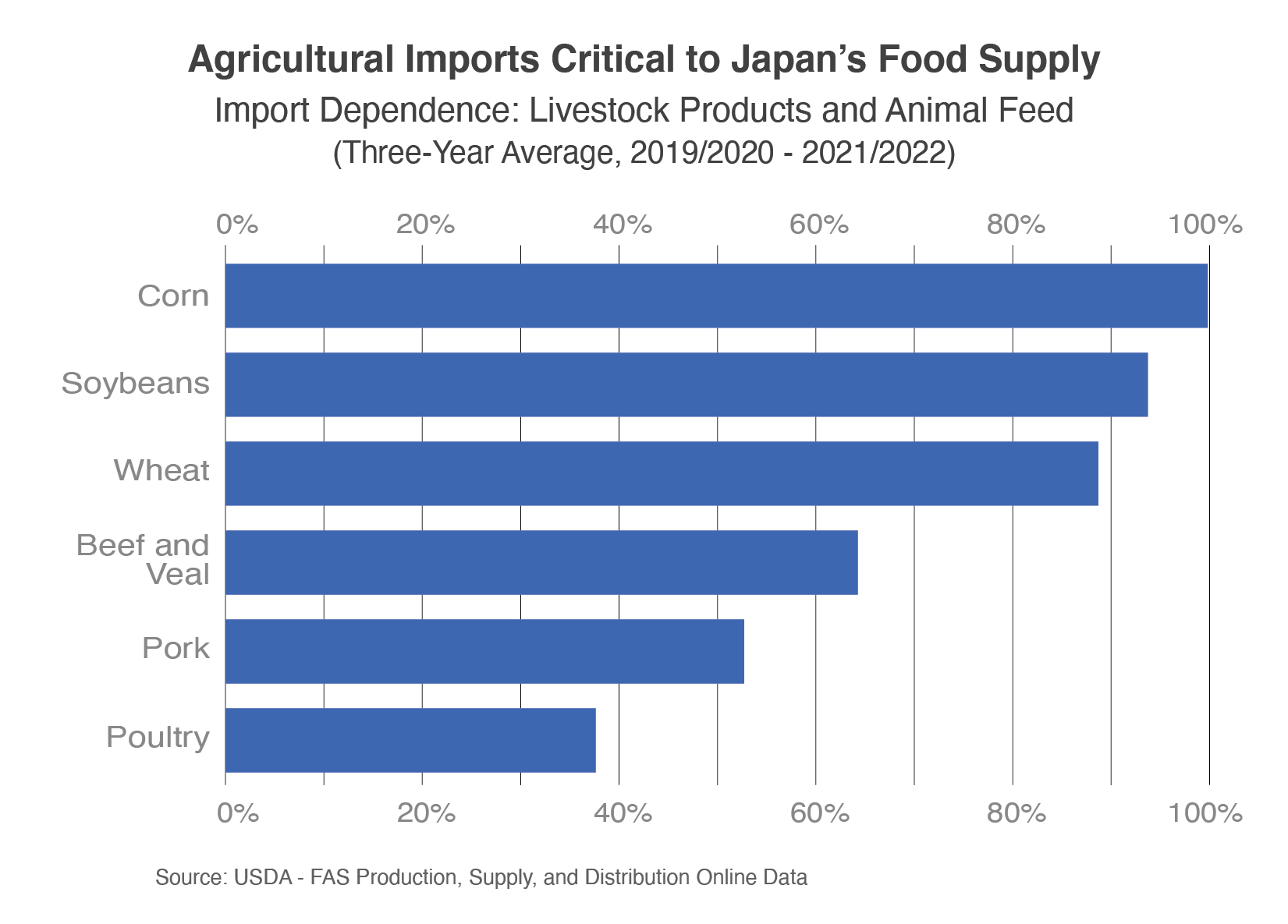
| Japans Reopening Signals Export Opportunities | Executive SummaryJapan has a well-developed food retail market that demands high-quality, high-value agricultural and food products. Despite reduced economic activity during the COVID-19 pandemic, trade data show that agricultural imports have remained resilient. As Japan’s top supplier of agricultural products, the United States is a stable and reliable partner with a long-standing relationship. Although competition in Japan has intensified in recent years, U.S. suppliers can find many opportunities to market consumer-oriented products that follow Japanese retail trends. The U.S. Department of Agriculture’s (USDA) Foreign Agricultural Service (FAS) maintains a website1 to help U.S. food and beverage exporters to navigate the Japanese market: USDAJapan.org. Macroeconomic PerspectiveJapan is a high-income country with a population of 125.7 million people.2 It is one of the most highly urbanized countries in the world with more than 90 percent of the population living in urban areas. With the third-largest economy in the world, behind only the United States and China, Japan has a highly diversified manufacturing and service economy. According to household data from IHS Markit, 95 percent of Japanese households, approximately 51.6 million households, have incomes higher than $20,000 at purchasing power parity. In 2021, Japan had a gross domestic product (GDP) per capita at purchasing power parity of $42,940. According to the latest International Monetary Fund forecast, real GDP growth is projected at 1.6 percent in 2023 and 1.3 percent in 2024. Since the initial response to the COVID-19 outbreak in 2020, the Government of Japan’s containment measures and consumers’ risk-averse behaviors limited economic activity. However, in the third quarter of 2022, Japan loosened border controls, boosting economic activity and seeking to reconnect with the world. Since October 2022, visa-free tourism resumed for U.S. citizens (see GAIN report JA2022-0112 for more information on Japan’s reopening). While Japan’s economic recovery continues, challenges remain. Japan’s lack of natural resources, including agricultural land, makes the country susceptible to external pressures such as food and energy prices. For example, price shocks from Russia’s war in Ukraine and supply chain disruptions have impacted domestic purchasing power. Increased prices have subdued household confidence and real income. Also, from a demographic perspective, Japan not only has an aging population but also a declining population. This trend continues to limit economic growth and presents fiscal policy challenges. Japan and Agricultural TradeDespite various challenges and an uncertain global economic environment, Japan’s agricultural trade, particularly agricultural imports, has been resilient because these imports play a crucial role in Japan’s domestic food supply. According to Japan’s Ministry of Agriculture, Forestry and Fisheries annual report, Japan’s food self-sufficiency ratio on a caloric basis was 37 percent in 2020, suggesting that many food items depend on imports to boost food availability. In particular, imported livestock products and animal feed supplement Japan’s limited domestic agricultural production.3 In 2022, Japan imported $70.2 billion of agricultural products, a 16.4-percent increase from pre-COVID 2019 and also surpassing record-level agricultural imports of 2011 and 2012. Although rising food prices contribute to higher unit prices, putting downward pressure on real income and purchasing power, Japan is an advanced economy where demand for high-quality food is relatively stable compared to emerging economies. The United States is a dependable agricultural trading partner of Japan. Despite supply chain disruptions and economic shocks from the COVID-19 pandemic, the United States has continued to supply safe, high-quality agricultural products. With the implementation of the 2020 U.S.-Japan Trade Agreement (USJTA), U.S. agricultural exporters remain competitive, from a tariff perspective, with Comprehensive and Progressive Agreement for Trans-Pacific Partnership (CPTPP) member countries. However, macroeconomic conditions, including Japan’s economic recovery and exchange rate dynamics, affect U.S. export competitiveness. As the U.S. dollar strengthened during 2021 and 2022, U.S. exports to Japan became more expensive. However, since October 2022, the Japanese yen has rebounded somewhat, increasing purchasing power for Japanese importers. As Japan’s top agricultural supplier, the United States exported $14.6 billion of agricultural products in 2022, with consumer-oriented products making up almost half ($6.8 billion) of the agricultural exports. Japan was the fourth-largest market for U.S. consumer-oriented products. Exports Opportunities for Consumer-Oriented ProductsJapan’s highly developed food retail market allows consumers to have several options to meet their food needs, whether it is dining at a restaurant, shopping at supermarkets and convenience stores, or retailing via e-commerce, where customers have quality groceries and food delivered to their doorsteps. Customers continue to seek out high-quality food, emphasizing convenience and accessibility, such as ready-to-eat meals and on-the-go packaged food. Also, Japan’s demographic shift has opened the door for increased demand for health food. Japan’s older population generally has more spending power and influence regarding household consumption patterns, and the health-conscious population are willing to pay more for high-quality, nutritious foods (see U.S. Japan Organic Equivalence Arrangement for more information regarding shipping organic products to Japan). Food products that consumers believe support health and dietary and functional needs are promising for the foreseeable future. In October 2019, the United States and Japan signed the USJTA, which provides for limited tariff reductions and quota expansions to improve market access. Japan agreed to reduce or eliminate tariffs on about 600 agricultural tariff lines (e.g., beef, pork, and cheese), and expand preferential tariff-rate quotas for a limited number of U.S. products (e.g., wheat). Opening Japan’s highly protected agriculture market and reaching parity with exporters from Japan’s free trade agreement partners was a major priority for the U.S. agriculture sector. 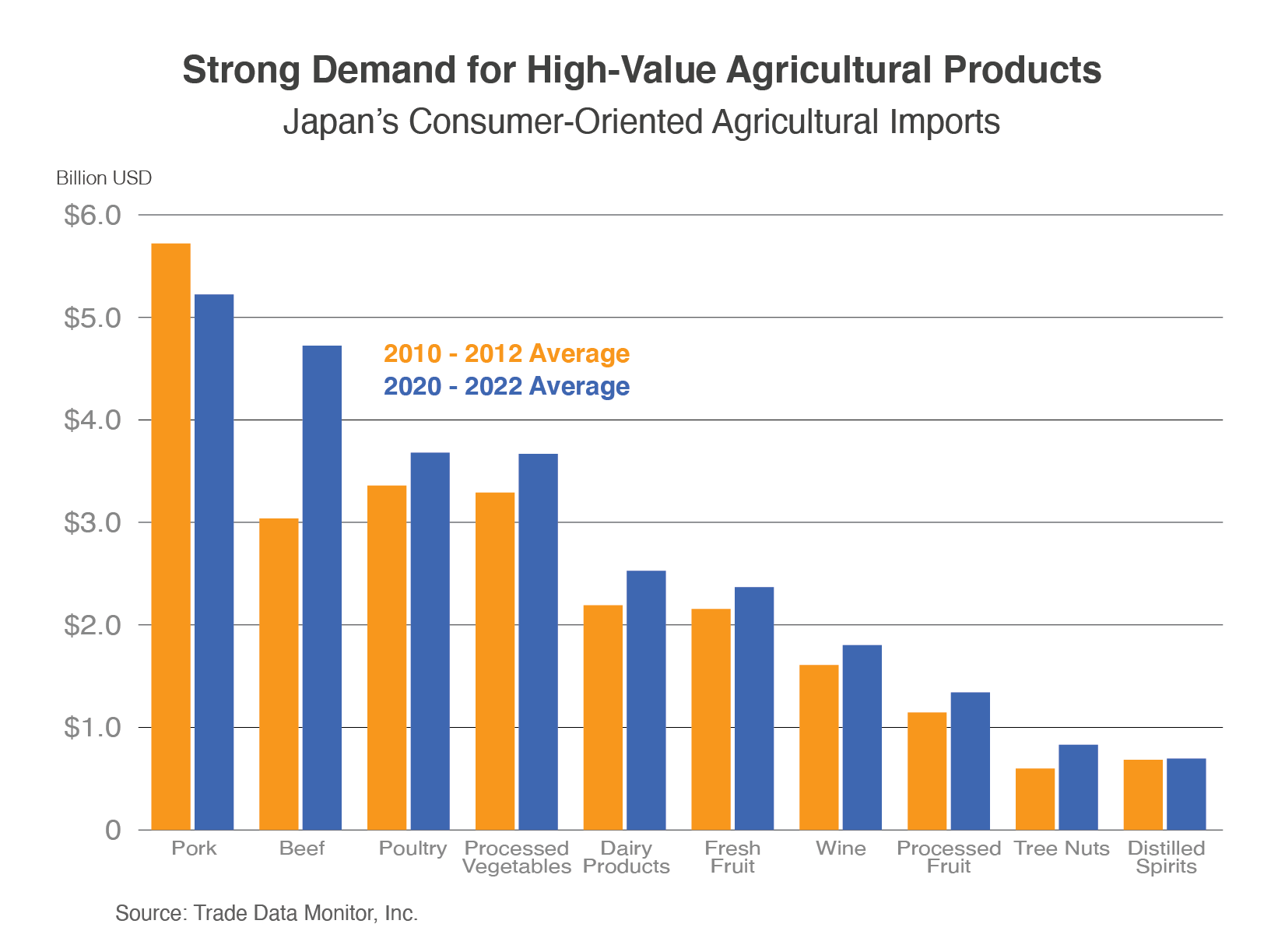 Consumer-oriented goods with strong prospects for growth include the following: Beef and Beef Products: Despite higher beef retail prices, beef shipments to Japan in value and shipment volumes have remained steady. Higher prices may shift consumer preferences from fresh or chilled beef to frozen beef, or from beef products to pork and poultry products. However, beef consumption is expected to increase in 2023 as Japan’s reopening to foreign visitors further supports the hotel, restaurant, and institutional (HRI) sector’s recovery. As a result of the recently revised agreement with Japan regarding the beef safeguard mechanism, U.S. beef exports are less likely to trigger safeguard tariffs in the coming years even with increased shipments. In 2022, the United States exported $2.3 billion of beef and beef products to Japan, nearly matching the previous year’s record of $2.4 billion. Cheese: The United States exported $231.8 million of cheese products to Japan in 2022, a 23.4-percent increase from a year ago. Prior to the COVID-19 pandemic, cheese products were generally marketed and consumed in dining options outside of the home. However, consumers taking advantage of expanded retail options in supermarkets during the pandemic have continued to consume cheese products beyond the stay-at-home period. According to cheese consumption data from the Agricultural Trade Office at the U.S. Embassy in Tokyo, Japan’s per capita cheese consumption is significantly lower than other advanced economies. From a marketing perspective, elevating the cheese consumption experience with cheese pairing guides will be important. Although the European Union (EU) suppliers enjoy a degree of marketing advantage (product differentiation) by promoting their geographical indications, import demand for most cheese products continues to rise. Tree Nuts: In 2022, Japan imported $826.5 million of tree nuts, of which 51.0 percent (approximately $421.1 million) were from the United States. Elevated unit prices in 2022 did not negatively impact shipment volumes, suggesting that demand for tree nuts is stable. The United States almost exclusively supplies almonds and walnuts, the top two imported tree nuts (not including mixed or prepared tree nuts). Another positive development is shelled pistachios, which had a higher import value than in-shell pistachios. Japan imported $28.3 million of shelled pistachios in 2022, a 35.9-percent increase from 2021’s record-breaking imports ($20.8 million). Combined with in-shell pistachios, Japan imported $50.9 million worth of pistachios, and the United States supplies almost 90 percent of shelled and in-shell pistachios. With an image of “guilt-free” snacking, tree nuts have great potential as a stand-alone product as well as ingredients for other prepared food. Processed Fruit: Processed (frozen, prepared, or preserved) fruits are essential ingredients in bakery products and snack foods. Although consumers have generally regarded fresh fruit as a premium product, consumers are shifting from fresh fruit to processed fruit. The link between processed fruit’s longer shelf life and perceived “freshness,” or the lack thereof, is less significant, especially among the younger generation. Also, processed fruit allows consumers to enjoy seasonal products year-round and to take advantage of many more fruit options that aren’t available from domestic production. While the United States has a strong presence in the dried fruit market (raisin and dried prune products), frozen fruit competition continues to intensify. Distilled Spirits: After record-high imports in 2019 ($817.1 million), the premium drink market experienced decreased sales with disruptions to the HRI food service industry in 2020 and 2021. During this slump, however, distilled spirits observed a consumption trend shift, where the COVID-19-induced trend of at-home drinking made distilled spirits more accessible. As consumers seek a premium experience, whether at home or from a bar, spirits-based, ready-to-drink beverages have growth potential. Imports from the United Kingdom, for example Scotch whiskey, make up more than 60 percent of the whiskey market share, but name recognition for American whiskeys, namely bourbon and Tennessee whiskey, is growing. In 2022, U.S. whiskey exports were up 7.2 percent in value during the past year. Looking AheadJapan’s declining agricultural production and evolving consumption trends indicate that agricultural imports will continue to play an integral role in meeting Japan’s food demands. Japan has emphasized import diversification and stabilization to secure food supplies, including through trade liberalization. Accordingly, Japan signed significant trade agreements with major U.S. competitors in recent years, notably the CPTPP and the Japan-EU Economic Partnership Agreement. As more economies in Asia and South America continue to join the CPTPP, Japan will continue to diversify trade partners for its food supply. Nevertheless, given U.S agriculture’s reputation for safety and reliability, the United States is well-positioned to continue as the leading agricultural product supplier. As competition intensifies in the food retail market, crafting a marketing strategy to cater to Japan’s consumer preferences will be essential for U.S. suppliers to remain competitive in a Japanese market that seeks quality, value, and convenience.
1 For additional updates, please see https://twitter.com/USDAJapan/ |
Japón | Intersectorial | Mercados | Lunes, 13 Febrero 2023 | |||||||||||||||||||||||||||||||||||||||||||||||||||||||||||||||||||||||||||||||||||||||||||||||||||||||||||||||||||||||||||||||||||||||||||||||||||||||||||||||||||||||||||||||||||||||||||||||||||||||||||||||||||||||||||||||||||||||||||||||||||||||||||||||||||||||||||||||||||||||||||||||||||||||||||||||||||||||||||||||||||||||||||||||||||||||||||||||||||||||||||||||||||||||||||||||||||||||||||||||||||||||||||||||||||||||||||||||||||||||||||||||||||||||||||||||||||||||||||||||||||||||||||||||||||||||||||||||||||||||||||||||||||||||||||||||||||||||||||||||||||||||||||||||||||||||||||||||||||||||||||||||||||||||||||||||||||||||
| [Infographie] Quelles sont les pratiques des Français dans la restauration hors domicile ? |  Pourquoi les Français fréquentent-ils la restauration hors domicile ? Quels sont leurs établissements favoris ? Quels sont les plats préférés des Français dans la restauration hors foyer ? Quel impact du télétravail sur la restauration ? Réponse dans l'infographie publiée dans votre magazine de février. |
Francia | Intersectorial | Clientes | Sábado, 11 Febrero 2023 | |||||||||||||||||||||||||||||||||||||||||||||||||||||||||||||||||||||||||||||||||||||||||||||||||||||||||||||||||||||||||||||||||||||||||||||||||||||||||||||||||||||||||||||||||||||||||||||||||||||||||||||||||||||||||||||||||||||||||||||||||||||||||||||||||||||||||||||||||||||||||||||||||||||||||||||||||||||||||||||||||||||||||||||||||||||||||||||||||||||||||||||||||||||||||||||||||||||||||||||||||||||||||||||||||||||||||||||||||||||||||||||||||||||||||||||||||||||||||||||||||||||||||||||||||||||||||||||||||||||||||||||||||||||||||||||||||||||||||||||||||||||||||||||||||||||||||||||||||||||||||||||||||||||||||||||||||||||||
| En 2023, selon NielsenIQ, 1 Français sur 4 pense à réduire ses dépenses alimentaires |  Alors que 2023 débute dans un climat de crise sociale, débat des retraites et pouvoir d’achat en berne, NielsenIQ a présenté sa conjoncture annuelle, synthétisant les évolutions de la grande consommation en 2022 pour mieux envisager l’exercice 2023. Que faut-il en retenir? “L’année 2022 a été marquée par de nombreux événements (guerre en Ukraine, crise énergétique, Covid et grippe aviaire, phénomènes météorologiques) qui ont transformé le quotidien et la consommation des Français. L’inflation a mis à mal leur pouvoir d’achat, les obligeant à faire des arbitrages. Tout comme les acteurs de grande distribution qui ont dû s’adapter, faire preuve de créativité et de souplesse pour compenser la hausse des prix et permettre aux consommateurs de remplir leurs caddies”, commente Nicolas Léger, Directeur Analytique chez NielsenIQ. La hausse des prix, la préoccupation majeure pour 77% des FrançaisSans surprise, l’inflation est, malgré elle, le buzzword de cette année 2022. Selon NielsenIQ, la hausse des prix est la préoccupation majeure pour 77% des Français interrogés à l’occasion de la dernière enquête. Viennent ensuite le réchauffement climatique (63%), le conflit en Ukraine (53%) et la crise sanitaire (31%). La France n’avait jamais connu un tel niveau d’inflation depuis 1984. Si la France n’est pas épargnée, avec une évolution du prix moyen des produits de grande consommation de 10,4% entre décembre 2021 et décembre 2022, nos voisins européens ne sont pas moins impactés : l’inflation atteint 13,3% en Allemagne, 13,7% en Italie, et même 18,6% en Pologne. Au-delà, les Etats-Unis connaissent une évolution de 13,9% quand la Turquie (121,6%) et l’Argentine (104%) battent tous les records. En France, selon NielsenIQ l’inflation devrait se poursuivre jusqu’à l’été 2023 avant d’approcher la stabilité. Conséquence : un surcoût conséquent pour les foyers français qui ont dû dépenser 280€ supplémentaires pour remplir leur caddie de produits de grande consommation (PGC). Ce surcoût pourrait même presque tripler et atteindre 790€ en 2023 vs 2021 selon les hypothèses de NielsenIQ. En 2022, les Français se sont adaptés pour limiter les effets de l’inflation sur leur pouvoir d’achat en évitant le gaspillage de nourriture (62%), en réduisant leurs dépenses de carburant (55%), en limitant les dépenses d’habillement (51%) ou de loisirs (50%). NielsenIQ évalue à 13 millions le nombre de ménages français “Fragilisés” par l’inflation, en hausse de plus de 25 points vs décembre 2021. A ces derniers, il faut ajouter les trois millions de foyers “Contraints”, qui avaient déjà un pouvoir d’achat limité avant même le retour de l’inflation. En 2022, ce sont surtout les jeunes adultes et les familles qui ont le plus réduit leurs dépenses alimentaires, les premiers ayant davantage retrouver le chemin de la consommation hors domicile sur le premier semestre. En 2023 selon NielsenIQ, 1 Français sur 4 pense à réduire ses dépenses alimentaires. Les Français arbitrent et réduisent leurs achats notamment en entretien (-27%), hygiène beauté (-25%), surgelés (-12%) et alcools (-9%, pourcentage qui monte jusqu’à -12,6% pour les foyers modestes) avec une moindre propension au stockage. Même si les volumes résistent, la “descente en gamme”, qui consiste à privilégier des produits moins onéreux pour un même besoin, est également une tendance observée par NielsenIQ en 2022. 62% de la baisse de volumes des marques nationales se fait vers les MDD (marques de distributeurs) qui se développent plus rapidement chez les classes moyennes. La MDD gagne d’ailleurs du terrain partout en Europe. Coca-Cola est le numéro 1 du Top 10 des fabricants ayant généré le plus de chiffre d’affaires additionnel cette année, avec 194 millions d’euros. Viennent ensuite P&G (159M€), Lactalis (129M€), Savencia (118M€), Orangina Schweppes Suntory (107M€), Nestlé (95M€), etc. Comparaison des prix et promotions, armes ultimes pour réduire le coût du caddieEn 2022, pour faire des économies sur leurs produits de tous les jours, les Français déclarent à 49% avoir prêté plus d’attention à la comparaison des prix, à 48% à chercher à acheter des produits en promotion ou bien à acheter des produits à prix réduit en raison de leur date de péremption proche (43%). 39% des personnes interrogées disent avoir consommé moins de viande ou poisson en 2022. 34% ont même changé leurs habitudes en s’obligeant à faire une liste de courses quand 34% déclarent avoir réduit leurs achats plaisir (vin, chocolat). Les acteurs de la grande consommation, enseignes et marques, ont compensé l’inflation des produits en mettant en place de nombreuses promotions. Le poids des promotions dans le chiffre d’affaires a ainsi atteint des records en 2022 avec un taux relevé à 21,7%. La consommation des Français a également été impactée par de fortes perturbations en linéaires. Le taux de ruptures en valeur a atteint 5,3% en décembre 2022 (vs décembre 2021), 25% de ces ruptures de la disponibilité de produits en linéaires étant liées à des causes amont généralisées. Grande distribution : comment les acteurs se sont-ils démarqués en 2022?Selon le bilan NielsenIQ, la fragmentation des achats se poursuit, avec des paniers plus petits et une fréquence d’achat en hausse pour un meilleur contrôle des dépenses. En 2022, les hypermarchés retrouvent enfin de la croissance (+4,6% en 2022 avec 38% de part de marché), mais comme le souligne Daniel Ducrocq, les hypermarchés qui ont réussi à se démarquer en 2022 sont ceux qui ont offert la meilleure expérience client. Il souligne également que le circuit de “proximité” reste le plus dynamique (+12,3% de croissance du chiffre d’affaires avec 9% de parts de marché), aux côtés des enseignes comme Lidl et Aldi. Ces derniers gardent probablement une réelle marge de progression quand on compare la situation française avec nos pays voisins : Aldi et Lidl y captent parfois 20% du marché, comme au Royaume-Uni ou en Belgique. Concernant l’évolution des habitudes de consommation et d’alimentation, l’apparent ralentissement du e-commerce, de la livraison à domicile et du drive en particulier, masque en réalité une forte progression par rapport à l’avant pandémie. Par exemple le drive reste effet particulièrement dynamique sur le long terme, sa croissance entre 2019 et 2022 s’affichant à + 39%. Un Français sur 4 ne cuisine pas, un réel enjeu pour les industriels et les distributeurs2022 aura été une année différente des autres du fait de l’inflation record. De cette crise inflationniste ressort plusieurs constats, nouveaux comportements et habitudes de consommation qui marqueront 2023. Loin de toute surconsommation, la quête de plaisir reste un incontournable en temps de crise, car malgré les difficultés économiques, les Français restent peu enclins à réduire leur consommation plaisir. Le récent succès de la gamme GO Bubble Tea, meilleur lancement de l’année, en est un parfait exemple. Les marques innovent d’ailleurs dans ce sens mais du fait de la crise actuelle, le poids de l’innovation dans le chiffre d’affaires des PGC poursuit sa lente érosion, à 2,1% en 2022 contre 2,2% en 2021 et 2020, en cause un nombre inférieur de lancement cette année. Près d’1 Français sur 4 ne cuisine pas, une tendance qui s’accélère depuis 2021. 21,6% des Français sont des “vite-fait” et ne cuisinent jamais. Les habitudes d’alimentation évoluent : selon le bilan NielsenIQ, le grignotage entre les repas ne cesse de progresser. Comme un besoin de compenser la déstructuration avérée des repas, notamment chez les jeunes, le grignotage en matinée et en soirée augmentent respectivement de +3 pts. Toucher ces jeunes générations qui seront la consommation de demain est donc un réel enjeu pour les industriels et les distributeurs, que ce soit dans la manière de communiquer ou dans la proposition de produits. Les ventes de bio en baisseEn termes d’alimentation, les féculents restent une valeur sûre pour les Français, devant les légumes et la viande. 35% déclarent réduire leur consommation de viande. 79% des consommateurs déclarent accorder de l’importance à la nutrition. 50% font attention au Nutri-score des produits qu’ils achètent. Autre constat du bilan NielsenIQ, les ventes de bio en grande distribution ont diminué en 2022. L’accessibilité prix, la réduction des assortiments expliquent ce recul. Cependant, la consommation alternative a progressé en 2022 (+6,1% d’évolution des ventes en unités) notamment celle des produits sans pesticides, naturels, sans conservateurs ou sans alcool. Consommer responsable fait petit à petit son nid dans l’esprit des consommateurs. 60% des Français déclarent que consommer responsable est quelque chose d’important pour la société et qu’ils essaient de faire des choix durables quand ils le peuvent. 24% déclarent même que c’est une priorité pour eux et qu’ils le font au quotidien. L’achat local et les emballages sont deux enjeux qui joueront un rôle majeur dans les prochaines années selon NielsenIQ. (Source NielsenIQ) |
Francia | Mercados | Clientes | Intersectorial | Jueves, 09 Febrero 2023 | |||||||||||||||||||||||||||||||||||||||||||||||||||||||||||||||||||||||||||||||||||||||||||||||||||||||||||||||||||||||||||||||||||||||||||||||||||||||||||||||||||||||||||||||||||||||||||||||||||||||||||||||||||||||||||||||||||||||||||||||||||||||||||||||||||||||||||||||||||||||||||||||||||||||||||||||||||||||||||||||||||||||||||||||||||||||||||||||||||||||||||||||||||||||||||||||||||||||||||||||||||||||||||||||||||||||||||||||||||||||||||||||||||||||||||||||||||||||||||||||||||||||||||||||||||||||||||||||||||||||||||||||||||||||||||||||||||||||||||||||||||||||||||||||||||||||||||||||||||||||||||||||||||||||||||||||||||||||
| Sector Trend Analysis – Food Service in Japan | Note: This report includes forecasting data that is based on baseline historical data. Executive summaryThe Japan foodservice market was valued at US$183.9 billion in 2021, and it is projected to witness a compound annual growth rate (CAGR) of 3.3% during the forecast period, 2021 to 2025. Restaurant chains in Japan are taking earnings guidance off the menu after shutdowns and limited hours caused by the coronavirus pandemic have made near-future projections hard to predict, with sales in March 2020 down by almost 40% for some companies. The foodservice operators, which rely on lunch and dinner demand from business workers, are also suffering as more companies have employees working from home at the government's request. Japan's foodservice market is primarily driven by the increasing frequency of dining out amid time-pressed schedules and the growing influence of cross-culture dietary patterns due to the strong presence of foodservice providers offering Japanese, Korean, ethnic, and western cuisines. Japanese consumers, in general, tend to be highly demanding, putting great emphasis on quality and branding and are willing to spend more resources on value-added products. The latest trend in Japanese foodservice includes listing calories on the restaurants' menu. Connected to this overall trend, strong attention has been paid to the sugar content, and products with lower sugar content are considered healthier, which is expected to drive the market forward. The recovery of consumer foodservice in Japan is largely dependent on the successful rollout of the country's vaccination program, the reopening of its borders, and the ability of consumers to return to their pre-COVID-19 activities. Nevertheless, this is not expected to be achieved until 2022 when domestic and international travel resumes and because, in the short term at least, many consumers are expected to continue working from home. Although the timing of the government's Go To Eat and Go To Travel campaigns were not ideal in 2020, the fact these campaigns have now been extended means they could play an important role in kickstarting a recovery. Market overview and consumption trendsWith a population of approximately 127 million and a gross domestic product (GDP) of US$5.2 trillion in 2021, Japan is one of the largest consumer markets in the world, providing opportunities for Canadian exporters, especially for those interested in the foodservice market. In 2021, the Japan foodservice market was valued at US$183.9 billion. Consumer foodserviceCOVID-19 impact on consumer foodserviceThe government announced a nationwide state of emergency on 7 April 2020 in response to COVID-19, asking nonessential retailers and foodservice outlets to voluntarily close or to shorten their operating hours to help prevent spread of the virus. This covered not all, but most of the large cities in Japan with large and dense populations. Bars/pubs that mainly only sell alcoholic drinks were asked to close their outlets during the state of emergency. Meanwhile, other foodservice outlets were in general asked to open only between 5 a.m. and 8 p.m., with no alcoholic drinks to be sold after 7 p.m. Home delivery and takeaway services were not prohibited during the state of emergency, and as such many foodservice operators rushed to provide or expand such services. Nevertheless, all channels suffered heavy losses, with those predominantly focused on eat-in sales being the hardest hit. While the state of emergency was relaxed in late May 2020, COVID-19 remained a significant threat with a second and then a third wave of the virus seen later in 2020. Eating and drinking at bars, pubs, and restaurants was considered one of the most common ways for people to get COVID-19 and, therefore, the government continued to stress to the public to refrain from dining out, and especially to avoid drinking in large parties. As a further measure, the government offered cooperation money to bars and restaurants that shortened their operating hours and closed early. Eating at home became the most common trend in 2020 with consumers either making home-cooked meals, purchasing ready meals or meal kits, or shifting to takeaway and home delivery. Virtual drinking parties was another notable trend to come out of the state of emergency, with consumers adapting to the restrictions and looking for ways to keep spirits up while stuck at home.
In October 2020, the government announced the launch of its Go To Eat campaign to help provide a boost to the country's foodservice industry. Through the campaign consumers were able to purchase books of discount vouchers that entitled them to receive a discount of 25% on meals at participating foodservice outlets. This followed on the footsteps of the government's Go To Travel campaign which was launched in July 2020 and which subsidized domestic travel expenses by up to 50%. However, as the number of COVID-19 cases started to surge again in November, both campaigns were quickly suspended, with the expiry dates for each campaign extended to the end of 2021. Despite this, there was significant interest in these campaigns due to the generous discounts on offer. COVID-19 country impactDue to the outbreak of COVID-19, a state of emergency was imposed in seven major Japanese prefectures from 6 April 2020, and all 47 prefectures from 16 April. People were encouraged to stay at home, avoid group events, avoid stockpiling, and to wash their hands, although there were no penalties or mandatory requirements. Prefecture governments could close schools, public facilities, entertainment centres and shops. From 5 March 2020, border controls were applied to arrivals from areas in China and South Korea, and these controls were expanded to arrivals from other areas and countries as the virus spread globally. With the government advice to refrain from domestic travel, rail companies and airlines also reduced their operations. The government asked all nonessential retail and foodservice outlets to close or shorten their opening hours from 7 April in most large cities, although this was not mandatory due to constitutional barriers related to civil liberties. Grocery retailers, pharmacies and shopping centres either opened for shorter hours or as usual, whilst many non-grocery retailers closed. Bars and pubs were asked to close, with other outlets asked to operate only from 5 a.m. to 8 p.m., with no alcohol served after 7 p.m. Delivery and takeaway services were permitted. A growing number of employers mandated or recommended staff work from home. Meanwhile, all schools nationwide were asked to close from 2 March to early April 2020. Schools in some areas resumed classes on 6 April 2020. On 4 May 2020, the government extended the state of emergency to the end of May. It then analyzed regions by risk and removed the state of emergency for low-risk prefectures. Mask-wearing was commonplace in Japan already, so compliance is high. Schools are now open and teaching is in-person with social distancing measures in place, and clear plastic screens around desks to protect students. In mid-February 2021, the government started the rollout of COVID-19 vaccines across the country, starting with healthcare workers and the elderly. However, this has been slow, and cases started to rise once again in April, leading to further short-term local restrictions. Company responseLeading convenience store chains 7-Eleven and Lawson remained the overall leaders in terms of value share in 2020, with most foodservice players registering declines. While the performances of convenience store limited-service restaurants in business district areas were poor, due to the shift to remote working, this was partially offset by increased demand from residential and rural areas. Outlets in these residential and rural areas provided quick and easy access to prepared food options as an alternative to eating out. Frequent new product launches within these outlets also helped to ensure consumers returned. Investment in home delivery and takeaway services was the main focus of most foodservice players in 2020 as they looked to navigate their way through the COVID-19 crisis, and even bars/pubs branched out into this area to compensate for the loss of eat-in sales. Independent foodservice operationsIndependent foodservice operators are suffering greatly from the effects of COVID-19 with the number of bankruptcies for this industry being among the highest in history. The government has been offering support/cooperation money to compensate for store closures or shorter opening hours, and although it has been beneficial for smaller operations, it has not been enough to supplement the losses experienced by mid-size or larger operations. In response to the government request to stop serving alcohol after 7 p.m., some independent foodservice operators that previously only opened during the evenings adapted their business models to open at lunchtime or even breakfast to compensate for the loss of business. Furthermore, some independent bars and pubs that mainly served only alcoholic drinks prior to COVID-19 shifted to providing full meals, with some looking to attract consumers who would like to eat dinner and leave quickly. Some players also entered the food truck business during 2020 since it was considered to be a reduced risk of contracting COVID-19. They also have lower maintenance costs and provide an opportunity to reach out to consumers. What's next for consumer foodserviceThe recovery of consumer foodservice in Japan is largely dependent on the successful rollout of the country's vaccination program, the reopening of its borders, and the ability of consumers to return to their pre-COVID-19 activities. Nevertheless, this is not expected to be achieved until 2022 when domestic and international travel resumes and because, in the short term at least, many consumers are expected to continue working from home. Although the timing of the government's Go To Eat and Go To Travel campaigns were not ideal in 2020, the fact these campaigns have now been extended means they could play an important role in kickstarting a recovery. Following the outbreak of COVID-19, many operators opted to use cashless payments as they do not require direct contact. Full-service restaurantsRestrictions on outlet openings due to COVID-19 put a sizable hole in the sales of full-service restaurants in 2020. All categories declined in current value terms in 2020 compared with previous years. Over the forecast period, full-service restaurants projected to see a 3.6% current value CAGR, reaching US$96.4 billion.
Go To Eat campaign a bright spot in a difficult year for full-service restaurants2020 was a tough year for full-service restaurants with the outbreak of COVID-19 disrupting the ability of outlets to open and even when they did they often saw reduced operating hours and social distancing measures. Furthermore, even when they did open footfall was not as significant as pre-COVID-19 with many people following the government's advice to remain home when possible. This was particularly damaging to full-service restaurants in business districts and city centres, with work-from-home arrangements removing an important consumer base in these areas. Despite these considerable setbacks, full-service restaurants actually performed better than some other consumer foodservice channels, such as cafés/bars. This was partly due to ongoing demand from families in residential and rural areas. Sales were also boosted by the government's Go To Eat campaign which was launched in October 2020. This campaign allows consumers to buy books of discount vouchers entitling them to a 25% discount at participating restaurants within the consumer's prefecture. Nevertheless, after COVID-19 cases started to rise again in November, the government asked prefectural governors to consider limiting the number of diners in each group using the Go To Eat vouchers to four people. Full-service restaurants largely rely on eat-in sales for the majority of their business, but with COVID-19 placing restrictions on their ability to open to capacity, many turned their attention to takeaway and home delivery. Some players also offered unique takeaway menus to gain consumers' attention during 2020. Recovery and opportunitiesConsumers may need to be persuaded to return to full-service restaurants. The government's Go To Eat campaign proved popular following its launch, although it has been beset with problems due to an increase in COVID-19 cases. Nonetheless, while the vouchers had been due to expire in March 2021, due to the disruption in using them many prefectures have now extended the expiry date to December 2021. This should help support the slow recovery of full-service restaurants, as consumers will likely need to be incentivized to get them to eat out. Given the campaign's success the government may well choose to provide further support to full-service restaurants, with the channel facing further outlet closures in 2021. Significant challenges remain with focus expected to shift further towards takeaway and home delivery. Rising labour and ingredients costs and unfavourable demographic trends present considerable challenges to full-service restaurants, which could limit the channel's ability to return to pre-COVID-19 sales levels. In addition, the aging population has magnified the impact of the fact that many older consumers tend to prefer eating in the comfort of their homes. Meanwhile, ongoing economic uncertainty is likely to dampen demand, with many consumers keen to minimize spending where possible and, therefore, eating out less frequently. 2020 also saw an acceleration of the trend towards home delivery and takeaway food over dining out. Women in the workforce, prompted by government efforts, stimulate the economy and address the labour shortage. Consequently, many full-service restaurants will likely need to expand their home delivery and takeaway services or risk being left behind. Full-service restaurants will need to be creative with consumer confidence, which is still under pressure Japan is in the process of rolling out its COVID-19 vaccination program, although at the time of writing there are still no certainties as to how long it will be before life starts to return to relative normality. There are different variants of COVID-19 causing concern. With this in mind, full-service restaurants will need to continue being creative in order to encourage consumers to spend. Special promotions, digital marketing and unique menus could all offer some reward, while digital services such as cashless payments, digital menus and self-service could all help to allay fears around catching COVID-19. Limited-service restaurantsMost of the sales declined in 2020 compared with previous years except chained burger limited-service restaurants, chained convenience store limited-service restaurant, chained Latin American limited-service stores and chained pizza limited-service restaurants. Over the forecast period, limited-service restaurants are projected to increase at a CAGR of 2.6%, reaching US$71.3 billion in 2025.
2020 impactLimited-service restaurants compensate for loss of eat-in sales with increase in delivery and to-go sales In response to the outbreak of COVID-19 Japan introduced a range of measures to help prevent spread of the virus. With regard to consumer foodservice, this meant restrictions on eat-in services. Although this did have a negative impact on sales within limited-service restaurants in 2020, it was not as significant as in most other channels, with eat-in sales accounting for a relatively small share of sales. With consumers unable to eat in restaurants, takeaway, drive-through and home delivery sales increased their share. Convenience stores focus on new products and services as COVID-19 provides a stern test. Throughout 2020, the government encouraged people to work remotely and promoted staying home when possible. Under these conditions, limited-service restaurants saw reduced business, especially in business districts. In addition, home seclusion provided an incentive and the time for people to cook more at home, with home cooking thus becoming a threat to not just limited-service restaurants but also overall sales of consumer foodservice. Convenience stores is the dominant category within limited-service restaurants, and despite seeing a decline the channel managed to remain relatively stable in 2020. To maintain sales, convenience stores were active in launching new products and unique collaborations with full-service restaurants to help retain the interest of consumers and to compensate for the loss of foot traffic resulting from home seclusion. Leading pizza players introduce new services to cater to single-person households Pizza limited-service restaurants was one of the few categories to post growth in 2020 in both current value and transaction terms, albeit with growth coming from a low base. For example, Pizza Hut introduced "MY BOX" which is a set option for a single serving of pizza with a small side of French fries and fried chicken. Meanwhile, Domino's Pizza announced that it would no longer have a minimum order amount for home delivery, meaning consumers were able to order smaller portions or could just order from the side menu. These moves proved popular thanks to their recognition of Japan's increasing number of single-person households. Recovery and opportunitiesCompetition set to intensify as full-service restaurants expand into offering takeaway and home delivery Prior to the outbreak of COVID-19, limited-service restaurants largely focused on takeaway for business, with consumers typically going to full-service restaurants when they wanted to eat in. However, partially driven by necessity, more full-service restaurants started offering takeaway and home delivery during 2020 and it is expected that the competition between the two channels will intensify, while the line between full-service and limited-service restaurants is expected to become increasingly blurred. While full-service restaurants' takeaway menus tend to be more expensive, the variety and unique options they often offer may win over more consumers who are seeking new options or who want to try new things. In order to remain competitive, it will be important that limited-service restaurants provide regular new product launches including interesting and innovative concepts to catch the consumer's eye. Furthermore, with online orders surging in 2020, it is now easier than ever for consumers in Japan to quickly and easily compare the menus of different foodservice providers online and as such players will need to find points of differentiation. Working from home could influence decisions on new outlet locationsWith little expectation of limited-service restaurants seeing significant growth over the forecast period, it is anticipated that there will not be many new outlets opened, with many players focusing on consolidation in the wake of COVID-19. Nonetheless, for any new store openings that do emerge, it is expected that residential and rural areas will be targeted rather than locations near business districts or entertainment sites. Working from home is not well established in Japanese business culture, but it was well received when it became a necessity in 2020. As such, companies are expected to continue being more flexible with their employees' working arrangements even beyond 2021. As more consumers choose to work from home, this in turn could see foodservice demand shift away from business districts and into residential and rural areas. Third-party delivery companies expected to expand reach over the forecast periodTo expand delivery options/areas, a growing number of limited-service restaurants are partnering with delivery services such as Uber Eats and Demaekan, with this being seen as an effective way to increase their delivering capacity. For example, in October 2020, McDonald's announced it had formed a partnership with Demaekan, which is Japan's largest food delivery service. Now, in addition to its own delivery system (in selected areas and stores only), McDonald's will be able to utilize Demaekan's service, which has a large user base and is able to reach a wider delivery area, thereby opening the door to a wider customer base. In addition, McDonald's is also renovating its stores to make them more convenient and appealing. The company's official app also targets convenience-orientated consumers by providing a click and collect option. Cafés and BarsSales plummet in 2020 with the government's COVID-19 measures limiting foot traffic in these outlets. All categories, except chained café, dropped from 2016 to 2020. Over the forecast period, cafés/bars is projected to increase at a 4.0%, reaching US$39.6 billion.
COVID-19 measures deal a heavy blow to bars/pubsThe government announced a state of emergency on 7 April, with it requesting that nonessential retail and foodservice outlets close on a voluntary basis or at least reduce their hours, with most establishments complying with this request. As a result, during the state of emergency bars/pubs closed their doors. In a bid to contain the spread of COVID-19, the Japanese government issued a number of other requests, including asking bars/pubs and other foodservice operators to stop serving alcohol after 7 p.m. Even after the state of emergency was lifted, the government continued to recommend that consumers avoid visiting bars/pubs as this was seen as a common place to contract COVID-19. Furthermore, the government also offered payments to those bars/pubs that agreed to close or reduce their opening hours. With bars/pubs hugely reliant on evening drinkers, such as those enjoying a drink with friends after work, these measures had a huge negative impact on the channel, which saw its value sales drop by almost two thirds. Unable to cope with the massive drop in sales, a significant number of bars/pubs also closed their doors permanently in 2020. Players adjust their business models to manage through the pandemicSome players within cafés/bars responded better than others to the crisis and looked to create new opportunities to compensate for the loss of sales stemming from COVID-19. For example, many bars/pubs in Japan only open in the evenings, but with operators asked to stop serving alcohol after 7 p.m., some players started to open during the day offering light meals and refreshments, while some even started opening in the morning and offering breakfast. Another way in which cafés/bars looked to compensate for the loss of eat-in sales was through expanding or introducing takeaway, drive-through, and home delivery options. Starbucks expands its lead with customers attracted to new products and menu itemsDespite seeing a significant decline in sales in 2020 due to COVID-19, Starbucks Coffee Japan nonetheless expanded its lead in cafés/bars with its value share increasing by three percentage points. The company's growing lead is being driven by ongoing expansion of its store network and the frequent introduction of seasonally limited drinks, which have been well received by Japanese consumers. As well as expanding its store network, Starbucks is working to bring its offer into line with the increasingly central role of digital media and devices in consumers' lives, which served it well following the outbreak of COVID-19. Elsewhere, there were a number of unique and interesting collaborations as players looked to stand out from the competition with eye-catching menus. For example, McDonald's Holdings Co (Japan) Ltd was one of the few players in cafés/bars to register growth in 2020, with this being supported by frequent new product launches. Recovery and opportunitiesChallenges remain for bars/pubs, but this could inspire new innovationsBars/pubs is expected to return to growth in 2021 although the speed of recovery is largely dependent on the successful rollout of Japan's vaccination program and the containment of COVID-19. With a rapidly aging population, Japan is exercising caution to prevent any significant rise in case numbers. With bars/pubs often being small and crowded locations they are seen as particularly fertile grounds for spreading viruses and, as a result, it may be some time before the number of consumers visiting these outlets returns to pre-COVID-19 levels. Consequently, operators of these establishments may need to take a more creative approach, possibly focusing more on food or extending their takeaway services. The general decline in alcohol consumption may also force chained bars/pubs to resize their businesses in order to remain profitable. Moreover, these players face growing competition from rival foodservice formats such as fast food chains and full-service restaurant chains, which have been providing small servings of alcoholic drinks in order to target consumers looking for a quick dinner and drink after work. In addition, convenience stores have been providing eat-in space in their outlets, and the food and drink they provide is almost identical to that on offer in izakaya (informal Japanese bars typically associated with after-work drinks). New smoking ban could detract from the desire to visit cafés/barsSmoking in foodservice outlets was effectively banned by a law which came into force in April 2020, which had aimed to reduce the risk of the harmful impact of passive smoking ahead of the now rearranged 2020 Tokyo Olympics. While small privately owned restaurants with no employees are exempt, typical chained izakaya will be required to either ban smoking indoors or provide a separate smoking room. Although izakaya may be able to attract female consumers and families by banning smoking, these consumer groups tend to spend less per visit than male businessmen, the core consumers of such outlets, because they consume less alcohol. As such, this could represent a further challenge to the future of bars/pubs, with many consumers already focused on reducing their alcohol intake due to increased health concerns in the wake of COVID-19. Customer loyalty important in bringing consumers back into outletsGaining consumer loyalty will likely become increasingly important heading into the forecast period as competition intensifies, with repeat business being crucial to success. Not only are cafés/bars facing competition from within the channel and from other channels such as limited-service restaurants and full-service restaurants, but they are also likely to face the mounting challenge of consumers who choose to prepare and drink alcoholic and non-alcoholic drinks at home. During the state of emergency, many consumers became more familiar with how to prepare fresh coffee, cocktails and other drinks and it may be hard to persuade some of these consumers to shift back to cafés/bars. To do this, players will likely need to run successful digital marketing and engagement campaigns to bring consumers back into outlets, with new menu options, limited-time products and offers, and special promotions and discounts all likely to prove popular. Self-service caféSales plummet in 2020 due to home seclusion and COVID-19 measures. Over the forecast period, self-service cafeterias is expected to see a 6.3% CAGR, reaching US$2.1 billion.
2020 impactHome seclusion puts heavy pressure on self-service cafeterias due to their reliance on workers and studentsSelf-service cafeterias remains a niche within Japan's foodservice industry, accounting for only a small proportion of overall sales. Many consumers continue to associate such outlets with school, college, or work canteens. As such, self-service cafeterias were particularly hard hit by the outbreak of COVID-19 due to the fact that the core customer base of many of these outlets is comprised largely of workers and students. With many people switching to working and studying from home due to COVID-19, there was little demand for self-service cafeterias. Ikea opens new urban store and launches takeaway/lunchboxIt was a tough year for all players within self-service cafeterias in 2020, with the channel not being ideally suited to the COVID-19 environment. Nonetheless, the leading players looked to respond to the restrictions and lack of interest in eat-in services by focusing on takeaway and home delivery services. In June 2020, Ikea also opened its first small urban concept store in Harajuku, Tokyo. While it succeeded in expanding Ikea's presence into urban areas, Harajuku is one of Japan's most heavily crowded areas and so suffered due to people avoiding such areas due to COVID-19. Udon specialists look for new ways to drive salesUdon noodle soup specialist Marugame Seimen managed to increase its lead in 2020 despite still recording heavy losses. The company performed better than some of its rivals thanks to its combination of a takeaway service along with running regular menu discounts to attract consumers. This offer could be used as many times as the customer wished during the specified period and it was designed to encourage repeat visits/orders. Overall, however, the loss of business to workers and students was too much for most players, with all of the leading players suffering heavy losses in current value terms in 2020. Recovery and opportunitiesAs employees return to the workplace, sales should bounce backDue to the nature of many self-service cafeterias, the channel stands to bounce back quicker than many other consumer foodservice channels. With limited interaction with staff and a relatively fast turnover of customers, there are fewer concerns about being exposed to COVID-19. Key to the channel's recovery will, however, likely be heavily dependent on consumers returning to the workplace, with busy workers and students being a key consumer base for these outlets that provide quick and convenient meal options. Udon noodle soup at the heart of self-service cafeterias in JapanUdon noodle soup specialists were one of the more successful areas of self-service cafeterias during the review period and although they suffered a setback in 2020 due to COVID-19 restrictions, they stand to bounce back over the forecast period. These outlets have relatively few competitors in expanding areas such as third-party online ordering services or convenience stores limited-service restaurants, as consumers do not generally consider these channels to be suited to udon noodle soup. Typical customers include busy workers looking for lunch and university students looking for a light meal or snack, though the flexibility of the offer allows for an extremely diverse consumer base. Two of the top three self-service cafeteria brands by value Economic uncertainty expected to drive demand for value-for-money mealsPrice discounting and new menu developments are likely to be key to driving sales within self-service cafeterias over the forecast period, with the line between limited-service restaurants and self-service cafeterias becoming increasingly blurred. This blurring of the lines is being partially driven by some self-service cafeterias turning their attention to takeaway and home delivery in response to the COVID-19 crisis. Street stalls/kiosksWith street stalls/kiosks typically located in high-traffic areas, this put these outlets at a distinct disadvantage given the home seclusion seen in 2020 Sales decline by 5.2% from 2016 to 2020. The channel remains highly fragmented being dominated by independents in 2020. Over the forecast period, street stalls/kiosks is projected to see a 2.6% current value CAGR from 2021 to 2025, reaching US$195.3 million.
2020 impactFoot traffic fell in typically busy and vibrant areas as the government encouraged consumers to stay homeIn order to secure a significant audience, street stalls/kiosks are typically located in high-traffic areas such as business districts or near entertainment venues. Given this, the measures taken to control COVID-19 served as a heavy blow to many operators. With many consumers switching to working and studying from home, and with social and entertainment events put on hold, foot traffic in many typically busy urban areas dropped significantly. As a result, street stalls/kiosks also saw a steep drop in sales, with these outlets losing a key part of their target audience. Although not as significant, the loss of tourism due to COVID-19 was another factor behind the poor performance of street stalls/kiosks in 2020. The younger generation was, however, more active during COVID-19 as it was widely believed that younger people had a lower risk of facing any serious health problems from the virus. This was problematic for the government in trying to convince the younger generations to stay home, but at the same time it also benefited some foodservice operators, including those offering on-trend products such as bubble tea and Korean street food. Food trucks benefit from their mobility as consumers stay homeDespite a challenging year, street stalls/kiosks still performed better than some other consumer foodservice channels such as full-service restaurants and cafés/bars. This was in part thanks to the efforts of food trucks, some of which managed to see strong performances in 2020 despite COVID-19. The expansion of food trucks continues to offer opportunities in street stalls/kiosks, especially as health-conscious consumers increasingly demand access to fresh, healthy food in the midst of hectic modern lifestyles. A broad and unusual product variety, including international cuisine that it is often difficult to find in Japan such as Egyptian, Greek and Israeli, is another potential advantage of food trucks. Prior to COVID-19 food trucks primarily targeted areas around offices but following the outbreak of COVID-19, this business model evolved. Due to their mobility, food trucks were also able to shift from business districts to residential areas in line with the shift to home working and studying. This enabled the company to connect full-service restaurants with consumers who chose to stay home and who were reluctant to visit physical stores and foodservice outlets as a result of COVID-19. Beyond the potential of food trucks in urban areas, opportunities are still largely limited to usually short-lived and unpredictable trends such as the rise of bubble tea, though street stalls/kiosks does, at least, offer the flexibility to adapt quickly to such trends. Some of the more notable trends in 2020 included banana juice, which came to the attention of consumers after its health benefits were promoted on TV, and Korean street food. Japan has been going through somewhat of a Korean craze, with Korean culture influencing various areas of consumers' lives in Japan from beauty and fashion, music, TV and film, and now food. Even before the negative impact of COVID-19, street stalls/kiosks were seeing growth constrained by consumer concerns about product quality and hygiene. In addition, the trend towards eating at home, underpinned by busy consumer lifestyles and the aging population, was also impacting street stalls/kiosks sales, with growing numbers of consumers opting for home-cooked food, home delivery, takeaway or home dinner kits. These factors also continued to have an adverse effect on the channel's development in 2020. Recovery and opportunitiesDue to low overheads, food trucks could become the testing ground for new food conceptsFollowing the success of the food trucks model, platform providers (such as food truck rentals) and intermediary services (such as searching locations, renting food trucks, seed funding, etc.) like Mello Inc are expected to be a key component for the growth of street stalls/kiosks. With prevailing economic uncertainty in the wake of COVID-19, many entrepreneurs are also likely to lack the funds/budget to open full-service restaurants and so may instead turn to food trucks as a way to gauge the receptiveness of consumers to their menu ideas or food concepts. Furthermore, due to the mobility of food trucks, players can test their products in different locations, as well as taking them to events such as festivals and sports events. Consumer confidence key to recoveryKey to the recovery of street stalls/kiosks will be the successful containment of COVID-19 and the completion of Japan's vaccination program. Once consumers are confident about returning to the workplace and social engagements resume, foot traffic should return to urban centres, which are the key locations for most street stalls/kiosks. Additionally, the return of tourism will be another boost. In the short term, street stalls/kiosks are better placed to recover than channels with a heavier reliance on eat-in sales in small, enclosed spaces. Given the limited close interaction and quick transactions, there is perceived to be a lower risk of passing on COVID-19 at street stalls/kiosks compared to other channels such as full-service restaurants and bars/pubs; therefore, consumers are likely to feel more confident about buying food and drinks from them. Japan's youth key to the success of street stalls/kiosksThe younger generation in Japan is key to creating new trends in Japan. For example, bubble tea and sweets using tapioca benefited from the rising demand for products considered insta-bae (products which are considered photogenic on social media site Instagram) among younger female consumers, in particular. Recent trends such as bubble tea, banana juice, and Korean street food were all generated by the younger generation. Therefore, it will be important to monitor the interests of younger consumers. Additionally, operators will need to invest in social media marketing to help build engagement and attract consumers to their outlets. For more informationThe Canadian Trade Commissioner Service: International Trade Commissioners can provide Canadian industry with on-the-ground expertise regarding market potential, current conditions and local business contacts, and are an excellent point of contact for export advice. More agri-food market intelligence:
International agri-food market intelligence
Agri-food market intelligence service More on Canada's agriculture and agri-food sectors:
Canada's agriculture sectors For additional information on the Foodex Show 2022, please contact:
Ben Berry, Deputy Director Resources
Sector Trend Analysis – Food Service in Japan Prepared by: Hongli Wang, Senior Market Analyst © His Majesty the King in Right of Canada, represented by the Minister of Agriculture and Agri-Food (2023).
Photo credits To join our distribution list or to suggest additional report topics or markets, please contact: Agriculture and Agri-Food Canada, Global Analysis1341 Baseline Rd, Tower 5, 3rd floor Ottawa ON K1A 0C5 Canada Email: Esta dirección de correo electrónico está siendo protegida contra los robots de spam. Necesita tener JavaScript habilitado para poder verlo. The Government of Canada has prepared this report based on primary and secondary sources of information. Although every effort has been made to ensure that the information is accurate, Agriculture and Agri-Food Canada (AAFC) assumes no liability for any actions taken based on the information contained herein. Reproduction or redistribution of this document, in whole or in part, must include acknowledgement of agriculture and agri-food Canada as the owner of the copyright in the document, through a reference citing AAFC, the title of the document and the year. Where the reproduction or redistribution includes data from this document, it must also include an acknowledgement of the specific data source(s), as noted in this document. Agriculture and Agri-Food Canada provides this document and other report services to agriculture and food industry clients free of charge. |
Japón | Clientes | Mercados | Intersectorial | Miércoles, 08 Febrero 2023 | |||||||||||||||||||||||||||||||||||||||||||||||||||||||||||||||||||||||||||||||||||||||||||||||||||||||||||||||||||||||||||||||||||||||||||||||||||||||||||||||||||||||||||||||||||||||||||||||||||||||||||||||||||||||||||||||||||||||||||||||||||||||||||||||||||||||||||||||||||||||||||||||||||||||||||||||||||||||||||||||||||||||||||||||||||||||||||||||||||||||||||||||||||||||||||||||||||||||||||||||||||||||||||||||||||||||||||||||||||||||||||||||||||||||||||||||||||||||||||||||||||||||||||||||||||||||||||||||||||||||||||||||||||||||||||||||||||||||||||||||||||||||||||||||||||||||||||||||||||||||||||||||||||||||||||||||||||||||
Página 4 de 66