


Indicadores
| Título del ítem | Sumario | Categorías | Creado | |
|---|---|---|---|---|
| Net carb reduction can interest a range of consumers | KANSAS CITY – The term net carbs has become a versatile promotional tool, a claim that may appeal to consumers seeking keto-friendly products and consumers just wanting to reduce their carbohydrate intake. Diabetics and other consumers watching their blood sugar are potential customers, too. Food companies may take advantage of the trend by using certain ingredients, notably fiber and sweeteners, that allow them to reduce the number of net carbs in their products. No federal definition exists for net carbs. “Net carbs are the total amount of digestible carbohydrates in a food product or meal,” said Lindsey Morgan, senior director of product marketing, in giving out the definition used by Ardent Mills, Denver. “We calculate net carbs as total digestible carbohydrates minus total dietary fibers. The key difference between total carbs and net carbs is that total carbs include all the different types of carb in a food or meal. Net carbs, on the other hand, only include carbs that the body can fully digest into glucose for energy.” Brook Carson, vice president of research and development at Manildra Group USA, Leawood, Kan., said, “Net carbs are the carbohydrates in food that you can digest and use for energy.” Connecting with ketoThe keto diet originated as a way to treat epilepsy. No mention of net carbs was made back then, but many promotions for “keto-friendly” products mention net carbs today. “Different versions of the keto diet have been around since as early as 500 BC, when it was recorded in the Hippocratic Collection to help treat epilepsy,” said Tanya Jeradechachai, vice president of ingredient solutions R&D for MGP Ingredients, Atchison, Kan. “The rise of the ketogenic diet and keto-friendly products is not due to medical use but as a tool to achieve weight loss goals. In social media conversations, weight loss is the top health issue and drives the demand for these products. Consumers also associate keto-friendly products as a healthier option, and some are simply experimenting with a new diet trend or use low net carb products to help manage blood insulin and glucose levels.” Allied Market Research, Portland, Ore., said the global ketogenic diet food industry generated $8.4 billion in 2021 and estimated the market to reach $14.5 billion by 2031 through a compound annual growth rate of 5.9%. North America accounted for over 40% of the global ketogenic diet food market in 2021. Within the keto market, Allied Market Research projects the snacks segment will have the greatest CAGR at 7.8%. When creating sweet baked foods like cakes and cookies with lower net carbs, formulators must consider altering two components – flour and sugar.  When creating sweet baked foods like cakes and cookies with lower net carbs, formulators must consider altering two components – flour and sugar. Source: ©SEA WAVE – STOCK.ADOBE.COM International Food Information Council’s 2022 Food and Health survey found 7% of respondents said they followed a keto or high-fat diet in the past year, which tied with flexitarian, carb-cycling and intuitive eating. Low-carb diet was at 6%. Net carb claims may appeal to more consumers than just those on keto diets. “It’s not specifically to keto dieters,” said Lin Carson, PhD, founder and chief executive officer of Bakerpedia, Lake Oswego, Ore. “I don’t know of anyone who is really a diehard keto dieter.” Keto-friendly products appeal to consumers looking to cut down on their carbohydrate intake, she said. “That is where the market is headed to,” Dr. Carson said. “This is why net carbs is so important, not just for the keto diet but all dieters in general.” Keto indicates to consumers that a product is low in sugar or has zero sugar. “A lot of people that are diabetic or pre-diabetic are actually also looking at keto products and low net carbs,” Dr. Carson said. Ardent Mills has become active in the category. “As consumer health and dietary trends continue to diversify, specialty diets like keto friendly and low net-carb have become more mainstream and evolved from fads to industry disruptors,” said Matthew Schueller, director of marketing insight and analytics for Ardent Mills. “Our portfolio of keto-friendly grain blend offerings caters to such dietary niches while delivering functional and nutritional value. Moreover, our keto-certified flour blends are wheat-derived and designed to work on existing equipment and processes for ease of production, enabling manufacturers to innovate more easily to meet consumer demand.” The keto-certified claim came from the Paleo Foundation, which was founded in 2010 as a way to make it easier for consumers who had to follow the paleo diet. Besides pale certification, the foundation also offers keto certification and grain-free certification. A keto diet may have more defined nutritional targets than other low-carb diets, said Ms. Carson of Manildra. “The crossover is sometimes assumed, and the lines are blurring,” she said. “Keto-friendly does call for low carb but also suggests higher amounts of healthy fats.” When creating low-carb/keto-friendly products, food companies first should determine their nutritional targets and then decide if that target allows room for flour or sweeteners, Ms. Carson said. “The primary focus when lowering net carbs in bread is to build the structure needed for processing and for finished product characteristics,” she said. “Using wheat-based ingredients allows for a closer match to your conventional bread products. For example, using FiberGem RS4 type resistant wheat starch allows you to meet the body and textural requirements of flour. Wheat proteins allow you to build a structure and the rheology that is needed to make bread. Our goal is to help customers develop low carb formulas that can run on today's wholesale bakery lines.” Ardent Mills’ proprietary keto-certified flour blends are non-GMO, dairy-free, vegan and have no added sugar, Ms. Morgan said. “The magic of our formulation is that we kept it grain-based, which delivers nutritional and operational advantages,” she said. Dough must remain viscoelastic, meaning having both viscous and elastic properties, in pizza crust with lower net carbs.  Dough must remain viscoelastic, meaning having both viscous and elastic properties, in pizza crust with lower net carbs. Source: Ardent Mills Ken Ruud, director of innovation for Ardent Mills, added, “The problem with a lot of lower net carbohydrate products comes down to trapping leavening gases, whether that be a product of fermentation or chemical leavening (like baking soda). The net carb and keto-friendly flour blends developed at Ardent Mills work like conventional wheat flour and can make a viscoelastic dough: perfect for achieving a light and airy dough in pizza, flatbreads, and beyond.” Viscoelastic means having both viscous and elastic properties. Ardent Mills developed a keto-friendly pizza mix for foodservice and pizza chain operators. While lower in net carbs, the mix is not gluten-free, which allows for a more familiar tasting pizza experience, Mr. Ruud said. The approach to pizza crust and flatbreads would be similar to bread, Ms. Carson of Manildra said. However, more emphasis is needed on extensibility rather than volume when considering dough rheology. Reasons to add fiber“Fiber is a great solution to lower net carbs,” Ms. Carson said. “Because fiber is not digested, you can subtract dietary fiber from total carbohydrates. Additionally, it is also beneficial to displace carbohydrates with fat and protein. Adding healthy fats and proteins reduces the overall concentration of carbohydrates, making it easier to reach low net carbs with added fiber.” Dr. Carson of Bakerpedia said fiber reduces the glycemic index in a food product. “Fiber actually holds on to the sugar more and releases it slowly,” she said. “It’s really great for diabetes because it lowers the impact of the product on your blood glucose level.” Resistant starch, which meets the Food and Drug Administration’s definition of fiber, and wheat protein isolate are two other ingredients that work well in products with lower net carbs, she said. “Resistant wheat starch type 4 is effective and commonly used in lowering net carbs in foods because it contains a minimum of 90% dietary fiber while functioning similarly to native wheat starch or wheat flour, which is the gold standard for baking,” Ms. Jeradechachai of MGP Ingredients, said. “Seeds and nuts, such as flax and almonds, are also commonly used to lower net carb counts. The standard formulation strategy for low-net carb products is to make analog wheat flour by combining resistant wheat starch type 4 (RS4) with wheat protein isolates. MGP Ingredients offers Fibersym, an RS4 resistant wheat starch and rich source of dietary fiber, and several wheat protein isolates in the Arise line as keto ingredient solutions.” Dr. Carson recommended inulin, which also meets the FDA’s definition of fiber, for use in products with lower net carbs. “I feel like really the essential product right now is inulin,” she said. “There seems to be no substitute for it right now as far as our research has gone.” When sugar is removed from an application like a baked food, yeast has nothing to ferment on. Inulin will solve this issue, she said. “(Yeast) takes the natural-occurring carbohydrates, monosaccharides found in inulin, and it feeds off there for its fermentation,” Dr. Carson said. Ms. Carson of Manildra said whereas replacing flour in bread is the primary target, reducing carbohydrates in sweet goods can be more difficult. “You need to replace the carbohydrates found in flour, which provides important structure, but also replace the carbohydrates found in sweetness, which provides both function and sweetness,” she said. “You could use a similar approach to displace a portion of the carbohydrates with fat and protein and also add fiber. One of the biggest challenges in creating low-carb sweet goods is maintaining a smooth texture. By selecting the correct protein and fiber combination you can optimize both the protein structure and softness of your sweet goods.” Formulators must consider altering two components — sugar and flour — when creating sweet baked foods like cakes and cookies with lower net carbs, Ms. Jeradechachai said. “Sugar has several functionalities beyond sweetness,” she said. “The common strategy is to combine different ingredients along with alternative sweeteners to recreate the texture, structure, color and flavor that sugar provides. Using too much protein and fiber in the flour component can lead to a heavy and dense texture, which is undesirable for cakes and cookies. Resistant wheat starch type 4 is commonly used to help reduce bulking and create a light texture in these products.” |
EEUU | Clientes | Intersectorial | Domingo, 01 Enero 2023 | |
| Le rapport de lIGF sur linflation des produits alimentaires prévoit des prix élevés en 2023 | 
Plusieurs facteurs pourraient contribuer à maintenir les prix des produits alimentaires à des niveaux élevés en 2023 selon le rapport de l’IGF. Les prévisions macroéconomiques et anticipations de marché convergent vers des niveaux d’inflation significativement supérieurs à 4 % et parfois proches de 5 %. L’inspection générale des finances (IGF) a réalisé un rapport sur l’inflation des produits alimentaires. Ainsi, depuis janvier 2021, ce dernier constate les tensions inflationnistes, en particulier sur les produits alimentaires, qui ont atteint des niveaux sans précédent depuis 40 ans. S’élevant à 6,1% en juillet 2022, l’inflation devrait d’après l’Insee se situer à 6,4 % en glissement annuel en fin d’année. «Ces niveaux d’inflation n’ont pas été atteints depuis le pic d’avril 1980 qui se situait à 13,9 %. Pour leur part, les prix des produits alimentaires ont commencé à augmenter fortement à partir de mi-2021 et enregistrent aujourd’hui une hausse de 10 % (septembre 2022) avec 12 % prévue en décembre par l’Insee. Il est à noter que certains produits alimentaires ont connu des hausses de prix particulièrement élevées avec par exemple +60 % pour les huiles, +22 % pour la farine, +20 % pour les pâtes et +16 % pour la volaille. L’augmentation des prix, y compris pour les produits alimentaires, reste en France inférieure à celle des autres principaux pays européens», analyse le rapport dans sa synthèse. Le rapport explique que la hausse des prix des produits alimentaires s’explique par celle des prix des intrants utilisés tout au long de la chaîne de valeur (agriculture, industrie agroalimentaire, grande distribution). «D’une part, les matières premières agricoles connaissent, sur les marchés mondiaux, des augmentations de prix considérables depuis janvier 2020 alors qu’elles constituent les ingrédients de base des produits alimentaires et de l’alimentation animale. D’autre part, les produits énergétiques – utilisés pour faire fonctionner les machines agricoles, produire les engrais, chauffer les serres, transformer les aliments et fabriquer les emballages – ont connu une hausse dès 2021 avec une forte accélération à partir de février 2022. Au total, la hausse des prix des produits alimentaires résulte de la combinaison de plusieurs facteurs : guerre en Ukraine, reprise post-covid, réchauffement climatique, crise sanitaire animale et divers facteurs de nature économique (compétitivité de l’économie, pénurie de main d’œuvre…)», souligne l’IGF qui explique que les négociations commerciales entre l’industrie agroalimentaire et la grande distribution ont conduit à couvrir la totalité des hausses des prix des matières premières agricoles et une partie des autres coûts de production dont l’énergie et les emballages. Conformément à la loi EGALIM II, le cadre des négociations a évolué afin de « sanctuariser » la part de la matière première agricole dans les contrats. D’après les données transmises par l’Association nationale des industries alimentaires, à l’issue du cycle annuel de négociations, l’industrie agroalimentaire a demandé une hausse moyenne de 7%, débouchant après négociations avec la grande distribution sur un accord de hausse à 3,5 %. Face à l’augmentation de ses coûts, l’industrie agroalimentaire a renégocié ses tarifs à partir d’avril en demandant des hausses moyennes de 9,0 % conduisant à des accords de 6,2 %. Plusieurs facteurs pourraient contribuer à maintenir les prix des produits alimentaires à des niveaux élevés en 2023Ainsi, pour huit produits évalués, l’augmentation du prix des matières premières agricoles est très significativement supérieure à celle du prix de vente signifiant que, sur ces produits, l’industrie agroalimentaire et la grande distribution ont comprimé leurs marges brutes. D’autre part, pour la moitié des produits, la grande distribution diminue sa marge brute avec une baisse très significative de celle-ci pour les pâtes alimentaires (-15,6 %), le bœuf haché (-6 %) et l’escalope de poulet (-6,4 %). A contrario, une augmentation de la marge brute de la distribution est observée pour quatre produits, mais elle n’est significative que pour deux d’entre eux (le camembert (+6,1 %) et le yaourt (4,2 %)). Enfin, pour plus des deux tiers des produits, les analyses menées montrent que l’augmentation des coûts de production de l’industrie agroalimentaire est significativement supérieure à l’évolution de sa marge brute. Seuls trois produits (l’escalope de poulet, le beurre et le jambon) présentent, sans que cela puisse être interprété comme une évolution anormale, l’évolution de la marge brute de deux à trois points plus élevée que l’évolution de l’estimation des coûts de production réalisée par la mission. Ainsi, la combinaison des analyses menées au niveau sectoriel et sur l’échantillon de produits alimentaires suggère que dans le contexte inflationniste actuel : l’industrie agroalimentaire a comprimé ses marges ; la grande distribution n’a pas contribué à renchérir les prix à la consommation des produits alimentaires. Au total, plusieurs facteurs pourraient contribuer à maintenir les prix des produits alimentaires à des niveaux élevés en 2023. D’une part, les prévisions macroéconomiques et anticipations de marché convergent vers des niveaux d’inflation significativement supérieurs à 4 % et parfois proches de 5 %. D’autre part, le maintien des prix des matières premières agricoles à des niveaux élevés en 2023, la flambée des prix de l’énergie et les possibles difficultés à produire pour l’industrie agroalimentaire (en raison des contraintes sur l’approvisionnement, la main d’œuvre et le financement) risquent d’alimenter les tensions sur les prix des produits alimentaires. (Sources : IGF) |
Francia | Mercados | Intersectorial | Jueves, 29 Diciembre 2022 | |
| Colombia: Colombia Issues New Resolution on Nutrition and Front of Pack Labeling Requirements for Processed Foods |  On December 13, 2022, Colombia's Ministry of Health and Social Protection (MINHEALTH) issued Resolution 2492 of 2022, an amendment of Resolution 810 of 2021 that establishes new front-of-pack label requirements, nutrition profiles, and additional definitions for sweeteners, ultra-processed food, minimally processed food, food products without processing, and processed food products. Resolution 2492 requires implementation within six months following its date of publication in Colombia's Official Gazette (December 14, 2022). Holders of a permit, registry, or sanitary notification that have already implemented the provisions set in Resolution 810, and those who continue complying with Resolution 333 of 2011, should file a request with the Colombian National Institute for the Surveillance of Medications and Food Products (INVIMA) for the depletion of labels before February 28, 2023 (see email in report). This report includes the original regulation and an English translation. |
Mundial | Mercados | Envases y etiquetado | Legislación y normativa | Intersectorial | Jueves, 29 Diciembre 2022 | |
| Japan: Exporter Guide Annual |  The Japanese food market was valued at $698 billion in 2021 with retail sales accounting for $467 billion (67 percent) and foodservice sales accounting for $231 billion (33 percent). Japan relies on imports from other countries for the bulk of its food supply. The United States is the leading agricultural product supplier with a 23 percent market share in 2021. The Japanese market is highly competitive with consumers seeking quality, value, and convenience. This report serves as an all-in-one resource for prospective U.S. exporters to Japan with information on the food and beverage market, business culture, consumer preferences, import regulations, trends, and the U.S.-Japan Trade Agreement. Links are provided to additional resources with further details on each of these topics. |
Japón | Estudios de mercado | Mercados | Intersectorial | Martes, 27 Diciembre 2022 | |
| United Arab Emirates: Exporter Guide |  The United Arab Emirates (UAE) is a developed nation with high per capita income and substantial opportunities for U.S. agricultural exports. Foreign nationals comprise almost 90 percent of its very diverse population. This document is meant as a guide for U.S. agricultural and food exporters interested in this dynamic and reliable billion dollar market.. |
Mundial | Mercados | Intersectorial | Martes, 27 Diciembre 2022 | |
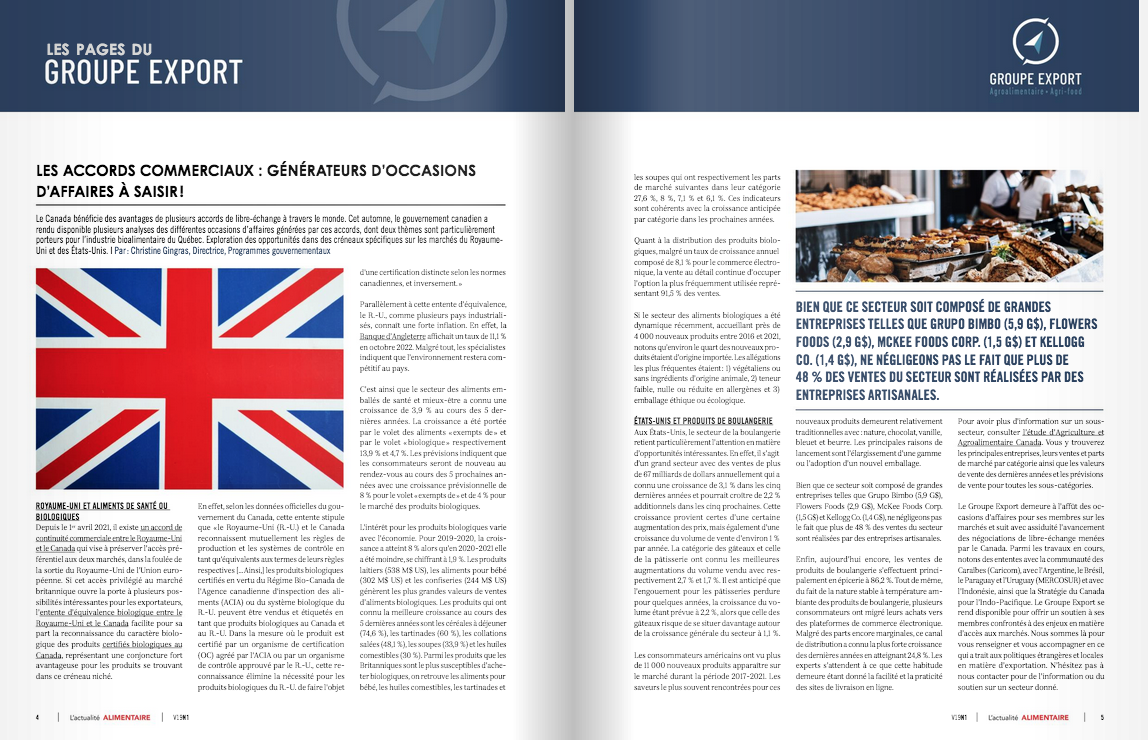
| Les accords commerciaux : générateurs doccasions daffaires à saisir ! | Le Canada bénéficie des avantages de plusieurs accords de libre-échange à travers le monde. Cet automne, le gouvernement canadien a rendu disponible plusieurs analyses des différentes occasions d’affaires générées par ces accords, dont deux thèmes sont particulièrement porteurs pour l’industrie bioalimentaire du Québec. Exploration des opportunités dans des créneaux spécifiques sur les marchés du Royaume-uni et des États-unis. | Par : Christine Gingras, Directrice, Programmes gouvernementauxROYAUME-UNI ET ALIMENTS DE SANTÉ OU BIOLOGIQUES Depuis le 1er avril 2021, il existe un accord de continuité commerciale entre le Royaume-Uni et le Canada qui vise à préserver l’accès préférentiel aux deux marchés, dans la foulée de la sortie du Royaume-Uni de l’Union européenne. Si cet accès privilégié au marché britannique ouvre la porte à plusieurs possibilités intéressantes pour les exportateurs, l’entente d’équivalence biologique entre le Royaume-Uni et le Canada facilite pour sa part la reconnaissance du caractère biologique des produits certifiés biologiques au Canada, représentant une conjoncture fort avantageuse pour les produits se trouvant dans ce créneau niché. En effet, selon les données officielles du gouvernement du Canada, cette entente stipule que «le Royaume-Uni (R.-U.) et le Canada reconnaissent mutuellement les règles de production et les systèmes de contrôle en tant qu’équivalents aux termes de leurs règles respectives [… Ainsi,] les produits biologiques certifiés en vertu du Régime Bio-Canada de l’Agence canadienne d’inspection des aliments (ACIA) ou du système biologique du R.-U. peuvent être vendus et étiquetés en tant que produits biologiques au Canada et au R.-U. Dans la mesure où le produit est certifié par un organisme de certification (OC) agréé par l’ACIA ou par un organisme de contrôle approuvé par le R.-U., cette re- connaissance élimine la nécessité pour les produits biologiques du R.-U. de faire l’objet d’une certification distincte selon les normes canadiennes, et inversement. » Parallèlement à cette entente d’équivalence, le R.-U., comme plusieurs pays industrialisés, connaît une forte inflation. En effet, la Banque d’Angleterre affichait un taux de 11,1 % en octobre 2022. Malgré tout, les spécialistes indiquent que l’environnement restera compétitif au pays. […] Pour lire l’article complet, rendez-vous à la page 4 de l’édition de décembre de notre magazine virtuel : https://fr.calameo.com/read/00623090846680b9cc746
|
Canadá | Intersectorial | Mercados | EEUU | Reino Unido | Lunes, 26 Diciembre 2022 | |
| Aumento del commercio agroalimentare dell'UE | Le esportazioni dell'UE sono aumentate dall'inizio dell'anno e hanno raggiunto i 20,9 miliardi di euro a settembre. Il valore delle importazioni dell'UE è stato di 15,6 miliardi di euro, con un saldo commerciale positivo per l'UE pari a 5,8 miliardi di euro. In valore, le esportazioni agroalimentari dell'UE sono aumentate del 3,1% rispetto ad agosto 2022. L'aumento delle esportazioni è stato in gran parte dovuto ai maggiori volumi di preparati di cereali, vino e preparati alimentari composti spediti soprattutto nel Regno Unito. Complessivamente, i maggiori cambiamenti sono stati osservati nelle esportazioni verso la Cina (+18%), il Regno Unito (+7%) e gli Stati Uniti (+5%). Nel settembre 2022, le esportazioni di colture proteiche e frutta (mele, pere, pesche) dall'UE verso la regione del Medio Oriente/Nord Africa (MENA) e l'Africa subsahariana sono aumentate in modo significativo, mentre le esportazioni di grano sono diminuite.  Nel settembre 2022 l'UE ha continuato a importare principalmente dal Brasile (1,9 miliardi di EURO), dall'Ucraina (1,4 miliardi di EURO) e dal Regno Unito (1,3 miliardi di EURO). Da gennaio 2022 le importazioni dal Brasile sono aumentate del 47% rispetto allo stesso periodo del 2021. Le importazioni dell'Ucraina sono aumentate del 76% mentre quelle del Regno Unito sono aumentate del 33%. L'UE ha importato soia, caffè, farina di soia e mais dal Brasile. I principali prodotti importati dall'Ucraina sono il mais, l'olio di girasole, i semi di girasole e la colza...
Mercoledì 21 dicembre 2022/ EE/ Unione Europea. |
Mundial | Mercados | Intersectorial | Sábado, 24 Diciembre 2022 | |
| European Union: European Commission Proposes New Rules on Packaging and Packaging Waste |  On November 30, 2022, the European Commission proposed a revision of the 1994 Directive on Packaging and Packaging Waste. Some of the proposed requirements may impact agri-food sectors and U.S. exports of processed food and beverages to the European Union. |
Mundial | Mercados | Envases y etiquetado | Legislación y normativa | Intersectorial | Jueves, 22 Diciembre 2022 | |
| European consumers cut back on food costs to cope with shortages and rising prices |  Most European consumers (53%) are strongly worried about food shortages, reveals new research from a consortium of leading universities in Europe. The ‘Changes in food behaviour in times of crisis’ study has been led by Aarhus University, Denmark, with funding from EIT Food, supported by the European Institute of Innovation and Technology (EIT), a body of the European Union. A survey of 5,000 consumers in 10 European countries found that more than half of consumers surveyed (55%) think that the war in Ukraine and ensuing economic and supply chain effects have made food production more vulnerable, while 54% think that the war is the main reason for increased food prices in Europe. The project is a follow-up study to research conducted in 2020, which demonstrated that COVID-19 lockdown measures may have caused lasting behaviour change in relation to food consumption. Since the last study, the effects of rising prices have been keenly felt by consumers, with shoppers observing price increases for most categories of food. The sharpest of these perceived price rises are in animal products, with 55% of consumers saying they have seen significant price increase in red meat, 52% in fish, and 51% in dairy. Nearly half, meanwhile, think that these costs are being unfairly distributed, with 48% of those surveyed believing that the war has enabled food retailers and manufacturers to make more profit. Consumers cut food costs by buying less or switching brandsRising prices have put more of a strain on household budgets, increasing food insecurity in the region, Klaus G. Grunert, Professor of Marketing at Aarhus University and Founder and Director of the MAPP Research Centre, told FoodNavigator. "We asked whether it is generally a struggle to have enough money to go shopping for food. 19.5% answer that this is ‘usually’ or ‘every time’ the case, up from 15.4% in 2020. 18.4% report that this is ‘never’ the case, down from 26.8% in 2020," he observed. Consumers are reacting to increased prices by cutting costs where they can, including buying less, buying cheaper brands, and shopping at cheaper stores. Nearly four in 10 consumers (37%) report that they are buying less red meat, while a third are buying less fish and poultry (33% for each). Shoppers are also cutting back entirely on certain categories to save money, with one in 10 consumers (12%) having stopped buying convenience foods altogether, and 10% having stopped buying alcoholic beverages. To cut costs on cereals and dairy products, a third of consumers say they have switched to buying a cheaper brand (35% and 33% respectively). Shoppers making more mindful choicesAs well as cost-saving behaviours, consumers across Europe are also making more deliberate purchasing choices. Over half 52% say they are now checking prices more than they did before the pandemic, an increase from 31% in 2020. Four in 10, meanwhile (41%), say they are making fewer unplanned purchases than before, up from 26% in 2020. Four in 10 are also checking use-by dates (40%) or using labels to compare products more (39%). Looking at trends of consumer behaviours with regards to cooking and eating, the project used the findings to group European consumers into five categories. This grouping shows that a third (33%) of consumers report that they now pay more attention to food prices, but otherwise report no major changes, while a third (32%) say they are making more mindful food choices, such as paying greater attention to labels or seeking out new food innovations. Only 19% of consumers showed resilient food behaviours, meaning that their behaviour remained mostly unchanged. Whether changing shopping patterns will have sticking power could depend on if they are motivated by mindfulness or have been adopted in response to price pressures, Professor Grunert suggested. "We believe that the changes pointing at more mindful food choices will persist. This is based on the finding that these trends were already under development two years ago in the wake of COVID and that they are consistent with pre-COVID goals that many consumers had but found hard to implement. Changes that are specific reactions to price increases may, however, not persist. This goes for changes in buying alcoholic drinks and possibly also dairy and meat," he told us. Policy initiatives and innovation needed to promote sustainable behavioursDr Andy Zynga, CEO of EIT Food, suggested the research pointed to areas that the food industry needs to innovate in to boost resilience and support a transition towards more sustainable diets. “The ongoing Russian war against Ukraine has brought into sharp focus just how fragile our food system can be,” he commented. “We urgently need to scale and support innovation to address supply chain issues and ensure that we are producing enough affordable, nutritious food for all; however, we must do so sustainably, fairly and efficiently. In order to meet and prevent future challenges, we have to build a system that puts resilient, future-proof and affordable solutions at its heart.” For Professor Grunert, the survey's findings should also be used as a tool to inform European policy as legislators work to promote a healthier and more sustainable food system. "Though the crisis in Ukraine and global economic downturn present unique and considerable threats to the European food system, we hope that this new, comprehensive research will empower decisionmakers to craft informed and timely policies that adequately tackle mounting consumer concerns regarding spiralling food costs. "It is also important that policymakers continue to uplift the significant progress made by consumers to make more mindful, healthy and sustainable food choices as we continue to address the growing obesity and sustainability challenges of our time.” What policy direction would the food systems expert advocate? "The results suggest that policy initiatives aimed at the green transition – for example, eco-labelling – are still highly relevant and should not be delayed in spite of an increased focus on prices. At the same time, the food sector faces a dilemma with simultaneous demands for more sustainable food and affordable prices," he responded. Economic worries make consumers more cautiousEconomic concerns are also making European consumers more conservative and economically cautious in their purchase decisions, according to Rochelle Schaetzl, Marketing Manager Europe at Griffiths Foods. "For such a long time trends were grouped into convenience, healthy nutrition, experience and efficiency. What we see now over the last 12 months is that health, nutrition, and sustainability is still important, but consumers are prepared to compromise on convenience for economic reasons,” Schaetzl told FoodNavigator at the recent FiE Paris event. Noting a return to ‘more classic, safer choices’, she said: “People are not prepared to take a risk with expenditure on something they are not 100% sure on.” As a result, Griffiths is having ‘more valuable conversations’ with its food manufacturing clients, she told us. “Our customers are asking for simple, stable, cost-optimised solutions that will appeal to the mass consumer. Customers that were not previously open to having conversations around vertical integration or optimisation are saying ‘let’s open our whole value chain and see where we can work together to find economies of scale and better solutions that work for both parties’. “I think it's a good think because we are having more sensible conversations and we can have conversations with our customers that we were never able to have before.” Griffiths was nominated as a finalist for a “Sensory Innovation” award at FiE with Savour Flex, which aims to addresses consumer demands to snack healthier and feel satisfied in terms of taste at the same time. It also launched a new “Made with Sustainable Sourced Ingredients” innovation. “In snacks, for example, there are more requests for basic flavours, classic flavours like a cheese and onion but with a more sustainable twist,” continued Schaetzl. “Those consumers not cash-strapped by the economic situation are saying they want to use the money they have to make more sustainable and more nutritious choices. So there's still that premium element to the market but it seems to be driven by more responsible choices as opposed to extravagant and indulgent flavours.” |
Mundial | Mercados | Clientes | Intersectorial | Jueves, 22 Diciembre 2022 | |
| FoodNavigators year in review: The most popular food and beverage stories of 2022 |  The food and beverage industry has faced an unprecedented couple of years. From the COVID-19 pandemic, through to supply chain challenges and – today – the energy crisis and war in Ukraine, supply chains and business models have had to show resilience in the face of extreme disruption. Unsurprisingly given this context, stories looking at issues around food safety and security proved popular reading in 2022. But despite these challenges, innovation has continued to remain front-and-centre of the industry’s thinking. Developments in the fast-paced food tech world continue to push the envelope and scientific advances in our understanding of health and diet expand the boundaries of functional nutrition. Meanwhile, plant-based R&D, the protein debate and broader concerns linked to sustainability – and worries over greenwashing – also continued to dominate our pages. Join us for a look back at 2022 through the lens of FoodNavigator’s most read and shared stories of the past 12 months. The protein dilemma: Plant-based versus animal?Stories examining innovation in plant-based products and new protein sourced remained hot topics in 2022. However, we are increasingly seeing push-back on the assumption that the plant-based category will shape the future of food, with questions being asked about the health and sustainability of animal- and plant-based products. Revisit our top five stories covering plant-based and conventional proteins. Food tech in focusProtein is of course one hot topic in the food tech space, where innovative approaches and novel technologies are being developed to answer some of the biggest challenges faced by the food sector and the need to feed a growing global population within finite planetary boundaries. From cell cultured meat, to gene editing, precision fermentation and cellular agriculture, check the R&D that caught your attention as innovators work to reshape the food system. Sustainable supply chains… and greenwashing fearsAnswering the big sustainability challenges remained front-of-mind for FoodNavigator readers in 2022, with issues like plastics and production systems attracting their share of attention. One thing that was remarkable, however, was that for every story that made our most popular list touting a sustainable solution another was looking at what consumers and regulators have clearly identified as a cause for concern… greenwashing. Food safety, security and the geopolitical crisisAs the year progressed, Russia’s invasion of Ukraine made headlines around the world… and the impact was increasingly felt in the food sector. From spiking energy and raw material prices, to concerns over food safety and security, the current geopolitical situation has had a destabilising effect. Elsewhere, concerns over food fraud and high-profile safety scares demonstrated the need to remain vigilant – and the price that such crises exact on brands. Nutritional science driving healthy innovationIn 2020, COVID-19 brought the link between health and diet to the fore. By 2022, as European economies continued to learn to ‘live with’ the disease, health and nutrition remained important innovation drivers. From the question of how to add fibre to food to the rise of diets like keto, here’s a round-up of the health trends that caught your eye. |
Mundial | Mercados | Intersectorial | Jueves, 22 Diciembre 2022 |
Página 9 de 66