


Indicadores
| Título del ítem | Sumario | Categorías | Creado | |
|---|---|---|---|---|
| France : Baisse historique de la production d'aliments en 2022 | En 2022, les fabricants d’aliments français enregistrent une baisse globale d’activité de 6,6% par rapport à 2021 perdant près d’un million et demi de tonne d’aliments composés pour s’établir à 19,2 Mt. 
 En recul de 800 000 T (- 10,2%), La demande en aliments volailles, surtout ceux destinés à la volaille de chair, a tout particulièrement été affectée par l’épidémie d’influenza aviaire qui a touché de plein fouet la filière avicole. Les aliments pour palmipèdes sont les plus touchés avec une baisse de 30% de la production en 2022. Pour le porc, le secteur enregistre une perte de 300 000 tonnes d’aliments, dans un contexte de décapitalisation du cheptel de truies et de baisse de production de la filière porcine française. Les aliments ruminants enregistrent une baisse plus modérée, surtout localisée sur les filières « bovins allaitants ». Le contexte de décapitalisation dans la filière bovine explique en partie cette observation. En filière laitière, l’impact de cette décapitalisation a été en grande partie compensée par un niveau de production laitière soutenu, à la faveur de l’amélioration des cours du lait. L’année 2022 a également été marquée par les conséquences de la guerre entre la Russie et l’Ukraine. Le coût de l’alimentation des animaux a été largement impacté par la hausse généralisée des matières premières, par les difficultés logistiques, les tensions sur les disponibilités et la hausse du prix des énergies (gaz, électricité, carburant). L’aide résilience mise en place par le Gouvernement au premier semestre 2022 a certes permis d’en limiter l’impact brutal pour les éleveurs mais n’a pas pour autant freiné les arrêts d’élevage.
Mars 2023/ SNIA / France. |
Francia | Intersectorial | Mercados | Producción | Sábado, 18 Marzo 2023 | |
| Fungi and oat hybrid makes ‘completely new protein for alternative meat sector | For more than 20 years, Prof Mohammad Taherzadeh has been working to better understand mycelium, the root-like structure from which fungi grow, at the University of Borås in Sweden. His conviction? That mycelium can offer a sustainable, scalable, and economically feasible alternative to meat. Having established a start-up, Millow, Prof Taherzadeh is working to put his ‘completely new’ mycelium-based protein on people’s plates. Two ingredients: mycelium and oatsMillow, which is both the name of Prof Taherzadeh’s product and his company, is founded on novel production techniques. The start-up grows mycelium on a substrate, which could be any grain or vegetable. Millow, for the most part, is using oats. “We like oats. They’re very nutritious, they have [lots of] vitamins and minerals, and they’re readily accessible all over the world,” Millow chair Staffan Hillberg explained. That makes for a ‘huge’ sustainability advantage, since when locally grown oats are used, transport-related emissions are limited. Millow uses a ‘controlled environment fermentation’ process, whereby part of the oats component is consumed by mycelia, resulting in a structured mycelia/oat hybrid. The process improves the digestibility of what would otherwise be raw oats, and retains their vitamins and minerals, we were told. From a macronutrient perspective, the start-up is able to ‘program’ the protein content by controlling the environment of its production units. “We’re aiming at around 20% protein, which we believe is a good number for human consumption.” 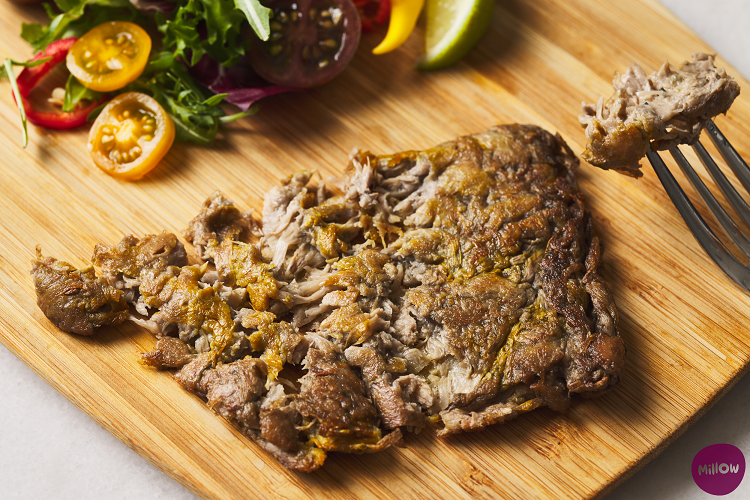
In blending mycelium and oats in the fermentation process, a unique texture is ‘built in’ to the product. Essentially, when the mycelium feeds on the oats it adds a kind of scaffolding. The benefit here is that minimal processing is required to shape the protein into meat alternative products. “Since we’re using the mycelium to build the texture, we don’t need any binders or additives afterwards,” Hillberg told this publication.
Being neutral in taste means there is no need to mask off-notes with additional ingredients, as can be the case with some soy and pea proteins. And importantly for food formulators, the protein can withstand variations in temperature – including boiling processes. Setting itself apart in the mycelium spacePrior to developing Millow’s unique fermentation process, Prof Taherzadeh studied different processes for mycoprotein production including traditional liquid fermentation. This is the technique used by meat alternative maker Marlow Foods-owned Quorn. He found the liquid fermentation process water-intensive and energy inefficient. Millow’s ‘controlled environment fermentation’ process uses 2.3% of the water and one-third of the energy used by traditional mycelium technologies, claims the start-up. Millow also prides itself on being modular and scalable. Instead of using large-scale fermenters – Quorn’s fermenters are 40m high – Millow opts for a greater number of smaller units. If one unit should fail, or become contaminated, it won’t affect the other units, Hillberg explained. As to scaling, each unit will be capable of producing around 220kg of product per day. “When we scale, we don’t build bigger units – we just add more.” Again, compared to traditional mycelium technologies, Millow claims it requires one-third of the investment and reduces CO2 emissions. Controlled environmental fermentation allows for temperature, water, and other inputs to be ‘minutely’ controlled. “That is why it is so energy efficient,” we were told. From start to finish, production time comes in at under 24 hours. “That is also very unique,” Hillberg stressed. “Essentially, you could install this process in the middle of Africa and produce food very efficiently and very nutritiously for people who don’t have access to this type of food.” 
At least one other company is fermenting mycelium on legumes and grains for food production. Israel-based Kinoko-Tech grows mycelium in a mixture of legumes and grains via a solid-state fermentation process. Similarly to Millow, Kinoko-Tech told us the fermentation process enables a ‘desirable mouthfeel and texture without the need for additional processing’. Kinoko-Tech is doing ‘something similar’, but it’s not strictly the same, explained Millow’s Hillberg, adding that their production processes differ. “We have a complete production process which is automated.” From unit to marketMillow is targeting the B2B meat alternative market. The first products are founded on a mycelium strain already authorised for use in food applications. For this reason, Millow will not initially be required to pass through Novel Foods regulations. But regulatory approval is required for blending mycelia with oats. This has already been granted by the Swedish Food Agency and Millow doesn’t foresee any issues in entering other markets. Although starting with a known mycelia strain, Millow has access to more than 1,000 different mycelium strains, the majority of which would require pre-market approval as a novel food. The company is already experimenting with some of these, observing that different strains bring different properties to its production product. “They can impact colour, texture and taste,” Hillberg explained. 
With regulatory approval assured in Sweden, Millow’s next plan is to scale up. The company has established a pilot plant on home soil and is in the early stages of partnering with food manufacturers in the Nordics. Current products in the pipeline include a mince alternative and meat-free ‘bites’. “We’ll start scaling up production [with plans to] launch in 2024.” Although supplying B2B to alt meat makers, being a structured product, Millow sees itself as more than an ingredient. As such, products containing Millow’s protein will carry the Millow branding, Hillberg explained. “We’re much more than an ingredient, we’re almost a finished product from a production point of view.” |
Mundial | Mercados | Producción | Otros | Jueves, 16 Marzo 2023 | |
| Desperate Bordeaux Grapegrowers Get Aid to Pull Up Vines |  Bordeaux grapegrowers are planning to tear out almost 23,500 acres of vines—and they're thrilled. After nine months of negotiations with local, regional and national government representatives, on March 1 the Bordeaux Wine Council (CIVB) reached an agreement with Marc Fesneau, France's minister of agriculture and food sovereignty, for financing the vine pull. These uprooting efforts will allow struggling growers to find new uses for their land and hopefully end a perpetual surplus of low-cost Bordeaux wines. They want to pull up their vines?Yes, because Bordeaux doesn't just produce some of the world's best wines, it also produces an ocean of value-priced bottlings. In the years after World War II, the average French adult drank 150 liters of wine per year, mainly red table wine. Today they consume 40 liters, or four-and-a-half cases, per year. Over the last five years, Bordeaux's only been selling 440 million cases out of average annual crops around 480 million cases. Every year, a surplus of wine accumulates and growers sink further into debt. The growers asked for money to help pull out their vines, but since 2008, European Union laws have forbidden the use of government funding to take agricultural land out of production. In recent months, protests have been staged by vignerons, growers who often work for less than minimum wage and have little to no retirement savings. In February, the French government approved funding for emergency distillation of surplus wine into industrial alcohol. But growers complained it was a stopgap solution, only suitable for vignerons suffering from a temporary lull in demand, due to the pandemic or cost of living crises, who don’t want to rip up their vines. A question of languageAnnouncing the March 1 agreement, Fesneau said, "I salute the consultation work carried out for the last several months, with the Gironde wine industry and the region, to find lasting solutions to the crisis in the sector and to manage the sector's phytosanitary issues in the territory." The key word to unlocking a solution was "phytosanitary." While EU law forbids funding vine removal when the reasons are economic in nature, the law does allow the funding of uprooting when vines face plant health issues. With growers looking at bankruptcy, Bordeaux could have ended up with thousands of acres of abandoned vineyards. "We're in a situation where if the vines aren't maintained and treated, there will be diseases, which will spread to the neighboring vines," said Christophe Chateau, spokesperson for the CIVB. In addition to pests, diseases such as the pernicious flavescence dorée and the red leaf virus flourish in neglected vineyards. What's in the deal?In this new package, Bordeaux growers in need will be able to access up to €38 million from the government and €19 million from the CIVB. The Nouvelle-Aquitaine region has put up an additional €10 million for the conversion to other crops. The CIVB has already begun a project with forestry organization Alliance Forêt Bois to reforest more than 4,500 acres of abandoned vines. Growers will receive a minimum of €6,000 per hectare (or about €2,400 per acre) to cover costs. This is less than the €10,000 per hectare initially demanded, but vignerons can receive additional funding to convert their land to carbon capture, reforest it or restructure it to grow new crops. The new agreement needs to be voted on by the general assembly of the CIVB. It's expected to pass without difficulty, and over the next few weeks, the process for submitting applications will take shape. "I think the program for pulling up the vines will start in the winter of 2023–2024," said Chateau. "It's great news." Stay on top of important wine stories with Wine Spectator's free Breaking News Alerts. |
Francia | Mundial | Mercados | Vitivinícola | Competidores | Producción | Miércoles, 15 Marzo 2023 | |
| Organic tomatoes in Italy: what prospects after remarkable growth? | Market demand and the reduction of conversion time to organic practices have led to an increase in the surface areas planted with organic tomatoes, but a greater vulnerability of production and increasing inflationary pressure on consumption could slow down this sector.From the article published in L'Informatore Agrario n.6/2023 "Organic tomatoes, what prospects after growth?", by Gabriele Canali and Gloria Zini.The remarkable development of organic food production in recent years has included processed tomato products. The data for northern Italy collected by the Pomodoro IO for this part of the country clearly demonstrates this. Until 2015, surface areas planted with organic tomatoes in northern Italy varied between 1,000 and 1,300 ha, with a share of total areas dedicated to processing tomatoes of about 3% to 4%. These crops really took off after 2016: from 1,309 hectares cultivated organically in 2015, the trend continued to increase to 4,077 hectares in 2022. The same has been true for the share of organic in the total cultivated surface areas in northern Italy, which rose from 3-4% in 2015 to 11% in 2022. |
Italia | Producción | Mercados | Conservas Vegetales | Lunes, 13 Marzo 2023 | |
| Chile: Wine Production and Trade |  The wine production area in Chile spans from the Atacama to Araucania region, with vineyards scattered up and down the regions’ valleys. Chilean area planted for wine totaled 130,086 hectares in 2021. Area planted for wine is trending downward, primarily due to a reduction in area planted from the O’Higgins region. Land in the O’Higgins region has been shifting toward more profitable crops such as cherries and citrus. In 2022, Chilean wine production totaled 1.244 billion liters, a 7.39 percent decrease from 2021. Likewise, in 2022, Chilean wine export volume totaled 833.5 million liters, a 4.0 percent decrease from 2021. Domestic consumption reached 292 million liters and stocks increased 1.413 billion liters in 2022. |
Mundial | Mercados | Competidores | Producción | Vitivinícola | Domingo, 12 Marzo 2023 | |
| Long-term projections for global meat production | 
333 Latin America with data from The United States Department of Agriculture (USDA). |
Mundial | Mercados | Cárnicos | Producción | Viernes, 10 Marzo 2023 | |
| Australian pork production expected to decrease in 2023 | Australian pork production is forecast to decline 3% in 2023 to 425,000 MT after stronger-than-expected production in 2022. Pork producers in early 2023 are being challenged by high feed grain prices relative to pork prices which is anticipated to have an impact on slaughter numbers and pork production in the latter part of 2023. Pork consumption is forecast to decline slightly in 2023 to 630,000 MT (CWE). Consumption in 2022 was the highest on record at an estimated 642,000 MT (CWE) but may in part be related to importers taking advantage of lower prices of EU pork than the previous year. Analysts anticipate imported EU pork prices to be higher in 2023 which could dampen Australia’s enthusiasm for pork imports in the forecast year.  Australia imports over a third of its pork needs, and for 2023 imports are forecast to remain stable at 240,000 MT (CWE). Exports, which are very low at only around 8% percent of production, are also expected to remain stable in 2023 at 35,000 MT (CWE).
March 7, 2023/ USDA/ United States. |
Australia | Producción | Mercados | Cárnicos | Viernes, 10 Marzo 2023 | |
| Croissance de production et importations de porc en Chine en 2023 | La production de viande porcine de la Chine devrait atteindre 55,5 millions de tonnes (Mt) en 2023, ce qui représente une hausse marginale. Les éleveurs devraient répondre à une demande plus forte des consommateurs suite à la suppression des restrictions nationales sur le COVID. Une croissance supplémentaire de la production de porc sera limitée par le prix de la viande de porc. En 2023, les importations de viande de porc devraient augmenter de près de 4 % sur l'année, pour atteindre 2,2 millions de tonnes, en raison d'une demande plus forte des consommateurs suite à la fin des restrictions COVID, mais la poursuite de la croissance sera freinée par l'augmentation de la production nationale. 
Importations chinoises de produits porcins. Source : USDA et Trade Data Monitor
6 mars 2023/ USDA/ Etats-Unis. |
China | Producción | Mercados | Cárnicos | Miércoles, 08 Marzo 2023 | |
| New online platform launched to help food manufacturers with efficiency and productivity |  The Food and Drink Innovation Gateway is a one-stop online tool which connects businesses in the sector, particularly small and medium sized, with a wide range of independent advice and expertise, from commercial authorities through to universities and government-backed programmes. FDF said this partnership would support companies to develop and grow their businesses through the adoption of existing and new technologies, including automation, AI and digital, as well as improving their energy efficiency, reduce waste and help to tackle labour shortages. InvestThe FDF’s chief executive Karen Betts said that the UK’s food and drink businesses are the lifeblood of homes and communities. “The FDF’s Innovation Gateway is designed to provide a much-needed ‘single point of entry’ for companies in our sector which are looking to invest in innovation, automation, new technologies and environmental sustainability. It will help to match businesses with the right support, which already exists in a range of different organisations across the UK but which can be difficult to identify and access,” said Betts. “I’m proud of the very practical support that FDF’s Gateway will offer to our dynamic sector, helping food and drink businesses to grow and thrive, and to remain at the heart of advanced manufacturing and a green economy.” CornerstoneThe new platform was launched at DEFRA’S National Food and Drink Summit this week. “The food and drink industry is a cornerstone of our economy and the largest manufacturing sector in the UK. SMEs are at the heart of this, making up 98% of food and drink manufacturers and employing 146,000 people across the country,” said Food and Farming Minister Mark Spencer MP. “They are global leaders in innovation and I am delighted the FDF’s new Food and Drink Innovation Gateway will be open to them, making it easier for them to adopt new technology.” |
Reino Unido | Logística | Producción | Intersectorial | Miércoles, 08 Marzo 2023 | |
| Vins : Château Dauzac dévoile sa Cuvée Neutre Carbone | 
A l’image du Grand Vin, la Cuvée Neutre Carbone sera élevée 15 mois en barriques. Le vin sera ensuite mis en bouteille en juin 2025 dans des bouteilles en réemploi et scellées avec de la cire végétale pour remplacer les capsules. Quant au reste du packaging, des études sont en cours afin de prévoir un packaging en harmonie avec le reste de la cuvée, c’est-à-dire neutre en carbone. Premier Grand Cru Classé à réaliser un tel projet, Château Dauzac dévoile sa Cuvée Neutre Carbone, une innovation qui s’inscrit dans la vision d’excellence de cette propriété novatrice. Déjà très engagé en faveur de la biodiversité, Château Dauzac témoigne à nouveau de son ambition de continuer à innover et progresser parmi les meilleurs Grands Crus Classés en 1855. Une cuvée pilote dans une démarche globaleLe projet de la Cuvée Neutre Carbone s’inscrit dans une démarche globale de Château Dauzac qui tend vers une décarbonisation sur l’ensemble de la propriété. Pour ce faire, un bilan carbone sur les différentes cuvées en appellation Margaux est en cours avec la société Climate Partner, afin d’identifier les pistes d’amélioration. Château Dauzac s’engage à travailler avec des partenaires ayant les mêmes engagements environnementaux, à chaque étape de la production, du travail du sol jusqu’à la mise en bouteille de la cuvée. Mis en bouteille en juin 2025Dans la logique d’excellence de Dauzac, une parcelle unique a été choisie pour réaliser la Cuvée Neutre Carbone, qui sera un monocépage de Cabernet Sauvignon, promesse d’un vin structuré et puissant. Pour le travail du sol, Château Dauzac s’est entouré dès février 2023 de son premier partenaire, Bioboon Agrology, qui accompagne la propriété avec des intrants issus à 100% de matières premières naturelles qui stimulent l’immunité naturelle de la plante et améliorent la vie biologique des sols. Leur utilisation débutera à partir du mois d’avril 2023. A l’image du Grand Vin, la Cuvée Neutre Carbone sera élevée 15 mois en barriques. Le vin sera ensuite mis en bouteille en juin 2025 dans des bouteilles en réemploi et scellées avec de la cire végétale pour remplacer les capsules. Quant au reste du packaging, des études sont en cours afin de prévoir un packaging en harmonie avec le reste de la cuvée, c’est-à-dire neutre en carbone. La commercialisation de ce vin sera réservée au circuit court. 2023 sera le premier millésime de la Cuvée Neutre Carbone interprété par Château Dauzac, qui s’attache à produire de grands vins dans une démarche innovante et vertueuse. |
Francia | Mercados | Competidores | Producción | Vitivinícola | Miércoles, 08 Marzo 2023 |
Página 1 de 36